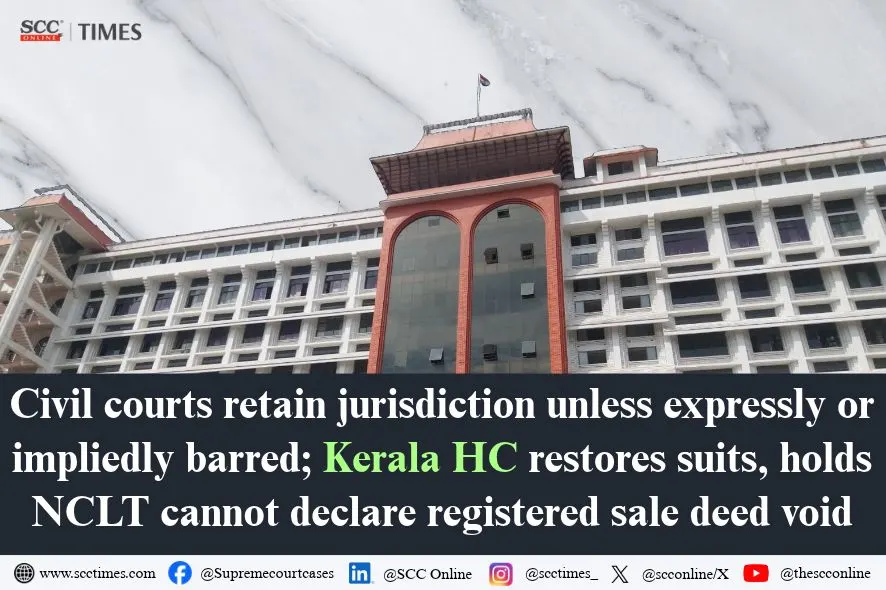
Kerala High Court: While allowing original petitions challenging orders of the Commercial Court declining jurisdiction over suits concerning an allegedly fraudulent sale deed, a Single Judge Bench of Easwaran S., J., held that the jurisdiction of civil courts is not ousted unless expressly or impliedly barred by law. The Court observed that the National Company Law Tribunal (NCLT), being a creature of statute, can exercise only the powers conferred upon it under the Companies Act, 2013 (2013 Act). A relief seeking a declaration that a registered sale deed is void and not binding on the company fell outside the NCLT’s jurisdiction under Sections 241 and 242 of the 2013 Act. Consequently, the bar under Section 430 was not attracted, and the suits were restored to the Commercial Court for trial.
Background
The original petitions have been filed as a challenge to orders dated 17 January 2026 passed by the Commercial Court-II, Thrissur in commercial suit . The said suits sought a declaration that the sale of plaint schedule property (property) to Defendants-Respondents (Defendants) 2 and 3 under sale deed , registered at the Sub-Registrar Office, Cherpu, was not binding on the plaintiffs, the company and its shareholders.
Plaintiffs-petitioners (plaintiffs) challenged the sale deed on the grounds that approval of the majority shareholders of the defendant Company was not taken, that defendant Company failed to conduct the statutory audit for the past few years, and that Defendant 1 had misappropriated the chit funds which were supposed to be received by the defendant Company. Complaints were filed regarding the same before the Magistrate Court-I, Thrissur. Plaintiffs further alleged that in the sale deed it was stated that a shareholders meeting was convened on 16 August 2014. Since no such meeting was convened, the entire transaction was fraudulent. The suits were filed for a declaration that the sale deed was not binding on the defendant Company.
As per the defendants, suits filed by the plaintiffs were vexatious and frivolous and that the sale deed was properly registered. They filed applications to reject the suits as not maintainable, alleging a bar under Section 430 of the 2013 Act.
The Commercial Court- II, Thrissur where the suits were transferred, upheld the objection by the defendants regarding the maintainability of the suits and held that the remedy of the plaintiffs is before the NCLT.
Aggrieved by the decision, the plaintiffs have filed the present petitions.
Also Read: Bom HC: Civil Court Jurisdiction Barred under Section 430 Companies Act| SCC Times
Contentions
Plaintiffs’ Contentions
Plaintiffs pointed out that the bar under Section 430 of the 2013 Act is not an absolute bar and is to be qualified by certain conditions. They stated that earlier when the matter was transferred from Magistrate Court to Commercial Court, no objection was raised regarding its maintainability. More so, the Magistrate Court found the suits to be maintainable before the Commercial Court and the same were transferred there.
Plaintiffs further contended that NCLT’s jurisdiction is limited to matters governed by Sections 241 and 242 of the 2013 Act. The civil court’s jurisdiction is ousted only in matters the Tribunal can decide. Hence, ordinary civil litigation relating to property where a declaratory relief is sought for, NCLT is not empowered to grant such relief, and the civil court retains the jurisdiction to grant declaratory relief. They relied on Saju George v. Saji Varghese, 2026 SCC OnLine Ker 8872 in support of their arguments.
Defendants’ Contentions
Defendants contended that even if the suits are maintainable, the same could not be tried by the court because they are barred by limitation. They further contended that question as to whether there was proper convening of the meeting of the shareholders prior to the execution of the sale deed is a matter which would primarily fall within the jurisdiction of the NCLT under Sections 241 and 242 of the 2013 Act.
Since the plaintiffs have a case of oppression and mismanagement of the Company, the civil court’s jurisdiction is barred, and the NCLT alone can grant the reliefs.
Issue
Whether the present suits are barred by Section 430 of the 2013 Act?
Analysis
The Court examined the scope of Sections 241, 242 and 430 of the 2013 Act. It found on the conjoint reading of Sections 241 and 242 of the 2013 Act that the NCLT has jurisdiction only when a dispute touches upon the management of the company and the respective rights of the shareholders.
The Court emphasised that a statutory tribunal must derive its authority from the statute creating it; there is no inherent power of its own. The Court reasoned that a shareholder’s challenge to an allegedly fraudulent sale deed, seeking a declaration that it is not binding on the defendant Company, falls within civil court jurisdiction rather than the NCLT’s jurisdiction under Sections 241 and 242 of the 2013 Act.
The Court reasoned that the power to grant declaratory decree or relief is always with the civil court. Referring to Section 9, Civil Procedure Code, 1908, the Court explained that civil courts retain jurisdiction unless it is expressly or impliedly excluded. Although legislation establishing a specialised tribunal may exclude civil court jurisdiction, such exclusion must specific. To hold an implied bar on the civil court, there must be strong circumstances arising from the statute and not on mere assumptions.
The Saju George concerned the National Green Tribunal wherein it was held that a claim for declaration of an easement right remained within civil court jurisdiction because the tribunal had only the powers specified by its governing statute. The Court applied the same principle here and held that NCLT’s power is confined to disputes arising under Sections 241 and 242 of the 2013 Act.
On the issue of limitation, the Court noted that the Commercial Court had rejected the suits on the jurisdictional ground and had not adjudicated the limitation issue. It therefore declined to determine that question for the first time in proceedings under Article 227 of the Constitution of India. The defendants were expressly permitted to raise limitation before the trial court at the appropriate stage.
Also Read: Del HC bars Civil Suit challenging Section 7 IBC Proceedings | SCC Times
Decision
In view of the above analysis, the Court allowed both original petitions and set aside the Commercial Court’s orders dated 17 January 2026. It restored commercial suits to the file of the Commercial Court-II, Thrissur for trial. The defendants’ right to raise the limitation objection was preserved.
[Satish Kumar v. Govindankutty, OP(C) Nos. 926 and 939 of 2026, decided on 13-10-2026]
Advocates who appeared in this case:
For the Petitioners: P.K. Mohamed Jameel, K. Sadanandan, Suharabi Kanneth, Smrithi Harris, Advocates.
For the Respondents: Thushara D.S., Senior Government Pleader, G. Sreekumar, K.R. Arun Krishnan, R. Rajpradeep, Advocates.