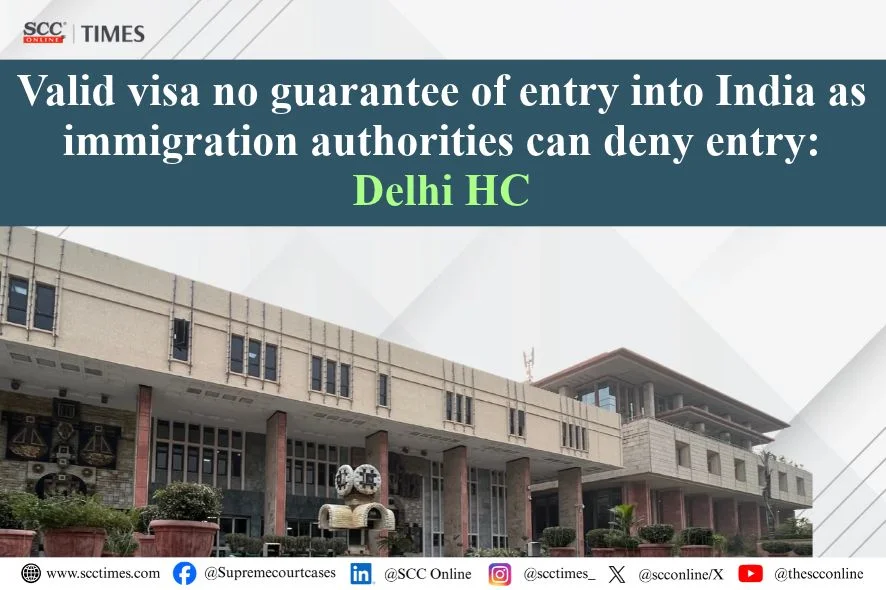
Delhi High Court: A Single Judge Bench of Amit Mahajan, J., declined to entertain a writ petition filed by a foreigner challenging denial of entry despite a valid visa. The Court held that a valid visa does not guarantee entry into India. Emphasising considerations of national security and public order, the Court observed that immigration authorities are empowered to deny entry on relevant grounds. Rejecting the Article 14 challenge as the two petitioners were not similarly situated, and having perused the sealed-cover material, the Court found no right infringed and dismissed the writ petition.
Background
Petitioner 1 is a citizen of Turkmenistan who was denied entry into India on 25 March 2026 by the respondents. As per her, she was in possession of a valid passport and a valid business visa issues by the embassy of India at Ashgabat, Turkmenistan.
She arrived at Terminal 3 of the Indira Gandhi International Airport, New Delhi, on 25 March 2026 along with her husband (Petitioner 2). She was travelling on the same flight i.e. Turkmenistan Airlines Flight T5-531 and with a visa of the same category as her husband. However, Petitioner 2 was permitted to enter India, whereas Petitioner 1 was stopped at the immigration counter and was thereafter returned to Turkmenistan on the same day, allegedly without furnishing any reasons/document recording the refusal of entry.
The present petition is filed by her seeking a direction to the respondents to furnish a “written speaking order” setting out the reasons for refusal of her entry of into India on 25 March 2026, and directions permitting her to enter India on the strength of the business visa issued to her.
Contentions
The petitioner had raised 2 grounds in the petition. First, she contended that the respondents had denied her entry without furnishing any reasons. Second, she contended that permitting Petitioner 2 to enter while denying her entry amounted to discriminatory treatment in violation of Articles 14 and 21 of the Constitution.
The respondents have filed a counter-affidavit stating that a foreign national does not possess any vested or indefeasible right to enter the territory of India merely by virtue of being in possession of a valid visa. Grant of visa and permission to enter India are two distinct matters, wherein the latter is subject to Indian immigration laws and the decisions of the competent authorities.
The respondents have further relied on the Immigration and Foreigners Act, 2025 (Act of 2025) that confers statutory powers upon the Central Government and the immigration authorities to regulate, restrict and, where circumstances so warrant, prohibit the entry of foreign nationals. These powers are especially important in cases involving national security, public order, and other matters covered by law.
The respondents have stated that “adverse inputs” had been received concerning Petitioner 1 and that upon such consideration, the competent immigration authority had denied her entry into India. The decision was taken in the interest of “national security” and “public order”. The travel history of Petitioner 1 includes as many as 47 visits to India for short duration of 1—3 days, and that she has travelled on both business and medical visas. Such pattern of travel gave rise to concerns which required examination by the immigration authorities.
Moreover, upon questioned by immigration authorities regarding the purpose of her visit, her activities and business associations, the responses given were unsatisfactory. The respondents have also placed before the Court, in sealed cover, materials and inputs forming the basis of the assessment made in respect of Petitioner 1.
Also Read: India notifies Immigration and Foreigners Rules, 2025
Analysis
The Court after examining the contentions from both sides observed that issuance of visa/refusal of entry/ granting clearance of immigration is a sovereign function of State. These are governed by considerations of national security, foreign policy, and administrative discretion.
Section 3, Foreigners Act, 1946 (Act of 1946) [now repealed] and Section 7, Act of 2025, empower the Central Government to prohibit, regulate, or restrict the entry of foreigners into India, their departure from India, and their presence or continued stay in the country. The respondents can, therefore or rather are entitled to consider all relevant factors that may warrant scrutiny.
The Act of 2025 being the relevant governing statute requires a foreigner seeking to enter India to possess a valid passport or travel document and a valid visa. However, the statutory framework also provides that a foreigner may be denied entry into India, even if they possess valid travel documents, on specified grounds, including national security, the sovereignty and integrity of India, relations with foreign States, public health, and any other grounds specified by the Central Government. It also empowers immigration officers to examine a foreigner’s passport, travel documents, and visa upon entry and to seek any necessary information. Therefore, holding a valid visa does not confer an absolute or unconditional right to enter India.
The Court relied on judgment of the Supreme Court in Hans Muller of Nurenburg v. State of W.B., (1955) 1 SCC 167, wherein the Court noted that the Act of 1946 granted the Central Government absolute discretion to expel foreigners. Since the Constitution did not expressly restrict this power, the Government retained an unrestricted right to expel them.
In Louis De Raedt v. Union of India, (1991) 3 SCC 554, the Supreme Court with respect to the right to reside and settle in the country, noted as follows:
“13. The next point taken on behalf of the petitioners, that the foreigners also enjoy some fundamental rights under the Constitution of this country, is also of not much help to them. The fundamental right of the foreigner is confined to Article 21 for life and liberty and does not include the right to reside and settle in this country, as mentioned in Article 19(1)(e), which is applicable only to the citizens of this country…”
The Court after considering the above judgments and statutory framework concluded that the entry of a foreign national in India is not a matter of enforceable right against the State but a matter of sovereign discretion. Moreover, having perused the material placed in sealed cover, the Court was satisfied that decision taken by the respondents cannot be said to have arrived at without any material or application of mind.
The Court noted that there were discrepancies in the details of her parents and spouse. She failed to produce a business card or invitation letter to support the purpose of her visit and did not provide details of her business in her home country. Although she had been issued a business visa, she described herself as a “housewife”. The mobile number provided by her was also found to be invalid. Further, she made about 24 visits to India on a medical visa between 2018 and 2024, followed by 53 visits on a business visa between November 2024 and December 2025. In the absence of details regarding the business, company or entity with which she was associated, the purpose of the petitioner’s visits could not be ascertained.
Thus, considering the overall circumstances and the material on record, the Court held that the petitioner’s claim was liable to be rejected, as a foreign national has no inherent or legally enforceable right to enter India.
The Court iterated that it cannot replace the competent authority’s decision with its own judgment regarding the entry of a foreign national, particularly when the decision is based on confidential information concerning national security and public order.
Rejecting the challenge to violation of Article 14, it held that merely because Petitioner 2 travelled with Petitioner 1 on the same flight and was permitted to enter India, does not itself establish that both petitioners were similarly situated in all material aspects. The respondents have specifically received adverse inputs regarding Petitioner 1 but there is nothing on record to show the same with regards to Petitioner 2. Article 14 prohibits arbitrary discrimination but allows the State to consider material distinctions relevant for the exercise of a statutory power.
As discussed above, there exists no inherent or legally enforceable right of a foreign national to seek entry into India. It is a well settled law that extraordinary jurisdiction of this Court under Article 226 of the Constitution of India can be invoked only where there is a violation of a right. In the absence of any right, no writ can be issued.
Decision
Consequently, since the Petitioner has not been able to establish that any right vested in her has been infringed, the Court declined to exercise its jurisdiction under Article 226 of the Constitution. Accordingly, it dismissed the writ petition being devoid of any merit.
[Annagurbanova Yazbibi Hummetgulyyevna v. Union of India, W.P.(C) 5740/2026, decided on 30-9-2026]
Advocates who appeared in this case:
For the Petitioners: Shivam Pandey, Priyanshu Upadhyay, Ajay Singh, Ankit R. Pandey and Srijan Kumar, Advocates.
For the Respondents: Gaurav Barathi, Standing Panel Counsel, Vishal Thakur, Amita Singh and Devender Kumar, Advocates.