








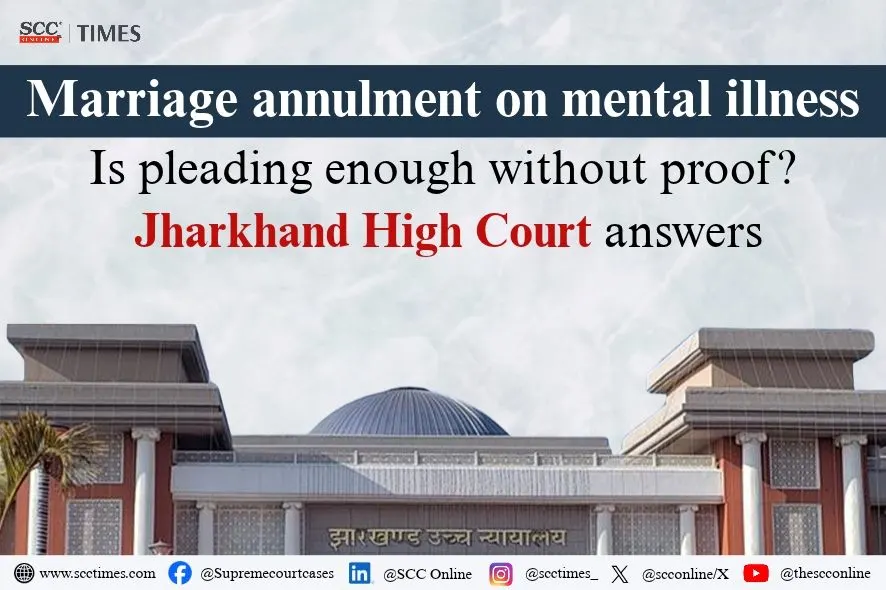
Jharkhand High Court: A Division Bench of M.S. Sonak, C.J. and Manoj Prasad, J.* examined whether a marriage could be annulled on the ground that the wife was incapable of giving valid consent due to unsoundness of mind or was suffering from a mental disorder of such a kind or to such an extent as to be unfit for marriage and the procreation of children. Reiterating that pleadings are no substitute for proof, the Court held that unsubstantiated allegations, unsupported by cogent evidence, could not establish either ground under Section 12(1)(b) read with Section 5(ii), Hindu Marriage Act, 1955 (Hindu Marriage Act).
Background
The dispute revolving around the allegations on respondent-wife suffering from mental illness was raised by the appellant-husband in the trail court seeking the marriage to be declared null and void. The marriage between the appellant and the respondent, was solemnised on 17 November 2016. The appellant alleged that after the marriage, he discovered that the respondent was incapable of cohabiting with him because she was suffering from an existing mental or neurological condition. He claimed that she had been experiencing unsoundness of mind or a neurological problem before the marriage, which had allegedly been concealed by her family. He further alleged that she suffered from epilepsy or paralysis and that these conditions prevented the consummation of the marriage. The appellant also asserted that the respondent had informed him that she had never consented to the marriage because she was in love with another person and the marriage was solemnised under pressure from her family.
The appellant based on these allegations filed a suit before the Principal Judge, Family Court, Bokaro, on 4 January 2017, under Section 12(1)(b), Hindu Marriage Act, alleging that the marriage was performed in contravention of the condition specified in Section 5(ii), Hindu Marriage Act. The respondent was incapable of giving a valid consent to it, in consequence of unsoundness of mind and even if, capable of giving a valid consent, has been suffering from a mental disorder of such a kind or to such an extent as to be unfit for marriage and the procreation of children.
The respondent denied the allegations and contended that the entire set of allegations were false and baseless. The respondent further alleged that she had been subjected to cruelty and harassment by the appellant and his family members in connection with demands for additional dowry. She stated that criminal proceedings under Section 498-A and other provisions of the Penal Code, 1860 had been instituted in relation to the alleged cruelty. She also denied the allegation that she had attempted to commit suicide.
The trial court, after considering the oral and documentary evidence, dismissed the suit, concluding that had failed to establish the alleged mental illness or any other condition warranting annulment under Section 12, Hindu Marriage Act. Aggrieved by this decision, the appellant filed for an appeal, challenging the judgment and decree of the Family Court.
Issue for Determination
Whether the appellant has proved by sufficient evidence that the respondent was incapable of giving valid consent to marriage, or was suffering from any mental illness, i.e., unsoundness of mind, so as to render her incapable of giving valid consent, or that she was unfit for procreation of a child?
Decision and Analysis
At the outset, the Court observed that merely making allegations in the pleadings was insufficient to establish the wife’s alleged mental illness or incapacity to give valid consent. The Court reiterated that
“Pleading is not a substitute for proof and facts pleaded, if not proved, are of no consequence.”
The Court examined the two medical prescriptions and the scan report produced by the appellant. It found that the documents did not establish the alleged history of mental illness. The report of Shree Krishna Sewa Sadan was merely an ultrasonography report of a gravid uterus, showing a single intrauterine gestation corresponding to a gestational age of 29 weeks and two days. Thus, the report did not substantiate the claim that the respondent suffered from a mental disorder or lacked the capacity to consent to marriage. Hence, it demolished the appellant’s claim under Section 5(ii)(b), Hindu Marriage Act.
The respondent in her examination-in-chief on affidavit, had supported her contentions as per her defence, and been subjected to lengthy cross-examination for 3 days, where she stood the test of cross-examination and did not produce any material supporting the appellant’s allegations.
The Court concluded after considering the materials on record that the point for determination stood answered in favour of the respondent and against the appellant. Consequently, it was held that the appellant failed to make out any case under Section 12, Hindu Marriage Act read with Section 5(ii)(b) of the said Act. The appeal was therefore dismissed.
[Prem Ranjeet Kumar Suraj v. Munni Kumari, 2026 SCC OnLine Jhar 3187, decided on 27-10-2026]
*Judgment authored by: Justice Sanjay Kumar Dwivedi
Advocates who appeared in this case:
For the Appellant: Shaukat Eqbal, Shadab Eqbal, Ankit Raj, Advocates
For the Respondent: Maneesh Kumar, Advocate






0 replies