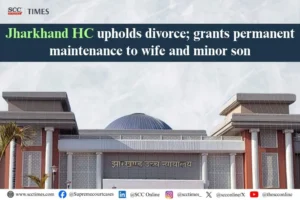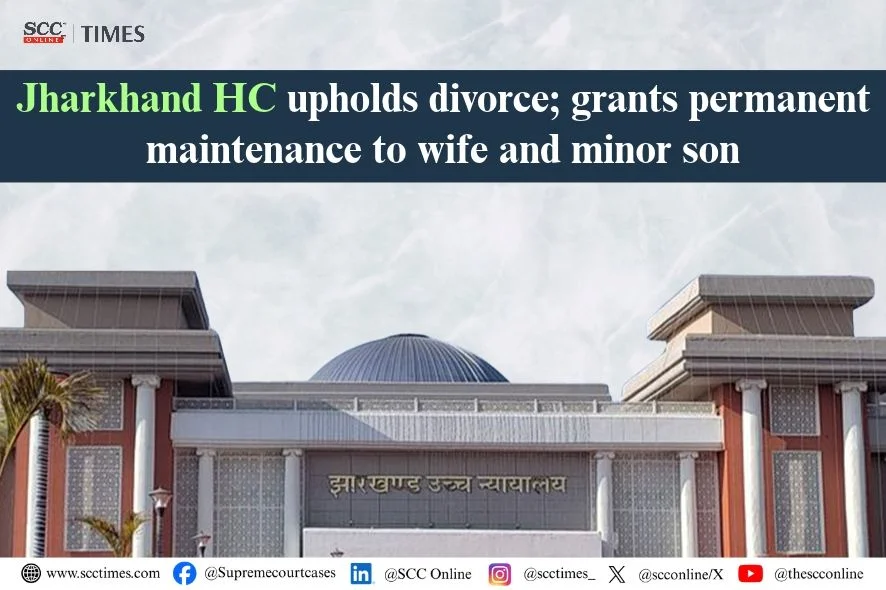
Jharkhand High Court: In an appeal under Section 19(1) of the Family Courts Act, 1984, arising from a decree of divorce granted under Section 13(1-A)(ii) of the Hindu Marriage Act, 1955, the Division Bench of M.S. Sonak, C.J., Manoj Prasad, J.* affirmed the divorce decree on account of the wife’s non-compliance with an earlier decree for restitution of conjugal rights. However, considering the wife’s limited income, her responsibility towards the minor child, the admitted maintenance arrears, and the husband’s inadequate financial disclosures, the Court granted permanent alimony of ₹10,000 per month each to the wife and the minor son under Section 25 of the Hindu Marriage Act, holding that such financial support was necessary to secure their sustenance and welfare.
Background
The marriage between appellant-wife and respondent-husband, solemnised on 6 February 2013. Their matrimonial relationship deteriorated over time, and the wife allegedly left the matrimonial home on 18 September 2015, taking her belongings and their minor son with her. The parties thereafter became involved in several matrimonial and related legal proceedings. In 2016, the husband instituted matrimonial case under Section 9, Hindu Marriage Act, seeking restitution of conjugal rights. The wife appeared in those proceedings and made allegations of maltreatment and atrocities against the husband. Following trial, the Family Court decreed the husband’s application on 9 March 2017. Consequently, the wife was required to resume matrimonial cohabitation in accordance with the decree. However, the parties did not resume their conjugal relationship, and the decree was not complied with.
The wife also initiated proceedings under Section 125, Criminal Procedure Code, 1973. the husband submitted that the wife declined to return to the matrimonial home despite the decree for restitution of conjugal rights. The maintenance proceeding was subsequently withdrawn by order dated 19 January 2018. The husband also referred to a complaint case instituted by the wife in 2016, alleging that the parties’ continuing disputes demonstrated the breakdown of their relationship.
On 12 March 2018, the husband instituted matrimonial suit, seeking dissolution of marriage under Section 13(1-A)(ii), Hindu Marriage Act. His principal contention was that more than one year had elapsed since the decree for restitution of conjugal rights without any resumption. However, the wife submitted that while residing with her husband, she was subjected to cruelty and her husband declined to restore conjugal life and has stated about pendency of various cases between them. The Family Court decided the relevant issues concerning cruelty and non-restitution of conjugal rights in favour of the husband and accordingly dissolved the marriage by the decree dated 3 June 2022.
Aggrieved by the decision, the wife preferred the present appeal. She argued that the Family Court had improperly framed an additional issue concerning cruelty allegedly committed by the wife against the husband because that issue went beyond the pleadings. The wife further maintained that she had been subjected to cruelty, had been expelled from the matrimonial home, and feared for her own safety and that of her child. The wife also alleged that the husband had contracted a second marriage and had a child from that relationship, and thus restitution of conjugal life was no longer practically possible.The husband argued that the decree for restitution of conjugal rights had never been set aside by a competent court and that the wife had failed to comply with it. He further contended that the criminal proceedings instituted by the wife on allegedly false and fabricated reasons amounted to cruelty, and therefore the decree of divorce did not warrant interference. The appellant stated that the husband’s second marriage made the prospect of restoring conjugal life unrealistic and the only question of alimony remains for determination. Consequently, the wife did not press the challenge to the divorce decree as the principal issue and instead emphasised her entitlement to permanent alimony under Section 25, Hindu Marriage Act.
Issue
-
Whether the wife was entitled to permanent alimony under Section 25, Hindu Marriage Act?
-
Whether the divorce decree passed by the Family Court was in accordance with law or not?
Decision and Analysis
The Court noted that a coordinate Bench of this Court had directed the husband by order dated 13 August 2026, to submit a financial disclosure affidavit in accordance with the principles laid down in Rajnesh v. Neha, (2021) 2 SCC 324. The purpose of the disclosure was to enable the Court to assess the financial circumstances of both parties and determine a fair maintenance amount. Although the wife submitted the required affidavit, the husband initially failed to comply with the direction. An affidavit was subsequently filed during the hearing, but the Court considered the financial disclosures evasive and insufficiently informative regarding his assets and financial capacity.
In her affidavit, the wife stated that she worked as a Sahiya under the National Rural Health Mission and received an honorarium of only ₹2000 per month. She had a bank account but owned no immovable property. Her minor son was dependent upon her, and about ₹7000 per month was required for his upbringing. She further stated that maintenance arrears had accumulated to ₹3 lakhs. The husband’s financial position was depended on agricultural work performed on other people’s land as a bataidar and that his family possessed limited agricultural property. His affidavit, however, referred to land allotted to him, portions of which had allegedly been transferred through agreements and registered sale deeds.
The Court also noted that maintenance arrears exceeding ₹2.5 lakh were admitted and that the husband had undertaken to discharge them in 6 instalments over 6 months. These circumstances were considered alongside the wife’s limited earnings, lack of property, and responsibility for the minor child. The Court examined the mandate of Section 25(1), Hindu Marriage Act, which contains the provision for permanent alimony and maintenance. The Court emphasised that permanent alimony could be considered even where the prayer was made orally during the proceedings, provided the parties had a fair opportunity to address the issue.
The Court considered it just, fair and reasonable in directing the husband to pay permanent maintenance of ₹10,000 per month each for the wife and the minor son. The son’s maintenance would continue until he attained majority. The aggregate monthly liability was therefore ₹20,000 while the son’s entitlement continued. The Court clarified that the maintenance order would take effect from 15 October 2026, the date of the judgment, and would not prejudice recovery of any arrears arising under earlier maintenance orders.
On the second issue, the Court found that the Family Court had improperly framed the issue concerning alleged cruelty by the wife against the husband without an appropriate amendment to the pleadings. The Court held that this particular procedural course was not in accordance with law. The Court further distinguished the issue concerning cruelty allegedly committed by the husband against the wife, which was supported by the wife’s pleadings and could legitimately be considered.
The Court noted that the dominant issue as to whether the husband was entitled to a decree for divorce , does not warrant any interference in view of the fact that the decree for restitution of conjugal rights has not been interfered with by any court of law and the same was not complied with by the wife. The Court reiterated that the wife had not pressed her challenge to the dissolution of marriage. The Court therefore affirmed the divorce decree while granting the additional relief of permanent maintenance. Ultimately, the appeal was dismissed, subject to the modification granting monthly maintenance of ₹10,000 each to the wife and minor son, by way of permanent alimony in terms of Section 25 of Hindu Marriage Act.
[Pooja Devi v. Chandrakant Mehta, F.A. No. 48 of 2022, decided on 5-10-2026]
*Judgment authored by: Justice Manoj Prasad
Advocates who appeared in this case:
For the Appellant: Ashish Gautam, Advocate
For the Respondent: Sanjay Kumar Tiwary, Advocate