Kerala High Court: While considering an appeal challenging conviction for offences under Section 376-AB, Penal Code, 1860 (IPC) and Section 3(a) read with Sections 4(2) and 5(m) read with Section 6, Protection of Children from Sexual Offences Act, 2012 (POCSO Act), a Single Judge Bench of A. Badharudeen, J., held that the placement of penis on vagina constitutes penetrative sexual assault and could not be treated merely as sexual assault under Section 7, POCSO Act. The Court, however, observed that the accused cannot be separately sentenced under Section 376-AB IPC after sentence under Section 6, POCSO Act, and accordingly, set aside the separate sentence imposed under IPC.
Also Read: Penetration “to any extent” is penetrative sexual assault: HP HC
Background
The prosecution alleged that the accused, a neighbour of a 3-year-old girl, committed penetrative sexual assault on the child on 2 September 2021. Following investigation, a final report was filed alleging offences punishable under Sections 370 and 376-AB IPC and Section 3(a) read with Section 4(2) and Section 5(m) read with Section 6, POCSO Act. The Special Court convicted the accused and imposed rigorous imprisonment of 20 years under the relevant provisions of both IPC and POCSO Act, with the sentences directed to run concurrently.
Challenging the conviction, the accused contended that the prosecution evidence, even if accepted in its entirety, merely disclosed placing of the penis on the victim’s private part and not penetration, which did not satisfy the requirement of penetration and therefore the offence, at best, fell within Section 7, POCSO Act relating to sexual assault. On the other hand, the prosecution argued that the victim had specifically stated that the accused placed his penis on her vagina, causing pain and making her cry. It was contended that the requirement of penetration is satisfied even by the slightest degree of penetration into the vulva or labia majora.
Issues
1. Whether the Special Court is right in holding that the accused committed offence punishable under Section 376-AB IPC?
2. Whether the Special Court erred in holding that the accused committed the offence under Section 3(a) rad with Section 4(2), POCSO Act and under Section 5(m) read with Section 6, POCSO Act?
3. Whether the verdict would require interference?
4. The order to be passed.
Analysis
The Court noted that the age of the victim was conclusively established through the birth certificate and that she was only 3 years old at the time of the incident. The Court further observed that the victim was subjected to a voir dire examination and was found competent to depose. Her evidence was that the accused removed her undergarment, placed his penis on her private part, whereupon she felt pain and cried. The Court found her evidence consistent and unshaken in cross-examination.
The Court also examined the medical evidence. The doctor who examined the child recorded that the vaginal region appeared patulous though there were no visible external injuries or active bleeding. The doctor opined that the findings were not inconsistent with the history of sexual assault and that the history was suggestive of recent vaginal sexual assault. Further, the doctor also testified that the accused was a person capable of performing sexual act.
The Court referred to Raveendran V.S. v. State, 2025 SCC OnLine Ker 17013, where it was held that actual penile entry into the vagina is not essential and that even penetration within the labia majora or vulva, or the slightest penetration, would be sufficient to constitute rape and penetrative sexual assault. The Court also referred to Nawabuddin v. State of Uttarakhand, (2022) 5 SCC 419, wherein when the doctor opined that the victim girl felt pain and irritation in urination, and she had given evidence that the accused penetrated his finger into the vagina, then penetrative sexual assault was established.
The Court examined Sections 3 and 5, POCSO Act and highlighted that tracing the definition under Section 3, POCSO Act, clauses (b) to (d) do not provide penetration to a higher degree and even penetration of slightest degree or manipulation into any part of the body of the child so as to cause penetration into the vagina, urethra, anus or any part of body of the child or application of the mouth to the penis, anus, vagina or urethra of the child, would satisfy the requirement for the offence of penetrative sexual assault. The Court distinguished between penetrative sexual assault and sexual assault. In case of mere sexual assault, a touch on the vagina, penis, anus, or breast of the child with sexual intent is sufficient, while Section 7 does not provide the placement of the penis on the vagina.
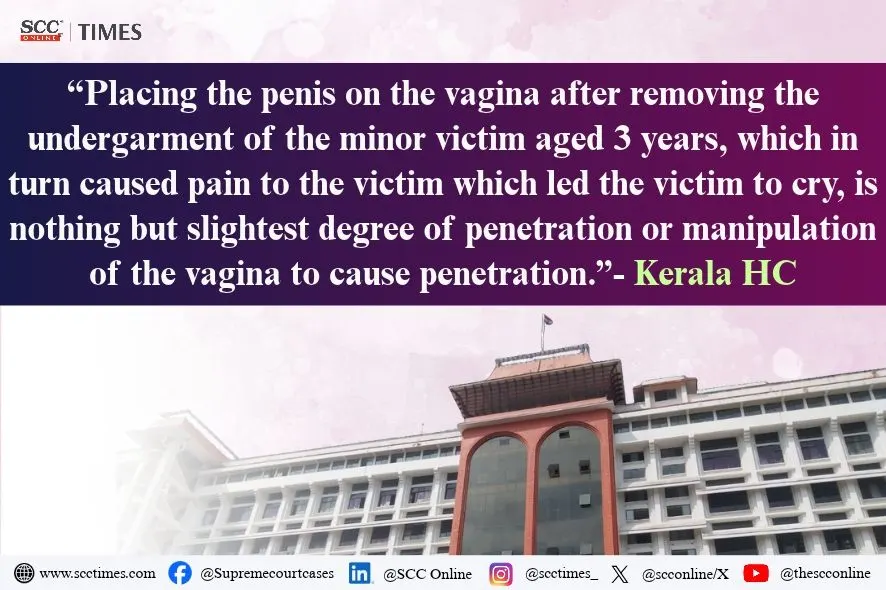
The Court also made a distinction between “touching” and “placing”. “Touching” means “an emotional movement to evoke the feeling in a person who was touched”. “Placing” means “setting something in a specific spot or orientation” or “placing something in a particular physical location or the contact”. The Court observed that touching and placing are not synonymous. According to the Court, a touch may not last long and a placement may last longer than a mere touch. The Court highlighted that the victim had not spoken merely about touching; rather, she stated that after removing her undergarment the accused placed his penis on her vagina and that she immediately suffered pain and cried.
The Court opined that such conduct could not be viewed lightly as a simple touch contemplated under Section 7, POCSO Act. The Court observed that the circumstances indicated either the slightest degree of penetration without emission of semen or manipulation of the vagina causing penetration. The Court further highlighted that the child’s experience of pain immediately after the act supported such an inference. Consequently, the Court held that placing the penis on the vagina of a 3-year-old child, causing pain and crying, amounted to penetrative sexual assault within the meaning of Section 3(a) to (d), POCSO Act.
On that basis, the Court affirmed the finding that the prosecution had successfully established the offences punishable under Section 376-AB IPC and Section 3(a) read with Section 4(2) and Section 5(m) read with Section 6, POCSO Act. The Court found no reason to interfere with the conviction recorded by the Special Court.
The Court, however, noted that after imposing punishment under Section 6, POCSO Act, the Special Court had also imposed a separate sentence under Section 376-AB IPC. The Court referred to Section 42, POCSO Act and observed that where the same act constitutes offences under both the POCSO Act and IPC, punishment must be imposed under the provision prescribing the greater punishment. The Court therefore held that there was no justification for imposing a separate sentence under Section 376-AB IPC in addition to the sentence under Section 6, POCSO Act.
Also Read: Keeping penis on vagina without penetration not rape: Chhattisgarh HC
Decision
Consequently, while partly allowing the appeal, the Court confirmed the conviction for offences under Section 376-AB IPC and Section 3(a) read with Sections 4(2) and 5(m) read with Section 6, POCSO Act. However, applying Section 42, POCSO Act, the Court set aside the separate sentence imposed under Section 376-AB IPC while maintaining the sentence imposed for the remaining offences under the POCSO Act.
[Shaji v. State of Kerala, 2026 SCC OnLine Ker 18776, decided on 13-10-2026]
Advocates who appeared in this case:
For the Appellant: Safna P.S.; Saurav B.
For the State: M.A. Shihab, Public Prosecutor.
Buy Protection of Children from Sexual Offences Act, 2012 HERE