


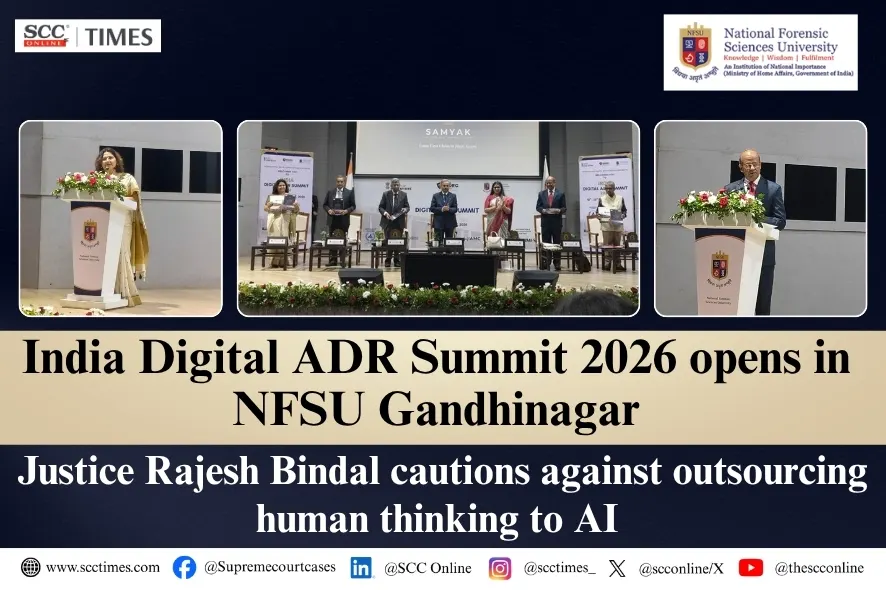
The India Digital Alternative Dispute Resolution (ADR) Summit 2026, organised by the School of Law, Forensic Justice and Policy Studies, National Forensic Sciences University (NFSU), is being held on September 12 and 13, 2026 at the NFSU campus in Gandhinagar, Gujarat.
The inaugural session, titled “Artificial Intelligence in Arbitration: Enhancing Decision-Making Without Replacing Human Judgment”, was attended by:
-
Justice N. V. Anjaria, Judge, Supreme Court of India;
-
R. Venkataramani, Attorney General for India;
-
Justice Sunita Agarwal, Chief Justice, High Court of Gujarat;
-
Justice M. R. Shah, Former Judge, Supreme Court of India;
-
Justice Rajesh Bindal, Former Judge, Supreme Court of India;
-
Professor Dr. S. O. Junare, Campus Director, NFSU Gandhinagar; and
-
Professor Dr. Purvi Pokhariyal, Dean, School of Law, Forensic Justice and Policy Studies, NFSU and Campus Director, NFSU Delhi.
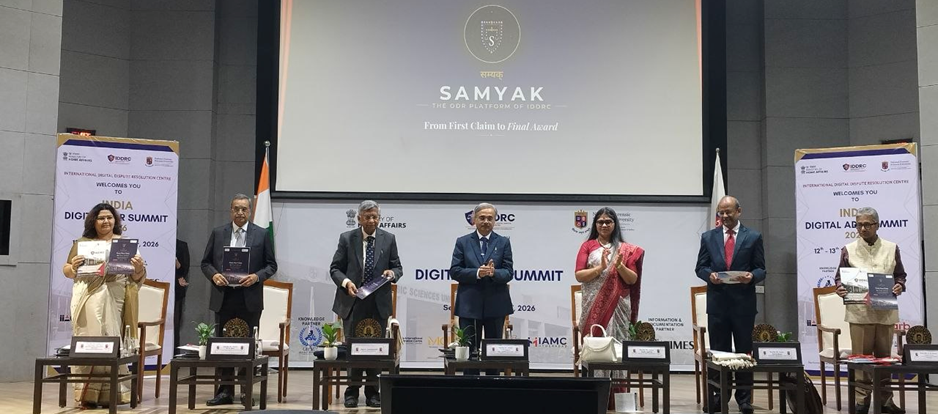
[In picture left to right: Prof. Dr. Purvi Pokhariyal, Justice N. V. Anjaria, R. Venkataramani, Justice M. R. Shah, Chief Justice Sunita Agarwal, Justice Rajesh Bindal and Prof. Dr. S. O. Junare]
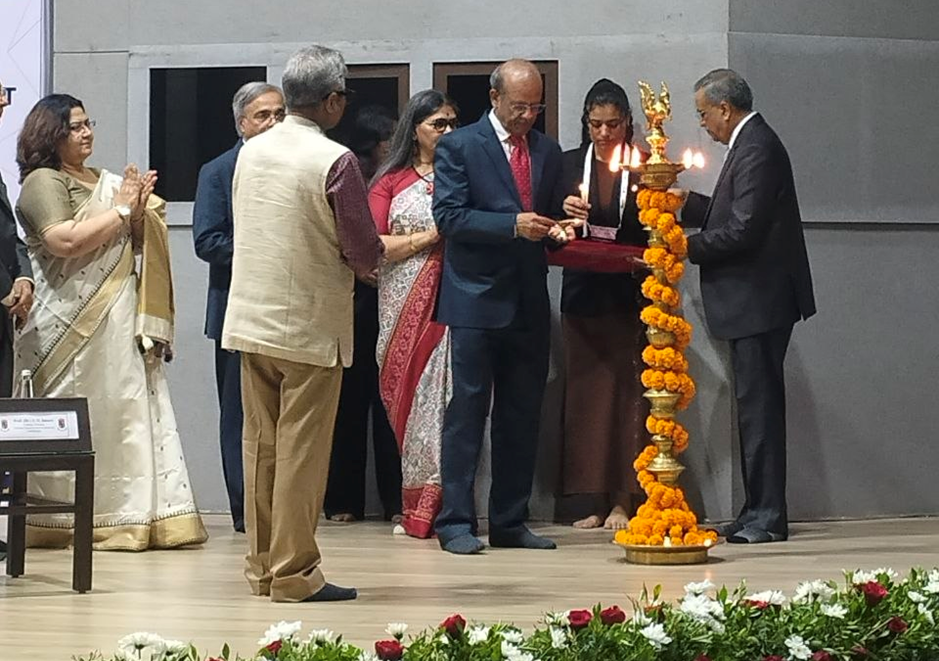
The inaugural ceremony included the ceremonial lighting of the lamp and the unveiling of SAMYAK, the Online Dispute Resolution (ODR) platform of the International Digital Dispute Resolution Centre (IDDRC), NFSU. The platform is intended to handle different stages of proceedings, from filing a claim and handling evidence to online hearings and rendering of awards.
The summit follows the establishment of the International Digital Dispute Resolution Centre (IDDRC) at NFSU, which was inaugurated on February 27, 2026 by Justice Surya Kant, Chief Justice of India.
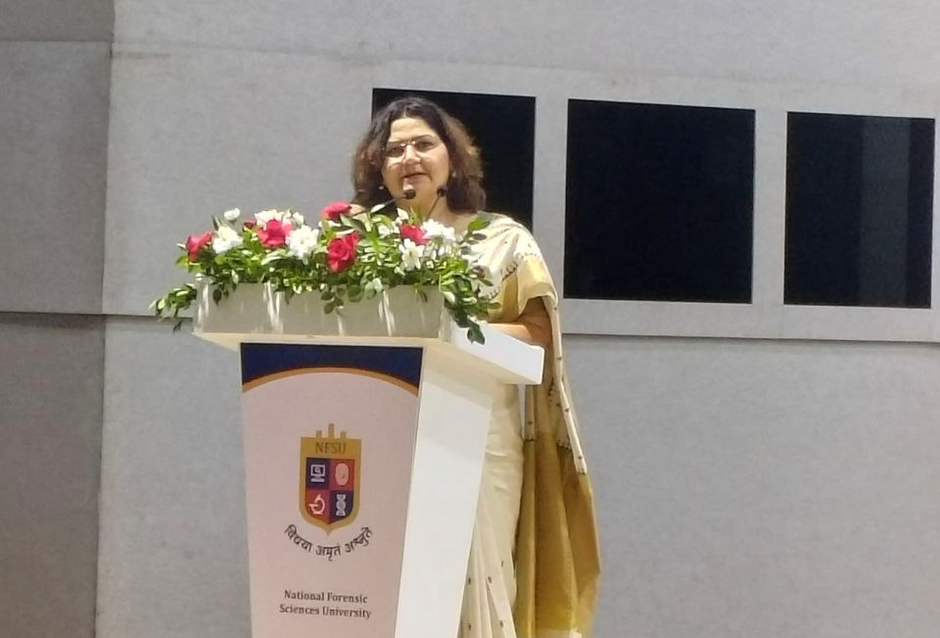
Prof. Purvi Pokhariyal: IDDRC seeks to build a digital platform for dispute resolution
Welcoming the gathering, Prof. Dr. Purvi Pokhariyal, Campus Director, NFSU Delhi, spoke about the development of the IDDRC and the University’s efforts to build a digital platform for dispute resolution.
Prof. Pokhariyal said the Centre was conceived to explore how the entire functioning of dispute resolution could be placed on a digital platform so that the process becomes more time-effective and economical, while also being fairer and more transparent. She specifically referred to privacy and the need for the platform to remain compliant with the Digital Personal Data Protection (DPDP) framework and secure.
She linked the project to NFSU’s work in cybersecurity and said the University sought to create a platform that was robust, secure and effective in terms of both time and cost. She said the idea of the Centre developed through a series of meetings with members and experts, following which arbitration rules were put in place and the decision was taken to develop an in-house digital platform to translate the conceptual framework into a functioning system.
According to Prof. Pokhariyal, the IDDRC reflected NFSU’s strategic commitment to modernising dispute resolution through structured governance and digital innovation. She said the Centre was anchored in transparent rules and a secure, “audit grade” technological system and would provide arbitration and mediation within a disciplined and internationally aligned framework. She also said the Centre was intended to enhance access to justice and address cross-border digital disputes.
Prof. Pokhariyal further said the initiative could contribute to strengthening India’s presence in the global dispute resolution landscape. She noted that the Centre had collaborated with the Gujarat High Court Arbitration Centre (GHAC), the Mumbai Centre for International Arbitration and the India International Arbitration Centre, among others, as academic partners. She said such collaborations were important to strengthening institutions and advancing the common objective of taking India to the global platform in digital dispute resolution.
Turning to artificial intelligence, Prof. Pokhariyal observed that dispute resolution had traditionally involved human intervention, with participants discussing, listening, analysing, giving reasons and delivering judgments. Against this background, she raised the question of whether artificial intelligence could be incorporated into dispute resolution, particularly as the legal services sector undergoes what she described as a “paradigm shift”.
She also linked the initiative to NFSU’s approach to legal education. Prof. Pokhariyal said the University’s law school had not adopted a traditional Bachelor of Arts, Bachelor of Laws or Bachelor of Business Laws programme, but had instead introduced a programme in Data Science and Law aimed at preparing “techno proficient lawyers”. She said students are taught artificial intelligence, Python and R, noting that the legal services sector would look very different by the time the students graduate.
Justice Rajesh Bindal: IDDRC is a dispute resolution centre, not merely an arbitration centre
Addressing the gathering, Justice Rajesh Bindal described the occasion as significant because the IDDRC had been established by an educational institution. He stressed that the Centre was not merely an arbitration centre but a “dispute resolution centre”, with the objective of resolving disputes through different means rather than restricting the process to arbitration or mediation.
Justice Bindal referred to mediation, conciliation, negotiation and arbitration as different means of dispute resolution and said that the appropriate method would depend on the dispute. He drew an analogy with medical treatment, observing that a doctor would not immediately recommend surgery for every illness, but would consider different methods depending on the ailment. Similarly, he said lawyers should not approach every dispute with the assumption that it must be taken to court when it could potentially be resolved through mediation, arbitration or negotiation.
He also emphasised the need to educate litigants about available alternatives. According to Justice Bindal, litigants often approach lawyers with the belief that the court is the only place where disputes can be resolved. He said people should be made aware that there are other mechanisms and institutions available to resolve disputes.
Justice Bindal then referred to court-pendency figures and said the disposal figures showed that a large proportion of cases being disposed of each month were uncontested. He said it was necessary to examine what kind of litigation was coming to the courts and “choking the system”, while noting that arbitration and mediation were already dealing with substantial disputes outside the courts.
He stressed the importance of institutions in arbitration, observing that a substantial proportion of arbitration was conducted on an ad hoc basis. According to Justice Bindal, institutional mechanisms were necessary for generating data, analysing the nature of disputes and using that information to guide future planning. He also referred to delays and the need to strengthen dispute-resolution mechanisms more broadly.
Justice Rajesh Bindal on AI: Technology has to be used as a tool
Turning to artificial intelligence, Justice Bindal said AI was increasingly being used in different spheres and that technology had already changed the way justice could be accessed. He referred to online hearings, electronic filing, digital records and remote access to case files, saying that technology had in this way brought “justice at doorstep”.
At the same time, he cautioned that “technology again has to be used as a tool” and should not reach a stage where technology controls its users. He identified what he described as the dangerous aspect of AI as the possibility that human beings could begin “outsourcing our thinking” to artificial intelligence.
Justice Bindal identified legal drafting, data analysis and briefing among the areas where AI could be used positively. He also referred to the possibility of analysing litigation data, including the contractual terms on which disputes arise, to improve drafting and understand recurring problems.
He, however, cautioned against errors generated by AI, particularly non-existent or inaccurate citations. Referring to instances where courts had seen citations that did not exist, he attributed such problems to reliance on AI without adequate application of the human mind. He also identified the possibility of AI-generated evidence as another issue that would need to be examined, observing that NFSU’s forensic capabilities could potentially assist in dealing with such material.
Confidentiality and data security were also highlighted as concerns. Justice Bindal noted that arbitration can involve confidential contractual and technical information and cautioned against uploading such material on public platforms. He referred to the use of public email, video-conferencing and speech-to-text software and warned against assuming that information placed on such platforms would remain private.
He said NFSU was in the process of developing software intended to address some of these concerns and indicated that the proposed system could be used by persons involved in arbitration and mediation. He also reiterated the need to address data security when AI tools are used for briefing and related purposes.
 ” alt=”” width=”600″ height=”600″/>
Justice Bindal further illustrated the risks of relying on AI without considering context by referring to the expression “leave granted” commonly used in Supreme Court proceedings. He said an AI translation had rendered it as “chhutti pradaan ki jaati hai”, without understanding the legal context in which the expression had been used.
He concluded by stressing that artificial intelligence was a creation of human beings and that human beings should not allow themselves to be completely displaced by it. While technology had “come to stay” and could not be ignored, he said it had to be controlled and used carefully.






NFSU’s unconventional approach to legal education is well articulated by Prof. Pokhariyal who stated that the National Forensic Sciences University had introduced a programme in Data Science and Law. This will certainly help prepare “techno-proficient lawyers”. It is heartening to know that students are taught artificial intelligence, Python and R. These skills are vital as the legal services sector would undergo a major change by the time the students graduate.
Former Supreme Court judge, Hon. Justice Rajesh Bindal aptly highlighted the need for lawyers and litigants to appreciate the fact all dipsutes need not reach the court of law. Apart from litigation, there are other lawful and peaceful methods of dipsute resolution such as mediation, arbitration, conciliation and negotiation too. Depending on the nature of the dispute, the suitable mechanism(s) should be chosen. The Honourable judge borrowed a perfect medical science analogy of hospitals, patients and doctors. It is noteworthy that doctors do not prescribe surgery to each and every patient. Similarly, the dispute resolution professionals should assess the nature of the dispute and accordingly advise the parties on suitability of it being referred either to litigation or to one or more of the ADR methods. The parties also need to realise that ADR is as important as the traditional litigation system. ADR system is not inferior to, second class or subordinate to the litigation mechanism. There is a dire need to raise public awareness through mass education or public opinion sensitisation campaigns on the significance of ADR. Prevalence of international treaties, conventions and model laws, rules on arbitration and mediation, as well the national laws on arbitration, meditaion and conciliation should be adequately highlighted. The rationale behind this exercise of ADR i.e. Justice and Peace for All by amicable, expeditious and cost-effective resolution of disputes needs to be explained to people-at-large.