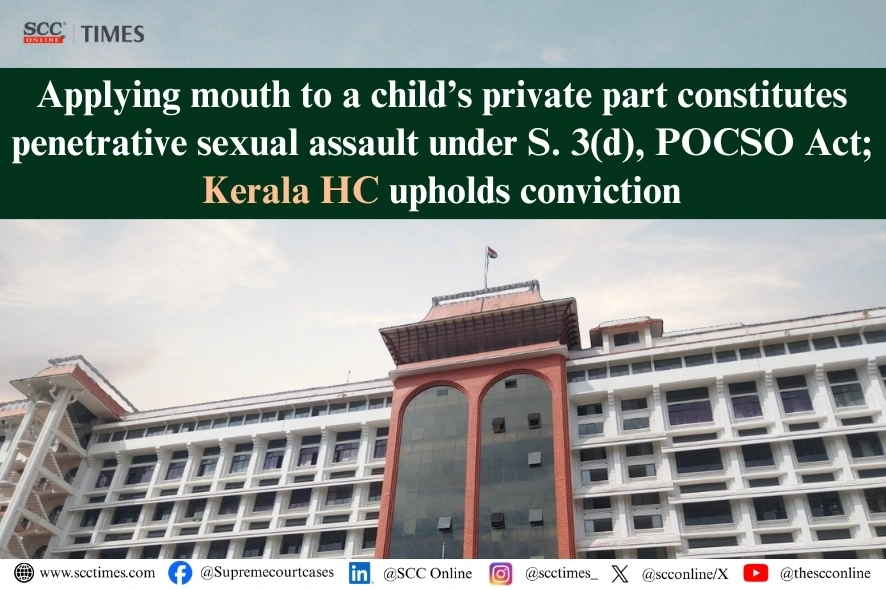
Kerala High Court: While considering an appeal challenging the conviction and sentence imposed by the Special Court for offences under Section 6 read with Section 5(l) and Section 10 read with Section 9(l), Protection of Children from Sexual Offences Act, 2012 (POCSO Act), a Single Judge Bench of A. Badharudeen, J., held that the evidence proved the accused’s act of applying mouth to a child’s private part which constituted penetrative sexual assault under Section 3(d), POCSO Act. Consequently, the conviction and sentence imposed by the Special Court were affirmed and the appeal was dismissed.
Also Watch: Touching Child’s Chest with Sexual Intent Is Sexual Assault Under POCSO: KerHC
Background
The prosecution case was that, on 26 January 2020 at about 7 p.m., the accused gave liquor and ganja beedi to a boy aged about 14½ years at a shop owned by him. After intoxicating the child, the accused subjected him to aggravated sexual assault twice on the same day. The prosecution alleged offences under Section 4 read with Section 3(d), Section 7 read with Section 8, and Section 6 read with Section 5(l), POCSO Act, Section 377, Penal Code, 1860 (IPC) and Section 77, Juvenile Justice (Care and Protection of Children) Act, 2015 (JJ Act).
The Special Court ultimately convicted the accused and sentenced him to undergo rigorous imprisonment for 5 years with a fine of ₹50,000 for the offence under Section 10 read with Section 9(l), POCSO Act, 20 years’ rigorous imprisonment with a fine of ₹1,00,000 for the offence under Section 6 read with Section 5(l), POCSO Act, and 5 years’ rigorous imprisonment with a fine of ₹50,000 for the offence under Section 77, JJ Act; in default of payment of fine, separate default sentences were imposed, with all substantive sentences directed to run concurrently and the benefit of set-off granted under Section 428, Criminal Procedure Code, 1973 (CrPC). However, he was acquitted of the charge under Section 377 IPC.
The accused’s counsel argued that the victim is a boy having bad habits and the people in the locality had made a complaint at the police station and on this premise, the accused was implicated in the case without any reason. It was contended that the prosecution evidence was insufficient to sustain the conviction and that leniency ought to be shown on account of the accused’s age. On the other hand, the State submitted that the child’s testimony was cogent and stood supported by the remaining prosecution evidence. It was further pointed out that no specific defence had been suggested to the victim in cross-examination apart from a plea that the case has been foisted.
Issues for consideration
-
Whether the Special Judge is right in holding that accused committed the offence punishable under Section 10 read with Section 9(l), POCSO Act?
-
Whether the Special Judge is right in holding that accused committed the offence punishable under Section 6 read with 5(l), POCSO Act?
-
Whether the Special Judge is right in holding that accused committed the offence punishable under Section 77, JJ Act?
-
Whether the impugned verdict would require any interference by this Court?
-
The order to be passed.
Also Read: Meghalaya HC grants POCSO bail citing prolonged custody
Analysis
The Court noted that there was no dispute regarding the victim’s status as a child within the meaning of Section 2(1)(d), POCSO Act. The Court observed that the prosecution had proved his age through the school admission register produced by the Headmistress which showed 3 May 2005 as his date of birth.
The Court further noted that the child deposed that when he visited the shop to purchase sweets and biscuits, the accused took him inside, removed his shirt and pants and kissed his private part. He further stated that the accused compelled him to smoke ganja, forced him to consume beer and advised him to quarrel with his parents. According to the child, he later returned to the shop, where the accused again removed his clothes and repeated the same acts. He also identified his first information statement and statements given before the Magistrate. The child also stated that he had created issues at home saying that he was an adopted child, as per the accused’s advice. The prosecution further examined Childline officials and investigating officers who proved the recording of the complaint, registration of the FIR and subsequent investigation.
While considering the offence under Section 5(l) read with Section 6, POCSO Act, the Court examined Section 3(d), POCSO Act which provides that penetrative sexual assault is committed when a person applies his mouth to the penis, vagina, anus or urethra of a child or makes the child to do so to such person or any other person. Referring to the evidence that the accused kissed the child’s private parts on 2 occasions, the Court held that it was sufficient to establish an offence under Section 3(d).
The Court observed that the law does not mandate oral sex or deeper penetration for the purpose of Section 3(d) and any intentional physical contact where the mouth is applied to the specified private parts of a child satisfies the mandate. The Court further observed that when the mouth touches the private part with sexual intent, the act falls within the definition of penetrative sexual assault and becomes punishable under Section 4, POCSO Act. On that basis, the Court concluded that the Special Judge was justified in finding that the accused committed the offence punishable under Section 5(l) read with Section 6, POCSO Act.
The Court then examined the conviction under Section 9(l) read with Section 10, POCSO Act. The Court noted that Section 9(l) applies where sexual assault is committed more than once or repeatedly. Since the evidence established that the accused repeatedly kissed the child’s private parts, the Court affirmed the finding that the accused had committed the offence punishable under Section 9(l) read with Section 10, POCSO Act.
Also Read: Kerala HC Upholds POCSO Conviction of Madrassa Teacher
Decision
The Court observed that the sentence imposed by the Special Court was very reasonable and did not warrant any interference. Consequently, while dismissing the appeal, the Court confirmed the conviction and sentence imposed by the Special Judge.
[Thomas Thomas v. State of Kerala, 2026 SCC OnLine Ker 13623, decided on 1-9-2026]
Advocates who appeared in this case:
For the Appellant: M.R. Sasith, Advocate.
For the Respondent: M.A. Shihab, Public Prosecutor.
Buy Protection of Children from Sexual Offences Act, 2012 HERE
Buy Juvenile Justice (Care and Protection of Children) Act, 2015 HERE