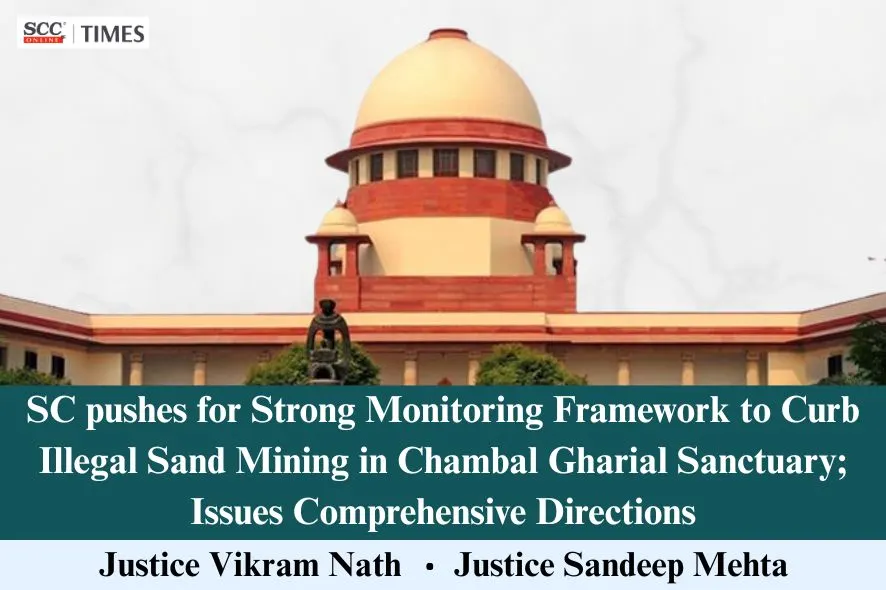
Supreme Court: While deliberating over these applications which originated from the Court’s suo motu cognizance over rampant illegal sand mining within the National Chambal Gharial Sanctuary, resulting in severe degradation of critical wildlife habitats, including that of the endangered Gharials, the Division Bench of Vikram Nath and Sandeep Mehta*, JJ., issued important directions for the States of Madhya Pradesh, Rajasthan, and Uttar Pradesh for immediate compliance.
The Court further took grim notice of the fact that enforcement personnels are inadequately equipped to deal illegal sand mining activities and opined that the foremost step required to be undertaken is the strengthening of the surveillance and monitoring framework to effectively curb and deter illegal sand mining activities. A robust, coordinated, and technology–driven mechanism, ensuring real-time monitoring and prompt enforcement, is essential to prevent the continued perpetration of such unlawful activities and to restore the Rule of Law in the affected regions.
The directions also covered several key aspects which were highlighted before the Court, thereby bringing out the gravity of the unabated course of illegal activities, which not only undermined the Rule of Law but also posed serious and escalating threats to human life, public safety, and ecological integrity.
Background
The present interlocutory applications formed part of the suo motu cognizance dated 13 March 2026 concerning illegal sand mining within the bounds of National Chambal Gharial Sanctuary. These applications highlighted certain disturbing recent developments such as — murder of forest guards in States of Madhya Pradesh, Rajasthan and illegal sand mining threatening structural integrity of inter-State bridge over Chambal River Stretch.
Also Read: Sand Mining in India — Grain of Despair: Failure of Regulatory Machinery
Court’s Assessment
Perusing the applications, the Court pointed out that it has time and again taken cognizance of the rampant illegal mining activities and the grave and far-reaching environmental consequences arising therefrom. The Court further pointed out that it has consistently observed that unregulated extraction of sand and other minor minerals lead to severe disruption of riverine and ecological systems by altering natural flow patterns, degrading riverbeds, destabilising sediment composition, and depleting groundwater reserves. “Such activities not only result in erosion, channel instability, and increased flood vulnerability, but also adversely affect aquatic biodiversity, riparian habitats, agriculture, and water security.”
The Court further remarked that ever-increasing demand for construction materials, has given rise to large-scale illegal sand mining, often carried out in an organised manner with little regard for the Rule of Law.
Having regard to the magnitude and seriousness of the issues involved in the present matter, as well as the prima facie lackadaisical approach adopted by the States concerned, this Court cannot remain a silent spectator.
The Court grimly noted that despite repeated directions issued from time to time, both on the judicial as well as administrative side, no effective or meaningful steps appear to have been taken thus far to address the continuing illegal sand mining activities and the resultant ecological degradation, more so when such activities are being carried out within a protected area, namely, a wildlife sanctuary, thereby exacerbating the gravity of the situation. Therefore, the Court opined that there is a need to assume a more proactive role in the matter and to issue appropriate directions to ensure effective compliance with the environmental protection regime and to safeguard the fragile ecosystem in question.
It is indeed a matter of grave and serious concern that the State authorities, who are entrusted with the solemn duty of enforcing the rule of law and protecting public resources, appear to have abdicated, if not altogether abandoned, their statutory and constitutional responsibilities.
The Court stated that continuing illegal mining activities, coupled with the grave incident highlighted in the present applications reflect not merely isolated lapses but a systemic and institutional failure to discharge obligations cast upon the State under law. “Such apathy, particularly in the face of escalating environmental degradation and threats to human life, is both indefensible and wholly unacceptable in a constitutional democracy governed by the rule of law.”
The Court expressed its dismay upon noting that in an affidavit filed before the National Green Tribunal, it was stated by the State of Madhya Pradesh that forest officials do not possess the necessary equipment, more specifically, adequate weaponry, to effectively deal with the sand mafia, who are reportedly armed with superior weaponry and modern vehicles.
Taking note of the gravity of rampant illegal sand mining in the National Chambal Gharial Sanctuary, the Court expressed disappointment over complete and manifest apathy on the part of Madhya Pradesh and Rajasthan towards the discharge of their fundamental constitutional obligations, namely, the maintenance of public order and the prevention of unlawful and unruly activities having a deleterious impact on the public at large and the fragile ecosystem. “The failure to equip enforcement personnel adequately and to ensure their safety while discharging official duties strikes at the very root of governance and the rule of law. This Court is, therefore, constrained to observe that such an approach not only emboldens the perpetrators of the crime but also erodes public confidence in the State’s ability to uphold law and order, thereby necessitating immediate, concrete, and accountable corrective measures at the highest levels of administration.”
Directions Issued
With the aforestated assessment regarding gravity of illegal sand mining in National Chambal Gharial Sanctuary and emphasising on the need for strengthening the surveillance and monitoring framework to effectively curb and deter illegal sand mining activities, the Court in exercise of Article 142 of the Constitution, issued the following directions:
-
States of Madhya Pradesh, Rajasthan, and Uttar Pradesh shall ensure the installation of high-resolution, Wi-Fi enabled CCTV cameras, mounted on appropriately elevated poles/masts, at all routes frequently used for illegal sand mining as well as along vulnerable stretches of the river where such activities are prevalent. The authorities concerned shall undertake detailed assessment regarding the positioning and placement of such CCTV cameras, in consultation with the Central Empowered Committee, to ensure that the installation is carried out in a manner that minimises ecological disturbance and complies with all applicable environmental regulations, particularly those relating to non-disturbance of the riverbed and surrounding forest areas, to the greatest extent possible.
-
Live feed of such surveillance cameras installed in terms of Direction (A) shall be placed under the direct control, supervision, and operational oversight of the Superintendent of Police/Senior Superintendent of Police of the district concerned and the Divisional Forest Officer, who shall ensure continuous and effective monitoring by designating appropriate officers, not below the rank of Sub-Inspector/Station House Officer and an appropriately ranked forest official, for the said purpose. In the event of detection of any instance of illegal mining or allied unlawful activity through such surveillance, the officers concerned shall be under a mandatory obligation to initiate prompt and appropriate action in accordance with law, including the mobilisation of enforcement teams and initiation of necessary legal proceedings, so as to ensure effective deterrence and prevention of such activities.
-
Authorities/departments concerned of the States of Madhya Pradesh and Rajasthan shall, on a pilot basis, ensure that GPS tracking devices are mandatorily installed in all vehicles and machinery, including dredgers, loaders, excavators, tractors, and any other equipment or machinery used in mining activities, registered/operating within District Morena, Madhya Pradesh and District Dholpur, Rajasthan, to enable real-time monitoring, effective surveillance, and complete traceability of their movement. The implementation shall be carried out through the respective Departments of Transport of the States, and the data generated shall be made accessible to the District Magistrates and the police authorities for enforcement purposes. Based on the outcome and effectiveness of the said pilot implementation, appropriate steps shall be taken for its phased extension to other districts falling within or adjoining the National Chambal Gharial Sanctuary. Appropriate publicity shall be given to the above direction, stipulating that any non-compliance shall result in the immediate seizure of the vehicle or machinery concerned, with no possibility of release except with the express permission of the Court.
-
States of Madhya Pradesh, Rajasthan, and Uttar Pradesh shall, by the next date of hearing, place on record a detailed report indicating the feasibility of establishing dedicated control rooms in each district falling within or adjoining the National Chambal Gharial Sanctuary, wherein the live CCTV feeds and data collected through surveillance mechanisms, including GPS tracking systems, may be centrally received, monitored, and analysed. The report shall also indicate the proposed framework for coordination between the departments concerned and enforcement agencies, to ensure that timely and effective action is taken in accordance with law based on such real-time inputs.
-
Authorities/departments concerned of the States of Madhya Pradesh, Rajasthan, and Uttar Pradesh shall ensure that any vehicle or machinery found to be involved in illegal sand mining is immediately seized, and that the driver, owner, and all persons involved are prosecuted in accordance with applicable laws, including the relevant environmental protection, conservation, and mining regulation statutes.
-
Authorities concerned including the State Pollution Control Boards of the states of Madhya Pradesh, Rajasthan, and Uttar Pradesh shall initiate appropriate, time-bound proceedings for the assessment, imposition, and recovery of environmental compensation from all violators, strictly in accordance with the “Polluter Pays” principle, to ensure restitution as well as remediation of the ecological damage caused by illegal sand mining activities. Such exercise shall be undertaken in a scientific, transparent and objective manner, having due regard to the extent of environmental degradation, and shall be effectively enforced to serve both compensatory and deterrent purposes.
-
States of Madhya Pradesh, Rajasthan, and Uttar Pradesh shall constitute dedicated and fully operational and well-equipped joint patrol teams in each district falling within or adjoining the National Chambal Gharial Sanctuary, comprising officials from the police and forest departments. The States shall ensure that an adequate and well-trained strength of support security personnel is deployed for such patrols on a continuous and round-the-clock basis, particularly in vulnerable and high-risk areas.
-
It shall further be ensured that such patrol teams are equipped with modern surveillance and communication equipment, protective gear, and appropriate arms, so as to enable them to effectively prevent illegal mining activities, respond swiftly to emergent situations, and safely handle instances involving resistance and violence by organized groups engaged in such activities.
-
At all existing or newly established check points, whether permanent or set up on the basis of specific intelligence inputs, the officers deployed shall be provided with adequate and modern equipment, including protective gear, communication devices, surveillance aids, and necessary arms, so as to ensure that they are fully equipped, both in terms of safety and operational capability, to effectively deal with unlawful and potentially dangerous illegal mining activities. States of Madhya Pradesh, Rajasthan, and Uttar Pradesh shall further ensure that such personnel are appropriately trained and supported, so as to enable them to respond swiftly and efficiently to any emergent situation arising at such check points.
-
States of Madhya Pradesh, Rajasthan, and Uttar Pradesh shall, in close coordination with one another, formulate and implement a comprehensive, uniform, and time-bound Standard Operating Procedure (SOP) to effectively deal with incidents involving illegal sand mining, particularly those involving organized, violent, or armed resistance by persons engaged in such activities. The SOP shall, inter alia, lay down clear operational protocols for interception, seizure, arrest, and emergency response, including safeguards for the safety of enforcement personnel.
-
The SOP shall further provide for robust inter-State coordination and communication mechanisms, including real-time information sharing, joint operations, and coordinated response strategies, so as to effectively address situations having inter-State and cross-border ramifications and to ensure seamless enforcement across territorial boundaries.
-
Any dereliction of duty, negligence, inaction, or failure to comply with the directions of the Court shall be viewed with utmost seriousness. The officers concerned would be held personally accountable and shall be liable to appropriate action, including initiation of contempt proceedings before the Court. Such action shall be taken without exception to ensure strict compliance and to uphold the authority of law and the orders of the Court.
-
States of Madhya Pradesh, Rajasthan, and Uttar Pradesh shall, by the next date of hearing, place on record comprehensive affidavits indicating the progress made in compliance with the directions, along with a detailed plan of action outlining the further steps proposed to be undertaken and the timelines for achieving full and effective compliance with the aforesaid directions.
Conclusion
The Court emphasised that issues involved in the matter are of grave concern inasmuch as, the rampant illegal mining activities in the riverbed have created an environmental crisis and havoc in the National Chambal Gharial Sanctuary, causing a grave risk to the very project of Gharial preservation. The Court also clarified that the aforestated directions have been given in furtherance of this Court’s constitutional obligation to uphold the rule of law and to ensure effective protection of the environment, which forms an integral facet of the right to life under Article 21 of the Constitution. “Protection of natural resources and fragile ecosystems is not only a statutory obligation but a constitutional imperative”.
The Court thus concluded the order expressing hope that the states concerned shall take effective action in furtherance of the aforestated directions in order to curb the menace of illegal sand mining in National Chambal Gharial Sanctuary.
[Illegal sand mining in the National Chambal Sanctuary and threat to endangered aquatic wildlife, In re, 2026 SCC OnLine SC 631, order dated 17-4-2026]
*Order by Justice Sandeep Mehta
Advocates who appeared in this case:
Amicus Curiae: Mr. Nikhil Goel, Sr.Adv. Ms. Rupali Samuel, AOR
For Petitioner(s): By Courts Motion, AOR
For Respondent(s): Mr. S.V. Raju, A.S.G. Ms. Manisha T. Karia, A.A.G. Mr. D.S. Parmar, A.A.G. Mr. Harmeet Singh Ruprah, AOR Mr. Sarthak Raizada Ga, Adv. Mr. Kanishk Sharma, Adv. Mr. Karan Singh, Adv. Mr. Anil Kaushik ASG Mr. Rajat Rana, Adv. Mr. Rishab Joshi, Adv. Mr. Sharan Dev Singh Thakur, Sr. A.A.G. Mr. Abhishek Saket, Adv. Mr. Sudeep Kumar, AOR Ms. Manisha, Adv. Ms. Rupali, Adv. Ms. Nidhi Singh, Adv. Mr. Shiv Mangal Sharma, A.A.G. Mr. Saurabh Rajpal, Adv. Ms. Arushi Rathore, Adv. Ms. Nidhi Jaswal, AOR Mr. Rohit K. Singh, AOR Mr. Pritam Bishwas, Adv. Mr. Yashveer Singh, Adv Mr. Kartikey Bansal, Adv. Mr. Pritam Singh, Adv. Mr. Umesh Kumar Shukla, Adv. Ms. Ruchira Goel, AOR
Buy Constitution of India HERE