2026 SCC Vol. 7 Part 5: Key Supreme Court Cases on Constitution, GST, Criminal Law and more
Key Supreme Court rulings on Article 227, RTE, Teachers Eligibility Test, custody, GST rebate, etc.

Bringing you the Best Analytical Legal News


Key Supreme Court rulings on Article 227, RTE, Teachers Eligibility Test, custody, GST rebate, etc.
Punjab and Haryana High Court examined whether a civil suit seeking partition, separate possession and rendition of accounts could proceed where an arbitration agreement covered division of the family properties.
The High Court held that the enquiry under Section 12-A(1), Commercial Courts Act is limited to whether the suit genuinely contemplated urgent interim relief and that the plaint must be examined holistically without adjudicating the merits of the interim relief.
“An unqualified application of Section 19… would defeat the object of the provision, and open the door to forum shopping, libel tourism, and luxury litigation.”
“The cause of action in a suit for partition is of a recurring nature and continues so long as the joint status subsists, crystallising only upon refusal of a demand for partition.”
“Order XLI Rule 23 of the CPC envisages remand in a situation in which the suit was decreed by the Court of first instance on a preliminary point and the decree is reversed in appeal by the appellate court.”
“The essence of an application under Order VII Rule 11 CPC to terminate a civil action or to put an end to a litigation is an essential duty of a Civil Court so that further judicial time is not invested wastefully.”
The Supreme Court distinguished Bank of India v. Maruti Civil Works, 2023 SCC OnLine Bom 2667, noting that it dealt with orders under Order VII Rules 10 and 11(d) CPC, which are not appealable under Order XLIII CPC.
The petitioner contended that the suit did not fall within the pecuniary jurisdiction of the Court, so the respondent filed an amendment application to amend the valuation of the suit \to bring the suit within the jurisdiction of the Court.
“The phrase “does not disclose the cause of action” must be very narrowly construed. The rejection of plaint at the threshold entails very serious consequences. This power must be exercised only in exceptional circumstances and when the Court is sure that plaintiff does not have any arguable case at all.”
“Short-circuiting of procedure to reach hasty outcomes is an undesirable propensity of an overburdened judiciary. Such impulses rendering procedural safeguards and substantive rights subvert certainty and consistency in law and need to be discouraged”.
“It is not disputed that Masjid is a place used for religious purpose for praying Namaz etc., therefore, it comes within the definition of ‘Waqf’.”
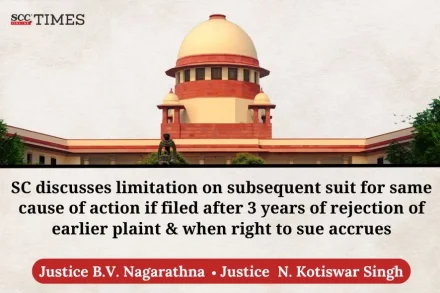
“The right to sue under Article 113 of the Limitation Act accrues when there is an accrual of rights asserted in the suit and an unequivocal threat by the defendant to infringe the right asserted by the plaintiff in the suit.”
If the power is given to do a certain thing in a certain way, the thing must be done in that way.
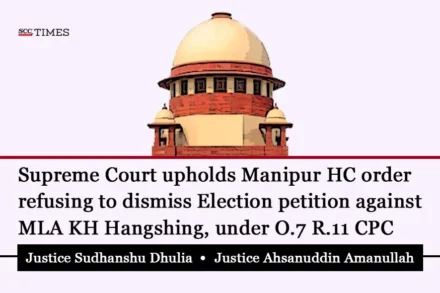
Supreme Court reiterated that the Election Petition should not be rejected at the very threshold where there is a “substantial compliance” of the provisions.
Filing of the application under Order 39 Rule 1 and 2 of the Civil Procedure Code, 1098 was just an act to wriggle out of and get over Section 12-A of the Commercial Courts Act, 2015
Calcutta High Court stated that “Order VII, Rule 11 is applicable to the plaint which does not disclose cause of action and not the cases where the plea is non-existence of cause of action.”
Calcutta High Court held that “in order to decide whether the suit is barred by any law, it is the statement in the plaint which will have to be construed.”
Calcutta High Court stated that the defendant did not produce any documents to prove he has complied with his obligation under MOU, leading to its cancellation.
The Calcutta High Court clarified that rejection of the plaint is not warranted based on allegations of collusion or lack of cause of action, which are factual issues to be determined during the trial.