


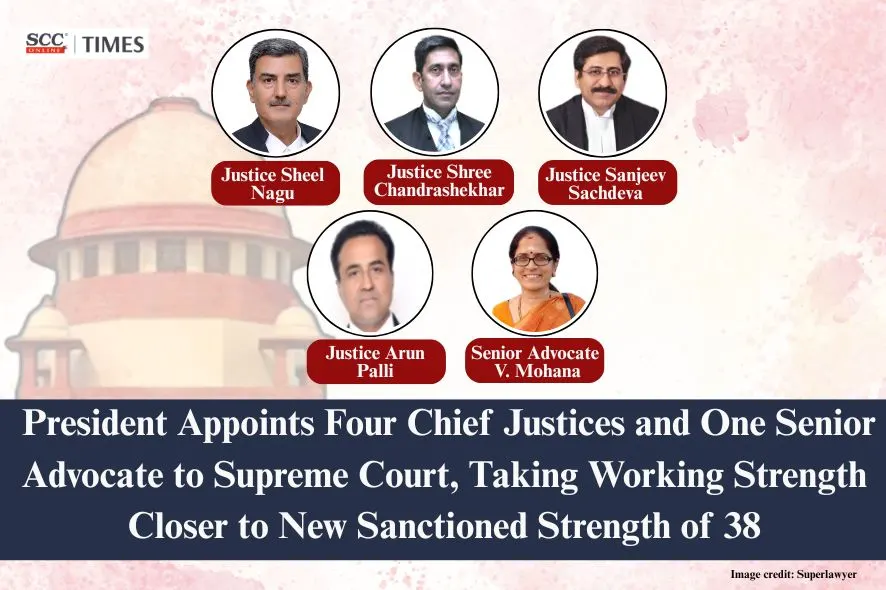
The President of India has appointed Chief Justice Sheel Nagu, Chief Justice Shree Chandrashekhar, Chief Justice Sanjeev Sachdeva, Chief Justice Arun Palli and Senior Advocate Venkita Subramani Mohana as Judges of the Supreme Court of India.
The appointments give effect to the recommendations made by the Supreme Court Collegium headed by the Chief Justice of India in its meetings held on 22 and 27 May 2026. The Collegium’s recommendations were made public on 27 May 2026.
Union Minister for Law and Justice Arjun Ram Meghwal first intimated the appointments through a post on X, where he also conveyed his best wishes to the newly appointed judges. The appointments were subsequently announced through an official Press Information Bureau (PIB) press release.
Announcing the appointments, the Union Minister for Law and Justice stated that, in exercise of the powers conferred by Article 124(2), Constitution of India, the President, after consultation with the Chief Justice of India, was pleased to appoint the following as Judges of the Supreme Court of India:
-
Justice Sheel Nagu, Chief Justice, Punjab and Haryana High Court (Parent High Court: Madhya Pradesh High Court)
-
Justice Shree Chandrashekhar, Chief Justice, Bombay High Court (Parent High Court: Jharkhand High Court)
-
Justice Sanjeev Sachdeva, Chief Justice, Madhya Pradesh High Court (Parent High Court: Delhi High Court)
-
Justice Arun Palli, Chief Justice, High Court of Jammu & Kashmir and Ladakh (Parent High Court: Punjab and Haryana High Court)
-
Senior Advocate V. Mohana, Supreme Court of India





Recently strength of judges at the Supreme Court of India has been increased to 38. On 5 May 2026, the Union cabinet approved the Supreme Court (Number of Judges) Amendment Bill, 2026 to raise the sanctioned strength of the top court from 34 to 38 judges. On 16 May 2026 , Honourable President Droupadi Murmu promulgated the Supreme Court (Number of Judges) Amendment Ordinance, 2026. It raises the sanctioned strength of the top court from 34 to 38 judges. Section 2 of the Supreme Court (Number of Judges) Act, 1956 now reads “thirty-seven” puisne judges in place of “thirty-three”, besides the Chief Justice.
The Ordinance was notified in the Gazette of India on 16 May, 2026. It came 11 days after the Union Cabinet cleared the corresponding Bill. The Bill was expected to be taken up in the ensuing Monsoon session of Parliament. The Budget session concluded on 2nd April 2026. The government, however, invoked Article 123 of the Constitution which empowers the President to legislate by Ordinance—on satisfaction that immediate action is necessary.
This is the first expansion of the sanctioned strength since 2019, when it was increased to 34 judges from 31 by the Supreme Court (Number of Judges) Amendment Act, 2019. It may be recalled that the Supreme Court began with eight judges in 1950. Successive amendments raised the strength to 11 in 1956, 14 in 1960, 18 in 1978, 26 in 1986 and 31 in 2009.
On 2nd of June 2026, it was indeed an honour and privilege to watch in-person at the C Block Auditorium of the Additional Buildings Complex the swearing-in ceremony of the five new judges at the top Court. The Honourable Supreme Court of India is indeed delighted to welcome Justice Sheel Nagu, Chief Justice, Punjab and Haryana High Court (Parent High Court: Madhya Pradesh High Court), Justice Shree Chandrashekhar, Chief Justice, Bombay High Court (Parent High Court: Jharkhand High Court), Justice Sanjeev Sachdeva, Chief Justice, Madhya Pradesh High Court (Parent High Court: Delhi High Court), Justice Arun Palli, Chief Justice, High Court of Jammu & Kashmir and Ladakh (Parent High Court: Punjab and Haryana High Court) and Senior Advocate V. Mohana, Supreme Court of India. It will certainly strengthen the apex court and expedite dispensation of justice.
The Honourable President of India made these appointments. These appointments come in the wake of recommendations made by the Supreme Court Collegium headed by the Honourable Chief Justice of India in its meetings held on 22nd and 27th of May 2026 which were made public on 27th of May 2026.
As pendency keeps rising in all courts across India, one is reminded of the the 229th Report of the Law Commission of India, written under Justice A.R. Lakshmanan, that suggested setting up a Constitution Bench at Delhi for constitutional matters, with four regional cassation benches at Delhi, Chennai or Hyderabad, Kolkata and Mumbai to dispose of appellate matters from the High Courts. The Report stressed that adding judges alone was insufficient to address pendency or access.
It is noteworthy that this proposal was rejected by a Full Court of the Supreme Court on 18 February, 2010. The Court found “no justification” for sittings outside Delhi. A writ petition seeking a National Court of Appeal, referred to a Constitution Bench in 2016, remains pending.
Former Chief Justice Dr. D.Y. Chandrachud had observed in 2024 that “we simply need more judges” and was engaging with the government on the question. Critics have, however, asked whether mere numbers will come to the rescue. The reason behind this thought-provoking question is that numerical strength alone does not dictate pendency trends because the docket also changes due to the constantly widening jurisdiction of the apex Court and the relentless filing of Special Leave Petitions (SLPs). These seminal issues more deliberations and introspection.