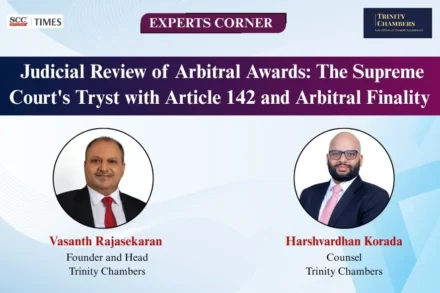
Judicial Review of Arbitral Awards: The Supreme Court’s Tryst with Article 142 and Arbitral Finality
by Vasanth Rajasekaran* and Harshvardhan Korada**
The Court held that the marriage was dead for all practical purposes, warranting to be nullified under Article 142 to grant a decree of divorce.
“The RTE Act is a child centric legislation and must be read so. Service of teachers cannot come at the cost of educational future of the children.”
“The Court wields considerable authority, yet the true essence of judicial magnanimity lies in restraint. Measured reprimand and corrective guidance remain the wiser course over sheer penal consequence.”
The criteria prescribed was not in any manner watered down or deviated from the criteria required to be satisfied while seeking regular appointment.
“Even if the appellant-wife is highly educated and professionally qualified, that by itself cannot be a reason to absolve the respondent-husband from his matrimonial, paternal, moral and legal responsibility to provide for his wife and children.”
“Appellants secured admission based on tribe certificates, which have since been cancelled, is not in doubt. Nonetheless, sight cannot be lost that their tribe certificates were invalidated after they had graduated.”
“Though the demand raised by the Bank is legally sustainable, we find that compliance thereof would lead to extreme hardship for the appellant.”
“True equality at the workplace can be achieved only with the right impetus given to disability rights as a facet of Corporate Social Responsibility.”
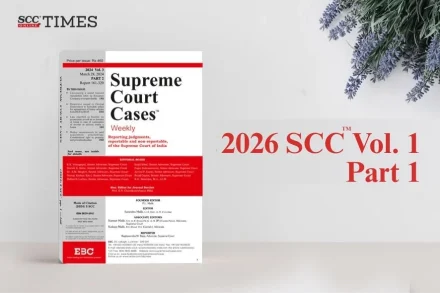
2026 SCC Vol. 1 Part 1: Explore the latest Supreme Court Cases on Constitution’s Articles 200 and 201.
“Irrespective of upon whom the culpability may lie from a strict penal perspective, HEIs cannot shirk away from their fundamental duty to ensure that their institutions as a whole are safe, equitable, inclusive and conducive spaces of learning.”
2025 SCC Vol. 8 Part 1: Explore the latest Supreme Court Cases on Constitution’s Articles 21, 142 and 200.
“In the interest of justice, equity, and the welfare of the child, we deem it appropriate to grant visitation rights to the wife so that she may gradually rebuild a bond with her daughter.”
The original judgment of the Special Court convicted and imposed a sentence of rigorous imprisonment for seven years on the convict. However, the convict had already undergone eleven years of actual sentence.
Supreme Court reiterated that where a citizen aggrieved by an action of the government department has approached the court and obtained a declaration of law in his/her favour, others similarly situated ought to be extended the benefit without the need for them to go to court.
Supreme Court acknowledged that the petitioner’s admission had been delayed through no fault of his own. It requested the Director of IIT Dhanbad to utilize his good offices to facilitate the petitioner’s ability to complete the coursework for the time already elapse.
“The wife took advantage of the settlement executed before the Mediator and managed to get the matrimonial case instituted by the husband withdrawn and also accepted a sum of Rs. 50 lakhs from the husband as permanent alimony.”
The Supreme Court considered an appeal seeking divorce for husband and wife aged 87 years and 82 years respectively, on the ground of irretrievable breakdown of marriage.
“Family Courts must restrict their considerations to the parameters of the provision of grant of divorce strictly in accordance with the Hindu Marriage Act, 1955 (‘Act’). Irretrievable breakdown of marriage is not a ground in the Act.”
Supreme Court: While reversing the impugned decision of the Bombay High Court, M.R. Shah* and B.V. Nagarathna, JJ., held that the prices