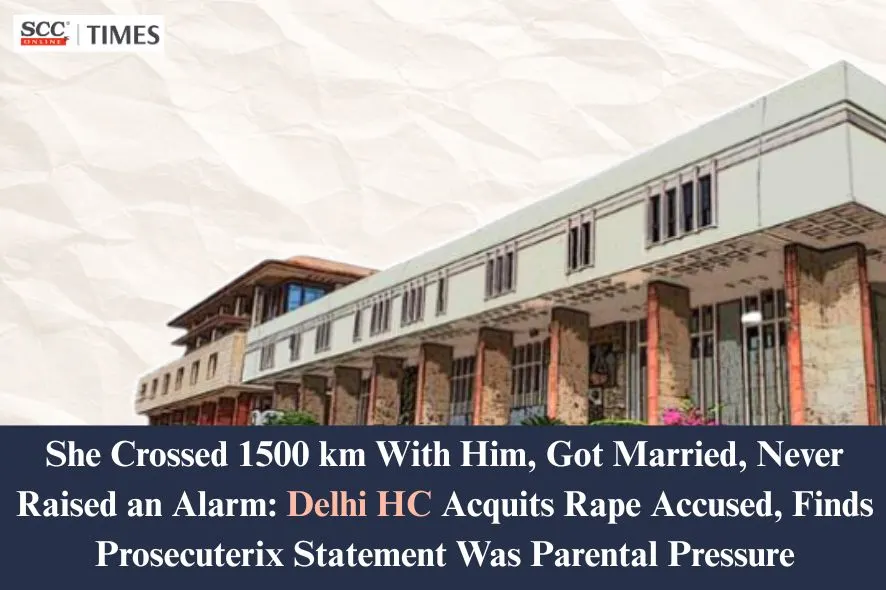
Delhi High Court: In a criminal appeal arising out of convictions under Sections 363, 366 and 376, Penal Code, 1860 (IPC), a Single Judge Bench of Vimal Kumar Yadav, J., acquitted the appellant after holding that the prosecutrix had voluntarily accompanied and married him and that the prosecution had failed to conclusively establish that she was a minor at the relevant time. The Court observed that determination of age was the “most vital aspect” of the case and reiterated that in the absence of a matriculation certificate or municipal birth certificate, ossification test could be relied upon as a last resort, with the benefit of margin of error going in favour of the accused.
“Fragmented, stratified and deeply divided Indian society across all the classes left no room practically for the young lovers to choose their partners”.
The Court further held that the conduct of the prosecutrix, her statements under Sections 161 and 164, Criminal Procedure Code, 1973 (CrPC), the marriage certificate under the Special Marriage Act, 1954 and the surrounding circumstances clearly reflected a consensual relationship between the parties. Taking note of the law prevailing at the relevant time, including Exception 2 to Section 375 IPC, the Court concluded that the prosecution had failed to prove the charges against the appellant beyond reasonable doubt. Consequently, the appeal was allowed and the appellant was acquitted of all charges.
Background
On 16 May 2004, Kanhiya Lal lodged a complaint at Police Station Fresh Bazar regarding the disappearance of his daughter (the prosecutrix), who had been missing since noon that day. He expressed suspicion that the accused, was involved in her disappearance. Treating the matter as a cognizable offence, the duty officer registered FIR No. 169 of 2004 under Section 363 IPC for kidnapping.
The present appeal arose from the conviction of the appellant under Sections 363, 366 and 376 IPC in FIR No. 169 of 2004 registered at the instance of the prosecutrix’s father. The appellant challenged the impugned judgment primarily on the ground that the prosecutrix was major and had attained the age of consent under the pre-amendment law. It was contended that the prosecutrix had voluntarily accompanied the appellant, travelled with him from Delhi to his native place in West Bengal through public transport, stayed with him for nearly 2 months and willingly solemnised marriage under the Special Marriage Act, 1954 before the police traced them and brought them back to Delhi. During investigation, the police recorded the statements of the prosecutrix under Sections 161 and 164 CrPC, conducted medical examination of both parties and thereafter sent the prosecutrix to Nari Niketan.
The prosecution, however, opposed the appeal by asserting that the prosecutrix had not attained the age of consent and therefore her consent, if any, was legally immaterial. It was argued that the appellant had enticed and taken away the prosecutrix, thereby committing offences under Sections 363 and 366 IPC, and had also subjected her to rape during the period she remained with him, attracting Section 376 IPC. The APP further contended that the substantive statement made by the prosecutrix before the Court during trial constituted the primary evidence and the same clearly established the guilt of the appellant, warranting no interference with the conviction and sentence awarded by the trial court.
Analysis
The Court observed that determination of age was the most vital aspect of the case and held the key to the outcome of the appeal. Referring to Section 94, Juvenile Justice Act, 2015 and the principles laid down in Jarnail Singh v. State of Haryana, (2013) 7 SCC 263, the Court reiterated that the matriculation certificate is the primary document for age determination, followed by a birth certificate issued by a municipal authority, and in the absence of both, ossification test can be resorted to as a last measure. In the present case, since no matriculation certificate or municipal birth certificate was available, reliance was placed upon the school leaving certificate reflecting the prosecutrix’s date of birth as 10 January 1990. However, the Court noted that such document had not been conclusively proved in accordance with the provisions of the Evidence Act, 1872 and therefore could not be treated as conclusive proof of age. The Court further examined the ossification test report, which assessed the prosecutrix’s age between 14 to 16 years, with a permissible margin of error of plus or minus 2 years. Giving the benefit of such margin to the accused, the Court held that the prosecutrix’s age could safely be taken as 18 years at the relevant time.
The Court further found that the conduct of the prosecutrix clearly reflected that she had accompanied the appellant of her own volition and had willingly married him under the Special Marriage Act, 1954. The Court took note of the prosecutrix’s statements under Sections 161 and 164 CrPC, wherein she had not levelled any allegation against the appellant, as well as the marriage certificate and various letters exchanged between the parties, which indicated a consensual relationship. It was further observed that the prosecutrix travelled more than 1500 km with the appellant through various modes of public transport and had several opportunities to seek help or raise alarm, which she never did. The refusal of the prosecutrix to undergo internal medical examination and the indication of amenorrhea in the MLC were also considered relevant circumstances by the Court. Holding that the substantive statement made during trial appeared to be under social and parental pressure, the Court concluded that the prosecutrix was a consenting party.
On the issue of rape, the Court additionally referred to Exception 2 to Section 375 IPC and observed that sexual intercourse by a man with his own wife, if the wife was not under 15 years of age, did not constitute rape under the law applicable at the relevant time.
Decision
Considering the overall facts and circumstances, the Court held that the prosecution had failed to establish the offences alleged against the appellant. Consequently, the appeal was allowed and the appellant was acquitted of all charges.
[Mohd. Quasim v. State (NCT of Delhi), 2026 SCC OnLine Del 4138, decided on 11-5-2026]
Advocates who appeared in this case:
For the Appellant: Samar Singh Kachwaha, Arsh Ranpal, Kavita Vinayak and Yash Dadriwal, Advocates
For the Respondents: Nawal Kishore Jha, APP for the State with ASI Inder Singh, PS Farsh Bazar, Astha, Advocate DHCLSC with Megha Singh
Buy Juvenile Justice (Care and Protection of Children) Act, 2015 HERE