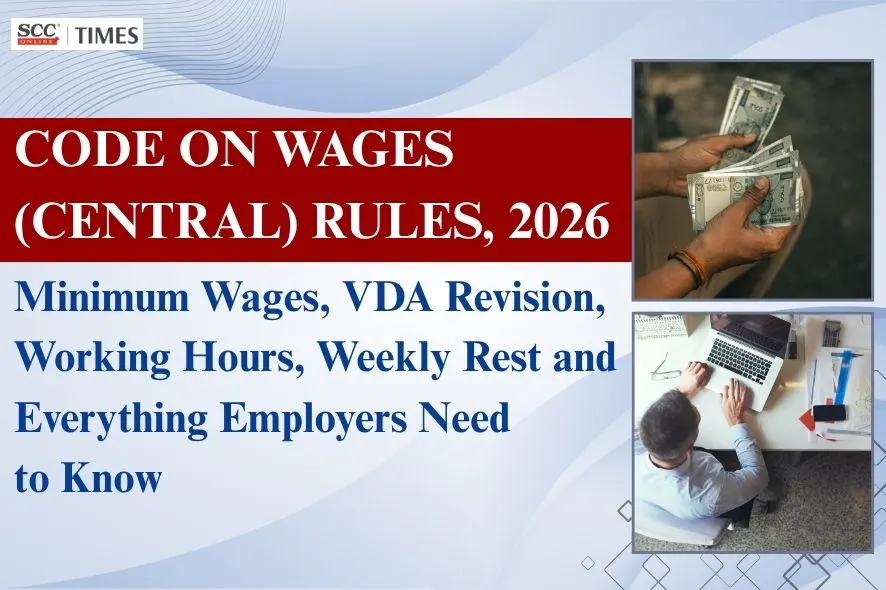
On 8 May 2026, the Ministry of Labour and Employment notified the Code on Wages (Central) Rules, 2026 to implement and operationalize the Code on Wages, 2019 by providing a clear, uniform, and practical framework for wage regulation across India. The provisions came into force on 8 May 2026.
All you need to know about Wages:
-
Calculation of minimum rate of wages:
-
Fixing Minimum Wages:
✓ Minimum wages are fixed on a daily basis, the criteria for which will be separately specified by the Central Government.
✓ These Rules will not apply to the Central Government employees.
-
Converting Daily Wages:
✓ If daily wages are fixed:
♦ Hourly wage= Daily wage ÷ 8
♦ Monthly wage= Daily wage * 26
✓ While calculating one-half and more than one-half will be rounded as the next figure and the factors less than one-half will be ignored.
-
In case the workweek is less than 6 days then the hourly wages will be used to calculate daily wages.
-
-
Variable Dearness Allowance:
-
VDA will be revised twice a year, before 1st April and 1st October.
-
For each revision, the Government will calculate, the cost of living allowance and the value of concessions on essential commodities, based on the Average Consumer Price Index for Industrial Workers published by the Labour Bureau.
-
This will ensure that minimum wages are adjusted according to changes in the cost of living.
-
-
Hours of work for normal working day:
-
A normal working day will be 8 hours for employees paid daily, with rest breaks as per the law.
-
For employees paid on a weekly or monthly basis, working hours are set so that total work does not exceed 48 hours per week.
-
-
Weekly day of rest:
-
Every employee will be getting one rest day each week, usually Sundays.
-
For shorter work weeks, rest days can include Saturday and Sunday.
-
The employer can choose another rest day but must inform employees in advance.
-
To qualify for a rest day, an employee must have worked continuously for the required number of days in that week.
-
Days like leave, holidays, layoff (with compensation), or reporting without work will be counted as working days.
-
An employee should not work on the rest day, unless given a replacement rest day before or after.
-
Employees must not work more than 10 days continuously without a break.
-
In case the employee works on a rest day, they should be paid overtime for that day and should also get a substitute rest day with normal pay.
-
Cases where wages are already calculated with rest days included, no separate payment for rest day is needed.
-
A “week” will mean 7 days starting from midnight Saturday night.
-
-
Night shift: If an employee works a night shift that goes past midnight:
-
The rest day will mean 24 continuous hours starting from when the shift ends.
-
The next day, for work calculation, is also counted as 24 hours from the shift’s end time.
-
Any work done after midnight is counted as part of the previous day, not the new day.
-
-
Fixing floor wages:
-
The Central Government sets the floor wage after consulting the Central Advisory Board and considering basic living needs like food, clothing, housing, and other factors.
-
It can also seek views from State Governments before finalizing it.
-
The floor wage is usually revised every 5 years, and it may also be adjusted regularly for changes in the cost of living.
-
-
Any employee will not be entitled to full day wages if they:
-
Have agreed to work part-time, or
-
Are not eligible for full wages under any other labour law.
-
-
Central Advisory Board:
-
The Board members will be nominated and constituted by the Central Government.
-
Functions of Chairperson:
✓ preside at the meetings of the Board;
✓ decide agenda of each meeting of the Board;
✓ where in the meeting of the Board, if any issue has to be decided by voting, conduct the voting and count or cause to be counted the secret voting in the meeting.
-
The term of office of the Chairperson and the members will be 3 years commencing from the date of appointment/ nomination.
-
If a member of the Board fails to attend 3 consecutive meetings without prior intimation to the Chairperson, he will cease to be a member.
-
Read more:
Industrial Relations (Central) Rules, 2026: How India’s New Industrial Relations Regime Is Changing
FAQs on the Labour Codes: Everything Employers and Employees Need to Know!
A Historic Leap in Labour Reform: India Implements Four Labour Codes from 21 Nov 2025
[Code on Wages (Central) Rules, 2026, dt. 8 May 2026]