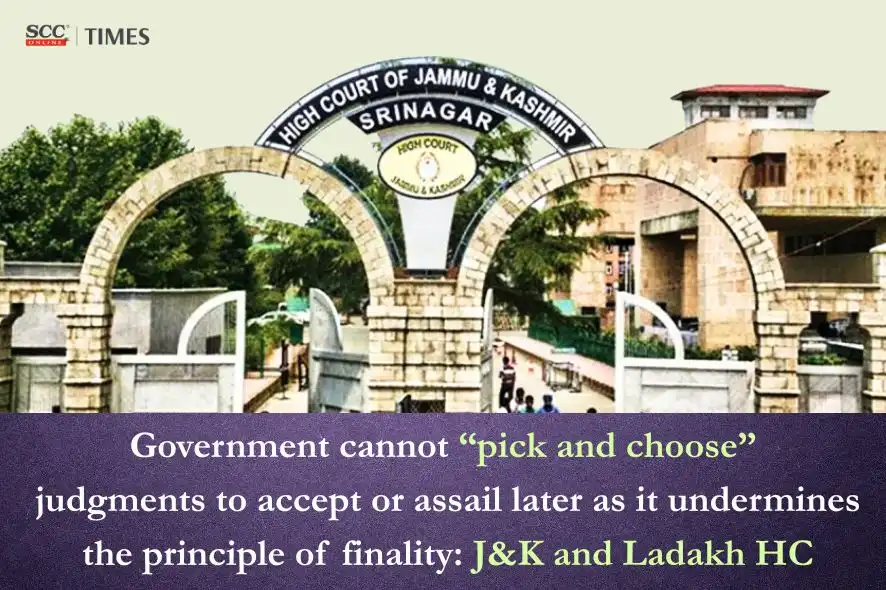
Jammu & Kashmir and Ladakh High Court: In a case dealing with whether land in respect of which proprietary rights were conferred under Government Order No. S-432 of 1966 (GO) could be alienated without obtaining prior permission of the Government, and consequently, whether issuance of Fard Intikhab for such alienation could be denied on that ground, the Division Bench of Arun Palli, CJ., and Rajnesh Oswal*, J., held that the Government cannot “pick and choose” judgments to accept or assail later as it undermines the principle of finality. The Court observed that the condition of obtaining prior permission for alienation, as stipulated in the GO, stood rendered otiose and could not be insisted upon, and therefore upheld the judgment of the writ court.
Also Read: SC reaffirms Judicial Discipline and respect for Precedents
Background
The dispute arose when Respondents 1 to 4, claiming ownership and possession of land measuring 9 kanals, applied online before Appellant 2 (Tehsildar), for issuance of Fard Intikhab for the purpose of sale. The application was rejected on the ground that it was in violation of GO. Aggrieved by this rejection, a writ petition was filed by the respondents which was allowed by the writ court, placing reliance on Mohd. Akbar Shah v. State (UT of J&K), 2016 SCC OnLine J&K 214 and Angrez Singh v. State (UT of J&K), 2023 SCC OnLine J&K 1372.
Being aggrieved, the appellants preferred an intra-court appeal contending that the GO categorically stipulates that the grantee shall utilise the land solely for agricultural purposes and shall not be entitled to alienate the same without prior permission of the Government. It was argued that since the respondents never applied to the Government for the grant of such permission, their application was rightly rejected by the Tehsildar. The Court specifically asked whether Mohd. Akbar Shah (supra) had been assailed by the Government, but the State replied that it was never challenged.
On the other hand, it was argued on behalf of the respondents that the present appeal was rendered infructuous with the passage of time, as the Fard Intikhab was already issued, and the subsequent sale deeds were duly executed and registered, leaving no surviving cause of action.
Analysis
The Court referred to Mohd. Akbar Shah (supra) wherein it was observed that:
“…In earlier times, agriculture activity was the backbone of economy of the State. The land, which was given for agriculture purposes to a State subject, was to ameliorate the sufferings of such person/his family. Now the times have changed. The agricultural activity is no more the main economic activity of the State. The condition of seeking previous permission of the Government for alienation of land, which was given for agriculture purposes, in terms of para 4 of the order of 1966, is rendered otiose and will not affect right of the owner of land to alienate the same provided other statutory requirements are fulfilled for such alienation.”
The Court noted that the writ court had relied on Mohd. Akbar Shah (supra) to hold that no prior permission of the Government for alienation of land under the guise of the aforesaid GO could be insisted upon.
The Court highlighted that once the initial judgment declaring the condition of prior permission as otiose had attained finality, it became a benchmark for all subsequent cases, and the Government cannot be permitted to resort to a policy of “pick and choose” which judgments it accepts and which it assails years later. The Court observed that such selective challenges undermine the principle of finality and violate the mandate of judicial discipline, which requires that settled positions remain undisturbed.
The Court opined that in the realm of jurisprudence, legal certainty is as indispensable as the administration of justice. Where a ruling by a Single Judge has held the field for a significant duration without being disturbed or reversed, it attains the character of a settled position of law and should not ordinarily be unsettled, as doing so would undermine judicial stability, unless the decision is demonstrably per incuriam or palpably erroneous.
The Court relied on Raj Narain Pandey v. Sant Prasad Tewari, (1973) 2 SCC 35, wherein the Supreme Court observed that:
“…In the matter of the interpretation of a local statute, the view taken by the High Court over a number of years should normally be adhered to and not disturbed. A different view would not only introduce an element of uncertainty and confusion, it would also have the effect of unsettling transactions which might have been entered into on the faith of those decisions. The doctrine of stare decisis can be aptly invoked in such a situation.”
The Court also referred to Kattite Valappil Pathumma v. Taluk Land Board, (1997) 4 SCC 114, wherein it was held that:
“…Interpretation of the law is not a mere mental exercise. Things which have been adjudged long ago should be allowed to rest in peace. A decision rendered long ago can be overruled only if this Court comes to the conclusion that it is manifestly wrong or unfair and not merely on the ground that another interpretation is possible and the court may arrive at a different conclusion.”
Decision
The Court observed that the appellants failed to demonstrate any legal infirmity in the judgment rendered in Mohd. Akbar Shah (supra) and found no reason to deviate from a view that had held the field for nearly a decade. Ultimately, the Court dismissed the appeal and upheld the writ court’s judgment.
[State (UT of J&K) v. Ravinder Kanta, 2026 SCC OnLine J&K 287, decided on 28-4-2026]
Advocates who appeared in this case:
For the Appellants: Monika Kohli, Sr. AAG.
For the Respondents: Jagpaul Singh, Advocate