Disclaimer: This has been reported after the availability of the order of the Court and not on media reports so as to give an accurate report to our readers.
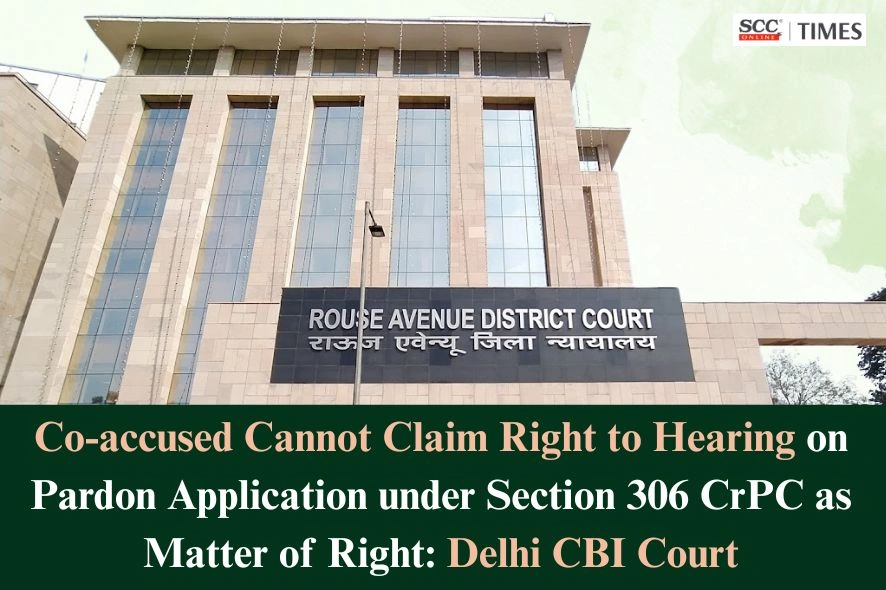
Rouse Avenue Court (Delhi): In an application arising out of proceedings under Section 306, Criminal Procedure Code, 1973 (CrPC), concerning plea of Accused 23 (A-23), seeking pardon and permission to turn approver in a corruption and conspiracy case, the Special Judge, Atul Krishna Agrawal, J., held that co-accused persons have no vested or statutory right of hearing on an application under Section 5(2), Prevention of Corruption Act, 1988 (PC Act) read with Section 306 CrPC. The Court also held that the proper safeguard available to co-accused persons is the right to cross-examine the approver during trial. Noting divergent views of various High Courts and distinguishing judgments rendered under the old CrPC, the Court dismissed the applications filed by co-accused persons seeking hearing rights, while clarifying that their assistance may be sought, if required, during consideration of the application on merits.
Issue
Whether co-accused have a right of being heard at the stage of consideration of an application for grant of pardon and made approver.
Also Read: “Not born as criminals”: Supreme Court permits woman convicted for fiancé’s murder to seek pardon
Background
The case arose out of a FIR registered for offences under Sections 120-B, 420, 467, 468 and 471 IPC read with Section 13(2), PC Act, against the accused and other co-accused. After the filing of the charge-sheet and supplementary charge-sheets, A-23 moved an application under Section 306 CrPC, seeking pardon and permission to turn approver, stating that he was acting voluntarily and was ready to make a full and true disclosure of all facts within his knowledge relating to the alleged conspiracy and involvement of other accused persons. His statement was thereafter recorded under Section 164 CrPC, before a Metropolitan Magistrate.
CBI initially expressed no objection to grant of pardon, subject to the condition that the applicant made full disclosure during trial and forfeited Rs 6 crores, to be deposited by him at the time of bail. However, when the applicant opposed forfeiture of the amount, CBI withdrew its no-objection and subsequently sought deferment of the application under Section 306 CrPC, on the ground that execution of Letters of Rogatories (LRs) were still pending. Later, in 2025, CBI once again changed its stand and informed the Court that it had no objection to the applicant being made an approver, provided he made full and true disclosure during trial.
At this stage, few of the co-accused objected to the consideration of the application without hearing them, contending that accused A-23 was himself the main conspirator and that grant of pardon in his favour would gravely prejudice their rights. It was also contended that A-23 was a habitual offender of economic offences and was accused in five other cases.
Analysis
At the outset it was noted by the Court that the relevant provision in this case ought to be Section 5(2), PC Act and not Section 306 or Section 307 CrPC. It was also noted that Section 5(2), PC Act nowhere provides for a right of hearing to co-accused persons on an application for pardon moved by one of the co-accused.
The Court opined that the co-accused counsel channelised their energy mostly on opposing grant of pardon to A-23 rather than explaining as to how co-accused persons have a right of hearing on an application under Section 306 CrPC moved by another co-accused. The Court observed that such arguments pertained to the merits of the pardon application and not to the limited issue presently under consideration, i.e. whether co-accused persons have a right of hearing or not and this question may arise for consideration of this court, at a later stage.
The Court observed that the principal judgment relied upon by the co-accused to claim a right of hearing was State (UT of Delhi) v. Sunil Batra, 1978 SCC OnLine Del 36, which itself was based on Prabhat Ranjan Sarkar v. State of Bihar, 1973 SCC OnLine Pat 44, decided under Section 337 of the
The Court observed that that a criminal court powers are restricted and bound by express provisions of CrPC and other statutes dealing with criminal offences.
“It is trite to observe that a criminal court does not have any such power as is not provided under the Statue since it cannot pass any order as it may deem fit, to further the ends of justice like a civil court can do.”
The Court noted that Section 306 CrPC does not provide right of hearing to co-accused persons on an application for pardon moved by another accused, though it also does not expressly prohibit such hearing. In view of the divergent judicial opinions on the issue, the Court held that whether co-accused persons should be heard would depend upon the facts and circumstances of each case and the discretion of the court guided by judicial pronouncements.
For the contention that A-23 has concealed certain vital facts, the Court observed that the only right available with the co-accused persons is the right of cross examination of such an approver, therefore, the objections were premature at the stage of consideration of the application under Section 306 CrPC.
The Court noted inconsistent stands taken by CBI, regarding the role of A-23, at one stage describing him as a principal accused, then conditionally supporting his plea for pardon, later withdrawing such consent, and eventually again expressing no objection to his becoming an approver. Observing that these shifting stands created reasonable doubt regarding CBI’s legal and factual position concerning A-23, the Court held that it may seek assistance from the co-accused while hearing the application.
“It is worthwhile to mention that CBI has been doing somersault and blowing hot and cold, with regard to the role of applicant/A-23.”
Dismissing the applications filed by A-11 and A-24 seeking hearing rights and the oral objections raised by other accused persons the Court clarified that the Court may seek assistance of the co-accused during hearing on the application under Section 306 CrPC, if it deems such assistance necessary for arriving at a just and fair decision.
[CBI v. Texcomash International, 2026 SCC OnLine Dis Crt (Del) 22, decided on 4-5-2026]
Advocates who appeared in this case:
For the petitioner: Tajvinder Singh, Ld. PP, CBI
For the respondent: Arjun Syal, Saurav Kumar, Ranjeet Singh
Buy Prevention of Corruption Act, 1988 HERE
Buy Code of Criminal Procedure, 1973 HERE