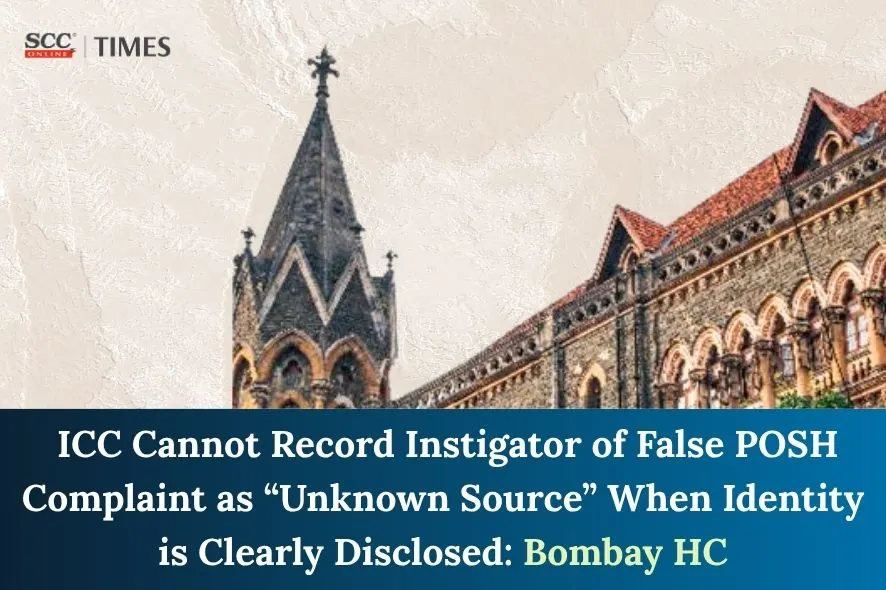
Bombay High Court at Goa: While considering an appeal filed by the petitioner under Section 18, Sexual Harassment of Women at Workplace (Prevention, Prohibition and Redressal) Act, 2013 (POSH Act) against the judgment and order passed by the Industrial Tribunal (Tribunal), which had dismissed the appeal as not maintainable, a Single Judge Bench of Dr Neela Gokhale, J., held that the petitioner was clearly a person aggrieved by the Internal Complaints Committee’s (ICC) recommendations and had a statutory right to appeal. The Court further held that the ICC erred in recording the instigation of the complaint as having come from an “unknown source” under the POSH Act, despite the retraction statement clearly naming the instigator. Accordingly, the Court quashed the Tribunal’s order and directed modification of the ICC’s conclusion to reflect that the instigation came from the identified individual. The Court accordingly disposed of the petition.
Also Read: POSH | Kerala HC sets aside ICC report due to non-service of complaint copy on delinquent
Background
The dispute arose when a complainant filed a sexual harassment complaint against the petitioner, which was later retracted. The complainant admitted that she was forced to sign a pre-prepared complaint under threats from another individual. The ICC, however, concluded that the complaint was instigated by an unknown source and closed the proceedings.
The petitioner approached the Tribunal under Section 18 POSH Act, contending that the ICC had failed to discharge its duties by not recording the instigator’s name, despite the retraction statement. The Tribunal dismissed the appeal, holding it was not maintainable and that the retraction statement could not be relied upon to prove malicious intent.
Issue
Whether the Tribunal was justified in dismissing the appeal as not maintainable and whether the ICC erred in recording instigation by an “unknown source” despite clear evidence naming the instigator.
Analysis
The Court emphasised that the proceedings before the ICC were initiated by the complaint of the complainant alleging sexual harassment at the workplace against the petitioner. However, within two months, the complainant issued a letter dated 6 January 2025 to the employer specifically and clearly naming another individual as the instigator of the said complaint. The Court noted that a copy of the retraction letter was also sent to the Director of the employer, the State Commissioner for Persons with Disabilities, and the Presiding Officer of the ICC.
The Court observed that the inquiry report also recorded the reply of the petitioner and the statement of the complainant that she was threatened with dire consequences by the instigator and forced to sign the complaint letter against the petitioner. The Court highlighted that ICC clearly failed in the discharge of its duties to specify that the complaint was being closed on account of false allegations made against the petitioner at the behest of the instigator, who compelled the complainant. The Court also noted that ICC also clearly erred in recording that the complainant was instigated by an “unknown source” to file the false complaint under threat of future harassment, despite it being a matter of record that the source of instigation was known to be the individual.
The Court emphasised that the error on the part of the ICC in recording the instigator to be an “unknown source” instead of naming the individual is a cause of action for the petitioner to prefer an appeal before the Tribunal under Section 18 POSH Act. The Court noted that the petitioner is clearly a person aggrieved by the recommendations made by the ICC and has a statutory right to prefer an appeal in the manner prescribed under the POSH Act. Further, it is not necessary for the petitioner or a person aggrieved by the ICC’s recommendation to show any direct injury caused to him.
The Court noted that the complainant addressed her retraction letter specifically naming the instigator of the false complaint under threat of future harassment, and in these circumstances, there was no occasion for the ICC to proceed further with a substantive inquiry. The Court observed that the fact remains that the complaint was malicious and false in nature and the petitioner cannot be deprived of his statutory right to appeal against the inquiry report of the ICC under the provisions stipulated in the POSH Act. The Court further remarked that merely because the statement of the complainant cannot be taken as the gospel truth in the absence of a substantive inquiry, it cannot be a ground per se to dismiss the petitioner’s appeal as not maintainable, and therefore to that extent, the findings of the Tribunal cannot be sustained.
The Court emphasised that having closed the complaint on the basis of the retraction letter sent by the complainant, the ICC cannot selectively omit to name the source of instigation when he is named in the same retraction letter. The conclusion of the ICC in its inquiry report, to the extent that it records that some “unknown source” influenced the complainant to file a false sexual harassment complaint against the petitioner, cannot be sustained since the Tribunal ought to have considered this grievance of the petitioner.
However, the Court observed that no purpose would be served by remanding the matter to the Tribunal for addressing the grievance of the petitioner limited to the omission of the instigator’s name in the conclusion of the inquiry report. The grievance of the petitioner, to the extent that the ICC failed to record the name of the instigator as having compelled the complainant to make the complaint under threat of future harassment despite relying on the retraction statement, is valid. Thus, ICC cannot selectively omit to name the instigator while relying on the retraction statement.
The Court noted that its jurisdiction under Article 227 of the Constitution is well equipped with the powers to correct the error made by the Tribunal and the ICC in the inquiry report. Further, the words “unknown source” appearing in the conclusion paragraph of the inquiry report dated 10 January 2025 of the ICC require modification to the extent that they shall be read as the complainant was instigated by the instigator to file a false sexual harassment case against the petitioner.
The Court emphasised that the statute does not provide for action or punishment for a false or malicious complaint or for giving false evidence before the ICC against a person who may have instigated a woman or a person making the complaint. The Court also highlighted that the action or punishment contemplated under Section 14 POSH Act is limited to the woman or person making the complaint. In the present case, it is the complainant who is the author of the complaint, and it may be that she was threatened with dire consequences of future harassment that propelled her to make the false complaint against the petitioner.
Decision
Consequently, the Court quashed and set aside the order of the Tribunal dated 26 November 2025. The Court thus allowed the petition, and the conclusion of the ICC was directed to be modified to record that the instigator compelled the complainant to file a false sexual harassment case against the petitioner.
Further, the Court clarified that while the petitioner is at liberty to initiate appropriate proceedings against the instigator before a competent forum, disciplinary action under Section 14 POSH Act cannot be directed against the instigator since the provision applies only to the person making the complaint and hence rejected.
Accordingly, the Court disposed of the petition.
[ABC v. XYZ, 2026 SCC OnLine Bom 2653, decided on 20-4-2026]
Advocates who appeared in this case:
For the Petitioner: Shivraj Gaonkar, Advocate
For the Respondents: Rishikesh Gawas, Additional Government Advocate, Annelise Fernandes, Advocate