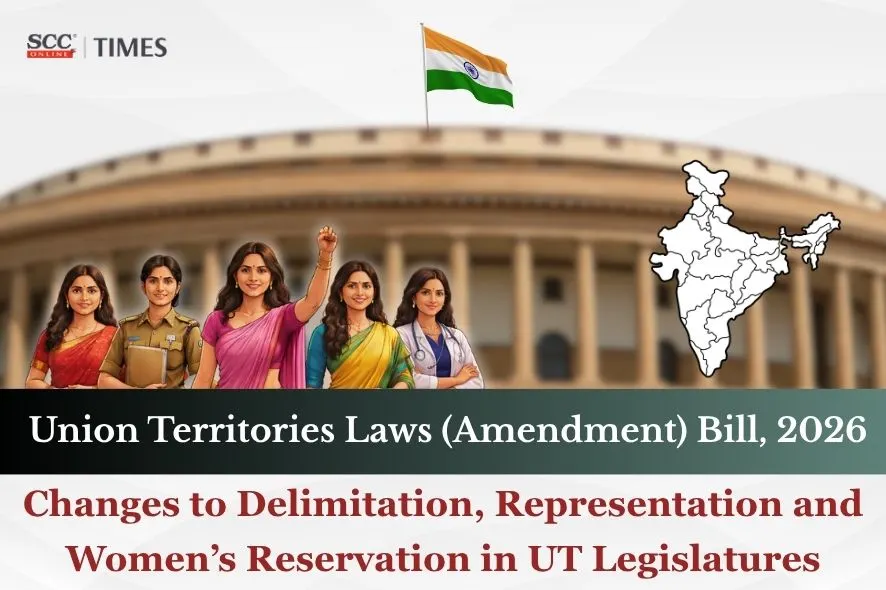
On 16 April 2026, the Union Territories Laws (Amendment) Bill, 2026 was introduced in Lok Sabha proposing to amend the Government of Union Territories Act, 1963, the Government of National Capital Territory of Delhi Act, 1991, and the Jammu and Kashmir Reorganization Act, 2019.
Key Features:
The Bill proposes amendments that are largely consequential and enabling in nature, arising from the revised constitutional framework, and are intended to ensure consistency and effective implementation of the provisions relating to delimitation, representation and reservation in the Legislative Assemblies of Union territories.
Proposed amendments in:
-
Government of Union Territories Act, 1963:
-
Earlier, the Act covered Legislative Assemblies and Councils of Ministers for certain Union Territories and for certain other matters.
Now, the Amendment Act is proposed to focus on the Legislative Assembly and Council of Ministers for the Union territory of Puducherry. -
The Amendment Bill also proposes to rename the Union Territory of “Pondicherry” as “Puducherry”.
-
Hence, this Bill suggests putting the focus from all the Union Territories to the Union Territory of Puducherry.
-
-
Government of National Capital Territory of Delhi Act, 1991:
-
The Bill proposes to revise the Legislative Assembly and its composition:
Earlier, the total number of seats in the Legislative Assembly was to be filled by persons chosen by direct election from territorial constituencies, which should be 70.
Now, according to the Bill, the Legislative Assembly of the Capital will consist of such a number of members, which will be chosen by direct election from territorial constituencies in the Capital, as determined by the Delimitation Commission. The total number of members should not be less than 70.
-
The Bill also proposes to amend the Section 38 of the Act which deals with Election Commission to delimit constituencies:
-
The title of Section 38 has been proposed to change to “Delimitation of constituencies”.
-
The Readjustment of Assembly and Parliamentary constituencies in the Capital has been proposed to be determined by the Delimitation Commission.
-
This delimitation should not affect representation in the Legislative Assembly until the dissolution of the then existing Assembly.
-
Until this readjustment takes effect, any election to the Legislative Assembly will be held on the basis of territorial constituencies existing before such readjustment.
-
-
The Bill has further proposed to remove Section 39 relating to Powers of Election Commission to maintain delimitation orders up-to-date.
-
-
Jammu and Kashmir Reorganization Act, 2019:
-
The Bill proposes to revise Section 10 relating to Representation in the House of the People:
Along with the provisions: “on and from the appointed day, there shall be allocated five seats to the successor Union Territory of Jammu and Kashmir and one seat to Union Territory of Ladakh, in the House of the People, and the First Schedule to the Representation of the People Act, 1950 shall be deemed to be amended accordingly.”
A new provision has been proposed which says that the number of seats allocated will be subject to readjustment on constituencies by the Delimitation Commission.
-
Section 14 relating to Legislative Assembly for the Union Territory of Jammu and Kashmir and its composition has been proposed to be amended:
-
The Legislative Assembly of the Union Territory of Jammu and Kashmir will have members elected directly from territorial constituencies. The total number of members will be decided by the Delimitation Commission and will be at least 114.
-
Despite what is mentioned above, 24 seats in the Legislative Assembly of Jammu and Kashmir will remain vacant until the areas currently under Pakistan’s occupation are no longer occupied and the people living there can elect their representatives. These 24 seats will not be counted when calculating the total strength of the Assembly.
-
-
The Bill further proposes to remove the following Sections:
-
Section 14-B- Reservation of seats for women to take effect;
-
Section 59- Definitions given under Part V;
-
Section 61- Power of Election Commission to maintain Delimitation Orders Up-to-date;
-
Section 62- Special provision as to readjustment of Parliamentary and Assembly Constituencies on the basis of 2011 census:
-
Section 63- Special provision as to readjustment of Assembly and Parliamentary Constituencies;
-
Section 64- Procedure as to delimitation.
-
-
Section 60 relating to Delimitation of constituencies has been proposed to revise:
-
The Delimitation Commission will be able to change the boundaries of Assembly and Parliamentary constituencies in the Union Territory of Jammu and Kashmir.
-
However,
✓ These changes will not affect the current Legislative Assembly until it is dissolved.
✓ Until the changes come into effect, elections can be held using the existing constituencies as they were before the readjustment.
-
-
Hence, this Bill does not involve any independent policy of departure but seeks to harmonize the existing statutory provisions with the amended constitutional scheme.
[Union Territories Laws (Amendment) Bill, 2026, dt. 17-4-2026]