








Disclaimer: This has been reported after the availability of the order of the Court and not on media reports so as to give an accurate report to our readers.
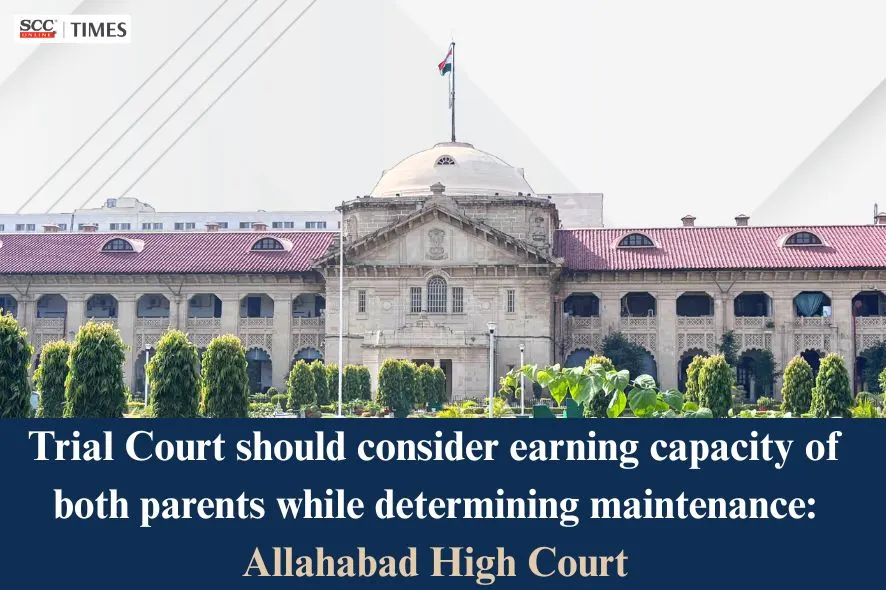
Allahabad High Court: While considering a revision challenging the order passed by the Principal Judge, Family Court whereby application filed by the father seeking impleadment of the mother of the minor child as a party in the proceedings was rejected, a Single Judge Bench of Madan Pal Singh, J., dismissed the revision, however, directed the trial court to consider the financial status and earning capacity of both parent while determining the quantum of maintenance.
The father stated that he was working as a Railway Clerk and earned Rs 41,000 per month whereas the mother was working as a police constable and earned about Rs 55,000 per month. He argued that since both parents were earning members, the liability to maintain the minor child was a joint and shared responsibility.
The Court stated principle of law that the person initiating a legal proceeding has the absolute prerogative to choose the parties against whom they seek relief and merely because the mother of the minor child is also earning does not absolve the father from his statutory obligation to maintain the child.
Further, the Court stated that the liability of the father to maintain his minor child is a legal and moral obligation, thus the father cannot seek to avoid or postpone such liability by insisting that the mother must first be impleaded as a party to the proceedings. The Court further stated that it cannot lose sight of the legal position that when both parents are earning members, the responsibility of maintaining the child is a shared and joint responsibility, as observed in Chandu Sridevi v. Chandu Sesha Rao.1
The Court held that although the application moved by the father was rightly rejected by the Family Court, it is equally necessary that while determining the quantum of maintenance, the trial court should take into consideration the financial status and earning capacity of both parents, including the fact that the mother of the minor child was also employed.
The Court opined that there was no illegality, perversity or jurisdictional error found in the impugned order warranting interference in exercise of revisional jurisdiction. However, the Court clarified that while deciding the main application under Section 144, Nagarik Suraksha Sanhita, 2023, the Family Court should take into consideration the income and financial capacity of both parents and determine the amount of maintenance in a just and reasonable manner keeping in view the principle of shared parental responsibility and the welfare of the minor child.
The Court dismissed the revision at hand and directed the trial court to proceed with the matter expeditiously.
[Arvind Kumar v. State of U.P., 2026 SCC OnLine All 1683, decided on 10-3-2026]
Advocates who appeared in this case:
For the Revisionist: Ravindra Kumar Mishra, Advocate
For the Opposite Party: Chandra Bhushan Singh, G.A.
1. Civil Appeal No. 1159 of 2023, arising out of SLP (C) No. 26395 of 2019.









0 replies