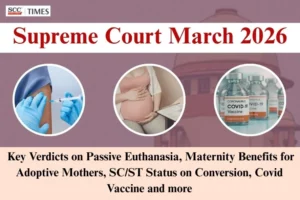

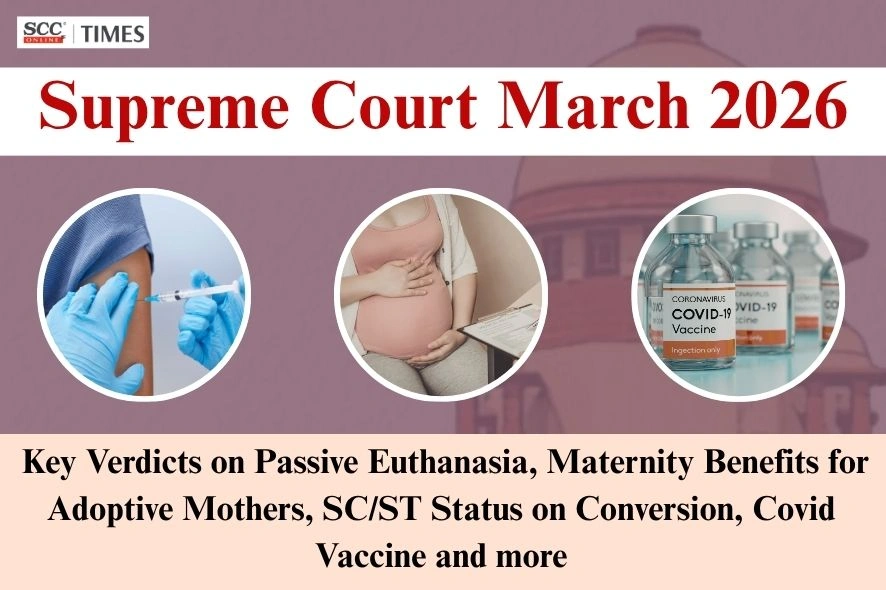
“March is Marching!”, this phrase defined Supreme Court in March 2026 with the Court delivering one landmark verdicts after the other. March was dominated by Supreme Court’s historic verdict allowing Passive Euthanasia for the first time in India; thereafter, the Court went on to uphold rights of Adoptive Mothers for Maternity Benefits and flagged systemic discrimination against women in Armed Forces regarding their consideration for Permanent Commission. Furthermore, the Court issued major clarification over SC/ST status upon conversion to Christianity and then directed the Union Government to draft a No-Fault Compensation Policy for Covid19 vaccine adverse effects.
This Supreme Court March 2026 Roundup highlights the month’s most important judgments, key legal developments, and institutional updates, along with features on judicial appointments, collegium recommendations, and the popular Know Thy Judge series.
Do not miss out on the latest Supreme Court Judgments published in SCC Weekly!
Top Stories that Marched!
In a Historic First, Supreme Court Permits Passive Euthanasia
In a landmark ruling on right to die with dignity, the Supreme Court in Harish Rana v. Union of India, 2026 SCC OnLine SC 358, for the first time, allowed the withdrawal of life-sustaining medical treatment for a patient in a Persistent Vegetative State for 13 years. The Court was dealing with the application filed by a young man who has been in vegetative state for 13 years, seeking assessment of suitability of continuing the his Clinically Assisted Nutrition and Hydration (CANH) in accordance with the principles laid down in Common Cause v. Union of India, (2018) 5 SCC 1 and modified in Common Cause v. Union of India, (2023) 14 SCC 131 (Common Cause Guidelines). The Division Bench of J.B. Pardiwala* and K.V. Viswanathan**, JJ., applying the Common Cause Guidelines in full measure, unanimously directed that the medical treatment, including CANH, being administered to the applicant be withdrawn and/or withheld. The Court further held that right to die with dignity is inseparable from the right to receive quality palliative and EOL care. The Court emphasised that it is imperative to ensure that the withdrawal process for the applicant is not marred by pain, agony, or suffering. “Our decision today does not neatly fit within logic and reason alone. It sits in a space between love, loss, medicine and mercy. This decision is not about choosing death, but is rather one of not artificially prolonging life”.
In his supplementing opinion, K.V. Viswanathan, J., also lauded the love and affection by which the parents and the siblings have nursed the applicant for 13 years in his vegetative state.
Also Read:
Passive Euthanasia in India: Key Takeaways from Supreme Court’s Landmark Verdict
In a significant verdict firmly affirming adoptive mothers’ entitlement to receive maternity benefits, the Division Bench of J.B. Pardiwala* and R. Mahadevan, JJ., in Hamsaanandini Nanduri v. Union of India, 2026 SCC OnLine SC 402, held that Section 60(4), Social Security Code, 2020 (2020 Code) insofar it puts 3 months age limit on the age of the adoptive child, for adoptive mothers to avail maternity benefit under the 2020 Code is violative of Articles 14, and 21 of the Constitution. While deliberating over the constitutional validity of Section 60(4) of the 2020 Code, the Court explained that distinction drawn by Section 60(4) does not have a rational nexus with the object of the 2020 Code. The object of maternity benefit is not associated with the process of childbirth but with the process of motherhood. The purpose of maternity protection does not vary with the manner in which the child is brought into the life of the beneficiary mother.
Acknowledging the importance of fathers in a child’s upbringing, the Court urged the government to come up with a provision recognizing paternity leave as a social security benefit.
Conversion to Christianity extinguishes SC/ST status and protection under SC/ST Act: Supreme Court
In Chinthada Anand v. State of A.P., 2026 SCC OnLine SC 466, which was appeal challenging the quashment of criminal proceedings under Scheduled Castes and Scheduled Tribes (Prevention of Atrocities) Act, 1989 (SC/ST Act) and Penal Code, 1860 (IPC), and thus, raising an important question as to whether a person born in a Scheduled Caste but professing Christianity could invoke the provisions of the SC/ST Act, the Division Bench of Prashant Kumar Mishra* and Manmohan, JJ., held that:
-
The appellant, having professed Christianity, could not claim the status of Scheduled Caste and therefore could not invoke the provisions of the SC/ST Act.
-
No person who professes a religion other than Hinduism, Sikhism or Buddhism shall be deemed to be a member of a Scheduled Caste.
-
The State Government Order and caste certificate could not override the Constitution (Scheduled Castes) Order, 1950.
-
The High Court had rightly exercised its power under Section 482 CrPC as the allegations under both the SC/ST Act and IPC did not disclose a sustainable case.
While considering the petition highlighting issues related to alleged deaths caused after receiving COVID-19 vaccine and whether lack of uniform policy on regarding compensation for covid vaccine deaths violates the Constitution, the Division Bench of Vikram Nath* and Sandeep Mehta, JJ., noted that there is no uniform policy mechanism for redressal of grievance of individuals who suffered adverse effects following vaccination. “This gap cannot be lightly overlooked, particularly when vaccination programmes are undertaken as public health measures under the aegis and authority of the State itself”. Hence, the Court directed the Union of India, to frame a no-fault compensation policy for serious adverse events following COVID-19 vaccination, through the Ministry of Health and Family Welfare (MoHFW).
Creamy layer status of OBC candidates can’t be decided on parental salary alone: Supreme Court
In Union of India v. Rohith Nathan, 2026 SCC OnLine SC 352, which was a batch of civil appeals arising out of separate orders passed by the Madras High Court, Delhi High Court, and Kerala High Court involving identical question of law regarding determination of creamy layer status for Other Backward Class (OBC) candidates in the Civil Services Examination based on income of parents employed in Public Sector Undertakings (PSUs), banks, or private organisations when such income was excluded from determination in the case of Government servants, the Division Bench of Pamidighantam Sri Narasimha and R. Mahadevan,* J., upheld the impugned judgments and affirmed the directions issued by the High Courts for reconsideration of the candidates’ claims under the Office Memorandum dated 08 September 1993.
The Court held that:
-
The clarificatory letter dated 14 October 2004 cannot override or alter the substantive framework of the Office Memorandum dated 08 September 1993
-
Creamy layer status among OBCs cannot be determined solely based on parental income.
-
If PSU/private employees are treated differently from Government employees holding equivalent posts, it would amount to hostile discrimination, thereby violating Articles 14 and 16 of the Constitution.
While deliberating over Vishvjeet v. State of U.P., 2026 SCC OnLine SC 431, wherein several employees (petitioners) working at the Gotona Bara Toll Plaza on the Lucknow-Sultanpur Highway, Barabanki, were arrested for allegedly assaulting an advocate (complainant) over refusal to pay toll; the Division Bench of Vikram Nath and Sandeep Mehta, JJ., grimly noted that members of the bar at Barabanki had indulged into hooliganism against the advocate who had filed the bail application on behalf of the petitioners. Condemning the lawyers’ actions in strict words, the Court deemed it fit release the petitioners on bail upon furnishing personal bonds to the satisfaction of the concerned Magistrate. The Court further directed transfer of the case to Tis Hazari Courts, New Delhi, for all further actions, to ensure that the petitioners get proper legal representation and a fair trial.
Did Kahaani 2 Really Copy ‘Sabak’? The Supreme Court’s Verdict, Simplified
While deliberating over this appeal filed by Director and Screenwriter Sujoy Ghosh (appellant) revolving around his alleged wrongful copying and use of complainant’s script titled “Sabak” to produce the film “Kahaani 2” which led to institution of proceedings against him; the Division Bench of P.S. Narasimha and Alok Aradhe*, JJ., in Sujoy Ghosh v. State of Jharkhand, 2026 SCC OnLine SC 454 allowed the appeal finding that the appellant’s work had preceded the complainant’s script hence the question of copyright infringement does not arise as the complainant’s script was not even in existence when the appellant registered his screenplay for “Kahaani 2”.
In National Highways Authority of India v. Tarsem Singh, 2026 SCC OnLine SC 481, which was a review petition filed by the National Highways Authority of India (NHAI) seeking recall of Union of India v. Tarsem Singh, 2025 SCC OnLine SC 235 (Tarsem Singh-II), whereby the Supreme Court had refused to clarify whether the judgment in Union of India v. Tarsem Singh, (2019) 9 SCC 304 (Tarsem Singh-I) would operate prospectively, the Division Bench of Surya Kant,* CJ., and Ujjal Bhuyan, J., finally settled the controversy and issued the following directions to balance the competing considerations of entitlement and finality:
-
Landowners whose claims relating to compensation were pending on or after 28 March 2008 were entitled to seek addition of solatium, interest, and interest on solatium.
-
Where such claims were raised after 28 March 2008 with delay, the landowners would not receive interest for the delayed period. Interest would accrue only from the date the claim was actually raised.
-
If compensation proceedings had attained finality before 28 March 2008, the matter cannot be reopened to claim solatium or interest.
-
Matters pending before High Courts were remanded for recalculation of compensation in accordance with these directions.
-
Amounts already paid to landowners should not be recovered.
Notable Supreme Court Judgments in March
Women in Armed Forces
In Pooja Pal v. Union of India, 2026 SCC OnLine SC 468, while considering these appeals preferred by a group of Service Commission Officers (SSCOs) of the Indian Army comprising primarily of several Short Service Commission Women Officers (SSCWOs) seeking grant of Permanent Commission (PC), the 3-Judge Bench of Surya Kant, CJI*, Ujjal Bhuyan and N. Kotiswar Singh, JJ., grimly flagged the unfair manner in which women officers have been treated due to certain systematic traits in the functioning of the Armed Forces. The Court pointed out that the inclusion of SSCWOs in the zone of consideration for PC is not a matter of discretion, but of constitutional obligation and any expectation to the contrary is inherently illegitimate. The Court found that the denial of PC to SSCWOs was not merely the outcome of individual assessments, but the consequence of a systemic framework rooted in assumptions that entrenched disadvantages in career progression.
Administrative Law
In Rajesh Goyal v. Laxmi Constructions, 2026 SCC OnLine SC 475, where the core controversy concerned with the Rent Authority undermining finality of judicial order by permitting to reopen the proceedings that had already attained finality before the Supreme Court and allowing the restoration application by order dated 15 May 2025, the Division Bench of Sanjay Karol* and N. Kotiswar Singh, JJ., declared the Rent Authority’s restoration order as void for lack of jurisdiction. The Court held that “respect for the authority of orders passed post adjudication by a judicial activity, be it this Court or the High Court is a basic principle of judicial comity, more so, upon attaining finality”. Regarding the show-cause notice issued to the Additional District Magistrate, the Court accepted the unconditional apology tendered and clarified that the proceedings would not affect the officer’s career progression.
Auctions/ Public Auctions/ Tenders and Bidding Process
In an appeal arising from Gujarat High Court’s judgment directing re-evaluation of technical bids by the consultant which was originally awarded to the appellant based on higher technical score, a Division Bench of P.S. Narasimha and Alok Aradhe, JJ., in Steag Energy Services (India) (P) Ltd. v. GSPC Pipavav Power Co. Ltd., 2026 SCC OnLine SC 478 upheld the Letter of Award dated 9 June 2025 and the contract dated 1 July 2025 in favour of the appellant and set aside the High Court’s judgment, holding that the High Court had exceeded the principle of judicial restraint in contractual matters. The Court held that courts cannot interfere in contractual matters merely because another view is possible or because a competing bidder has a marginally higher score, unless the decision-making process is vitiated by mala fides, arbitrariness, or perversity, the choice of the tendering authority and the owner must prevail.
In a civil appeal arising from the Madras High Court’s judgment dated 06 February 2020, it upheld the validity of the auction sale conducted in recovery proceedings but remitted the matter to the Debts Recovery Tribunal (DRT) for reconsideration of the valuation of the mortgaged properties, a Division Bench of J.B. Pardiwala and R. Mahadevan,* JJ., in OmSakthi Sekar v. V. Sukumar, 2026 SCC OnLine SC 368 affirmed the impugned order of the High Court and held that finality of confirmed auction sale does not bar judicial examination of adequacy of valuation or fixation of reserve price, particularly, where it was necessary to ensure that secured asset had fetched best possible price.
Criminal Law
Section 319 CrPC | Court not to conduct mini-trial; strong and cogent evidence sufficient to summon additional accused: Supreme Court
In the appeals challenging the trial court and the Allahabad High Court’s judgments refusing to allow an application filed under Section 319, Criminal Procedure Code, 1973 (CrPC) seeking summoning of additional accused persons on the basis of evidence recorded during murder trial, a Division Bench of Sanjay Karol* and Augustine George Masih, JJ., in Mohd. Kaleem v. State of U.P., 2026 SCC OnLine SC 397, set aside the impugned judgments and allowed the summoning of additional accused persons. The Court held that at the stage of exercising power under Section 319 CrPC, the Court should not conduct a detailed evaluation of credibility or insist on proof sufficient for conviction, and minor inconsistencies or absence of documentary corroboration cannot by themselves justify refusal to summon additional accused.
Crimes against Women
In an appeal challenging the setting aside of conviction and sentence under Section 376 IPC and other provisions of the SC/ST Act, on ground of inconsistencies in the prosecution’s story, the Division Bench of Sanjay Karol* and Nongmeikapam Kotiswar Singh, JJ., in State of H.P. v. Hukum Chand, 2026 SCC OnLine SC 462 stated that a truthful witness may make honest mistakes or omit immaterial details, and such normal variation should not result in wholesale rejection of evidence. However, when omissions or contradictions relate to material facts that form the foundation of the prosecution version, they assume significance and may create reasonable doubt. The Court reiterated that minor or trivial inconsistencies or discrepancies in the testimony of witnesses do not by themselves make the evidence unreliable.
Consumer Protection
In an appeal challenging order of the National Consumer Disputes Redressal Commission (NCDRC), dated 13 March 2023, whereby the consumer complaint of the appellant was dismissed on the ground that the complainant-appellant was not a consumer as per Section 2(1)(d) of the Consumer Protection Act, 1986 (Consumer Protection Act), a Division Bench of Pamidighantam Sri Narasimha and Manoj Misra,* JJ., in Sant Rohidas Leather Industries & Charmakar Development Corpn. Ltd. v. Vijaya Bank, 2026 SCC OnLine SC 445 upheld the impugned order, holding that although the reasoning adopted by the NCDRC regarding the commercial purpose of the deposit was not entirely correct, the dismissal of the complaint was nevertheless justified because the dispute involved serious allegations of fraud and disputed facts unsuitable for summary consumer proceedings.
Divorce- Irretrievable Breakdown of Marriage
While deliberating over Kishorekumar Mohan Kale v. Kashmira Kale, 2026 SCC OnLine SC 448, wherein the Division Bench of Vikram Nath and Sandeep Mehta, JJ., had to decide whether decree of divorce passed by the Oakland Circuit Court, USA is conclusive and binding on the parties. Upon perusal of the case’s trajectory and facts, the Court held such decree to be inconclusive and unsustainable as valid decree of divorce between the parties herein. The Court reasoned that the Circuit Court had granted the divorce decree on the ground of irretrievable breakdown of marriage, which is not a recognised ground under Hindu Marriage Act, 1955 (HMA); furthermore, appellant (husband) had not voluntarily submitted to the jurisdiction of a foreign forum. However, since the parties have been separated for 18 years, with no scope of reconciliation, the Court deemed it fit to dissolve their marriage on ground of irretrievable breakdown of marriage in exercise of powers under Article 142 of the Constitution.
Environment Law
While deciding whether a land proposed for development constituted forest land or deemed forest, thereby attracting the provisions of Section 2, Forest (Conservation) Act, 1980 (Forest Act), which mandates prior approval of the Central Government before use of forest land for non-forest purposes, the Division Bench of Dipankar Datta and Augustine George Masih,* JJ., in Naveen Solanki v. Rail Land Development Authority, 2026 SCC OnLine SC 452, upheld the impugned judgment and held that land which was not recorded as forest and was earmarked for development under a statutory Master Plan cannot subsequently be treated as deemed forest merely due to later growth of trees.
JAMP-Jubilant pharmaceutical product dossiers dispute
Supreme Court upholds interim relief in JAMP-Jubilant pharmaceutical product dossiers dispute
In a petition titled,Jamp India Pharmaceuticals (P) Ltd. v. Jubilant Generics Ltd., 2026 SCC OnLine SC 449 challenging the Allahabad High Court’s judgment upholding interim protection in favour of Jubilant Generics Ltd. (Jubilant) in a dispute over alleged misuse of pharmaceutical product dossiers, the Division Bench comprising J.B. Pardiwala and K.V. Viswanathan, JJ., stated that the High Court had not committed any error, legal or otherwise. The Court further clarified that the trial court must decide the suit independently, without being influenced by the High Court’s observations.
Practice and Procedure
In Sandeep Yadav v. Satish, 2026 SCC OnLine SC 474, which was long-pending criminal trial rooted in a violent incident arising out of a land dispute where a procedural irregularity triggered a significant legal controversy as to whether absence of signature on charge vitiated the entire trial and warranted a de novo trial, or whether it was merely a curable irregularity that did not prejudice the accused, the Division Bench of Ahsanuddin Amanullah and R. Mahadevan,* JJ., set aside the High Court’s order directing a fresh trial and restored the trial court’s order, holding that where the accused had full knowledge of the charges and actively participated in the trial, defects such as absence of signature on the charge constituted a curable procedural irregularity and did not vitiate the trial unless failure of justice was demonstrated. The Court further held that a de novo trial could not be ordered merely on technical grounds, particularly when the trial had substantially progressed and no real miscarriage of justice was shown.
Motor Vehicle Accidents
SC: State Liable for Accidents Involving Requisitioned Vehicles, Not Insurer
In District Magistrate & District Election Officer & Collector v. National Insurance Co. Ltd., 2026 SCC OnLine SC 455, concerning liability arising out of a motor accident involving a bus requisitioned by the State for Gram Panchayat elections, a Division Bench of Sanjay Karol* and Nongmeikapam Kotiswar Singh, JJ., upheld the view that liability to pay compensation would lie with the State authority and not the insurer. The Court held that liability attaches to the authority exercising effective control rather than the registered owner or its insurer.
The Court further distinguished cases involving contractual use of vehicles, emphasizing that requisition is a statutory, non-consensual act. Accordingly, it held that upon requisition, complete control and possession of the vehicle vest in the State, and therefore, the State, having assumed control for public purposes, must bear liability for the accident, and dismissed the appeal.
Multi-State Cooperative Society
Registrar Cane Coop. Societies v. Gurdeep Singh Narval, 2026 SCC OnLine SC 346 raised an important question concerning the legal status of Sugarcane Growers Cooperative Societies at Bajpur and Gadarpur following the bifurcation of the State of Uttar Pradesh and creation of the State of Uttarakhand in terms of between the Uttar Pradesh Reorganisation Act, 2000 (UP Reorganisation Act) and the Multi-State Cooperative Societies Act, 2002 (Multi-State Cooperative Societies Act). The Division Bench of Pamidighantam Sri Narasimha and Alok Aradhe,* JJ., held that Sugarcane Growers Cooperative Societies at Bajpur and Gadarpur are not Multi-State Cooperative Societies under the Multi-State Cooperative Societies Act. The Court quashed the High Court judgment dated 14 March 2007 declaring Sugarcane Growers Cooperative Societies at Bajpur and Gadarpur multi-state societies.
Labour and Service Laws
Examining the legality of a dismissal order passed by invoking Article 311(2)(b) of the Constitution without holding a departmental inquiry, the Division Bench of J.K. Maheshwari* & Atul. S. Chandurkar, JJ., in Manohar Lal v. State, 2026 SCC OnLine SC 363 quashed the order of the Delhi High Court which had affirmed the order of dismissal of service against the appellant, issued by exercising power under Article 311 of Constitution without conducting the departmental inquiry under Article 311(2). The Court held that the reasoning assigned by the disciplinary authority, while issuing an order of dismissal from service under clause (b) of Second Proviso to Article 311(2), for dispensing with an inquiry ought to be relevant and shall be recorded in writing.
In a civil appeal assailing the quashing of Karnataka State Administrative Tribunal’s order; and direction to consider the case of the respondent for appointment to the post in question, the Division Bench of Vikram Nath* and Sandeep Mehta, JJ., in State of Karnataka v. Santhosh Kumar C, 2026 SCC OnLine SC 458, held that the appointment of another candidate against the unfilled post after release of the select list cannot be allowed merely on non-joining of a selected candidate, in absence of any enabling provision.
In a batch of civil appeals filed by appellants, belonging to reserved categories, challenging the merit list of the Teachers Aptitude and Intelligence Test (TAIT-2022), the controversy before the Court was whether candidates belonging to reserved categories, who had availed relaxation in a qualifying examination for eligibility, could migrate to the open category on the basis of merit secured in the main selection examination. The Division Bench of Pamidighantam Sri Narasimha and Alok Aradhe,* JJ., in Chaya v. State of Maharashtra, 2026 SCC OnLine SC 457 held that reserved category candidates who secured higher marks than the last selected candidate in the open category were entitled to be considered for the open category, even if they had availed relaxation in the Teacher Eligibility Test (TET) qualifying marks. Such relaxation affects only the eligibility criteria and not the merit, and in the absence of an express prohibition in the recruitment rules, migration to the open category is permissible.
In a batch of appeals arising from a common judgment dated 22 February 2023 passed by the Jammu & Kashmir and Ladakh High Court whereby the Division Bench dismissed a batch of intra-court appeals and connected writ petitions challenging the rejection of the appellants’ claim for regularisation of their services and validity of exclusion contained in Section 3(b), Jammu and Kashmir Civil Services (Special Provisions) Act, 2010, a Division Bench of Vikram Nath* and Sandeep Mehta, JJ., in Abhishek Sharma v. State (UT of J&K), 2026 SCC OnLine SC 342 set aside the impugned judgments and declared that Section 3(b) of the Act, insofar as it excludes employees appointed on an “academic arrangement basis” from consideration for regularisation despite fulfilment of conditions under Section 5 of the Act, was unconstitutional and violative of Article 14 of the Constitution.
Policy Matters
In a Public Interest Litigation (PIL) filed by a registered charitable and religious organisation seeking directions to the Union of India and the States to frame uniform guidelines for declaration of public or gazetted holidays in India and also sought specific direction to declare the birth anniversary (Prakash Parv) of Guru Gobind Singh Ji, the 10th Sikh Guru, as a nationwide gazetted holiday, the Bench of Vikram Nath and Sandeep Mehta,* JJ., in All India Shiromani Singh Sabha v. Union of India, 2026 SCC OnLine SC 487, declined to issue directions holding that relief sought was not justiciable under Article 32 as declaration of nationwide gazetted holiday or framing of uniform policy for public holidays lies within executive policy domain.
SEBI
In the appeals filed under Section 15-Z, Securities and Exchange Board of India Act, 1992 (SEBI Act) challenging the order passed by the Securities Appellate Tribunal (SAT) whereby SAT set aside the penalties imposed by the Adjudicating Officer for violation of the SEBI (Prohibition of Fraudulent and Unfair Trade Practices Relating to Securities Market) Regulations, 2003 (PFUTP Regulations), and the Securities Contracts (Regulation) Act, 1956 (SCRA), a Division Bench of J.B. Pardiwala and K. V. Viswanathan,* JJ., in SEBI v. Terrascope Ventures Ltd., 2026 SCC OnLine SC 403 set aside the impugned order and restored the order of the Adjudicating Officer dated 29 April 2020. The Court held that the diversion of preferential allotment funds contrary to disclosed objects constitutes violation of PFUTP Regulations, the diversion amounted to fraudulent and unfair trade practice, and the subsequent ratification could not validate the illegality.
Reservation in Medical Colleges
Vivekkumar v. State of Maharashtra, 2026 SCC OnLine SC 359 raised an important issue concerning the consequences of admission obtained based on caste or tribe certificates that are subsequently declared invalid by the competent Scrutiny Committee. Invoking power under Article 142 of the Constitution, a Division Bench of Dipankar Datta and Rajesh Bindal, JJ., directed the issuance of degrees to appellants who had secured admission to medical courses on reserved seats based on tribe certificate. However, the Court acknowledged the injustice caused to genuine candidates who might have secured admission and therefore, held that the appellants could not be allowed to go “scot-free” and must bear some consequence for the irregular admission. It directed each appellant to deposit ₹10,00,000 with the Vice-Chancellor of the Maharashtra University of Health Sciences, Nashik (the University) and the same to be released to the deprived candidates.
Supreme Court Procedural Shifts
The Supreme Court of India, by Circular F.No. 3/Judl./2026 dated 18 March 2026, issued fresh directions governing the procedure for circulation of letters seeking adjournment of cases. The circular had been issued in supersession of earlier circulars dated 29 November 2025 and 2 December 2025.
Technology Laws
AI-made fake precedents surface in trial court order; Supreme Court issues notice
In a matter raising an important issue concerning the integrity of the judicial decision-making process in the era of Artificial Intelligence (AI), a Division Bench of Pamidighantam Sri Narasimha and Alok Aradhe, JJ., in Gummadi Usha Rani v. Sure Mallikarjuna Rao, 2026 SCC OnLine SC 341 took cognizance of the matter and issued notice to the Attorney General for India, the Solicitor General of India, and the Bar Council of India in order to examine the systemic implications of reliance on AI-generated non-existing, fake or synthetic alleged precedents.
Supreme Court Case Disposal and Pendency Status1
Pending Cases
| Case Type | Numbers |
|---|---|
| Civil | 73404 |
| Criminal | 19891 |
| Total | 93295 pending cases |
Coram Wise Case Pendency
| Coram | Pendency (incl. Civil & Criminal)2 |
|---|---|
| 3-Judges Bench | 1221 cases |
| 5-Judges Bench | 175 cases |
| 7-Judges Bench | 34 cases |
| 9-Judges Bench | 46 cases |
Disposal Status
| Civil Cases | Criminal Cases | Total | |
|---|---|---|---|
| Cases disposed of in Last Month | 2895 | 1506 | 4401 cases |
| Cases disposed of in Current Year | 12378 | 5873 | 18251 cases |
Appointments, Recommendations, Transfers, Designations in March
Supreme Court Collegium recommends appointment of Permanent Judges for Madras HC and Chhattisgarh HC
Supreme Court designates 7 former High Court Judges as Senior Advocates
President appoints Justice Sushrut Arvind Dharmadhikari as Chief Justice of Madras High Court
President appoints 7 Permanent Judges for Kerala High Court
SCC Weekly
2026 SCC Vol. 2 Part 1: Key Supreme Court Cases on Constitution, Disabilities Act, & Surrogacy
2026 SCC Vol. 2 Part 2: Key Supreme Court Cases on Environment Law, Constitution, BNS & IBC
2026 SCC Vol. 2 Part 4: Key Supreme Court Cases on Arbitration and Criminal Law
Know Thy Judge
Supreme Court of India: Justice N. Kotiswar Singh
Supreme Court of India: Justice Augustine George Masih
1. https://scdg.sci.gov.in/scnjdg/
2. Numbers inclusive of connected matters as well.