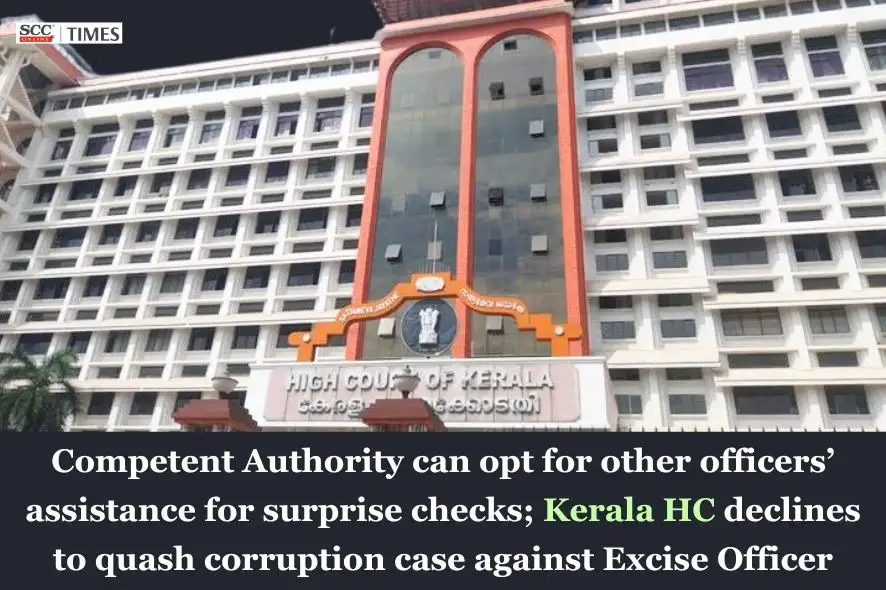
Kerala High Court: In a petition seeking quashment of FIR and further proceedings arising out of a surprise check conducted based on a complaint alleging demand of bribe in the form of Indian-made foreign liquor (IMFL) bottles for issuing transport permits, a Single Judge Bench of A. Badharudeen, J., dismissed the petition, holding that no case for quashing the FIR was made out. The Court observed that the other officers can be opted by the competent authority for surprise checks as assistance of a higher authority of the department concerned is not mandatory.
Background
On 18 December 2024, a petition was submitted alleging that Excise personnels posted at a KSBC warehouse were demanding bribe in the form of IMFL bottles for issuing transport permits for transporting load of IMFL bottles on trucks out of KSBC warehouse to retail outlets and bars. Acting on the petition, a surprise check was ordered by the Director, Vigilance and Anti-Corruption Bureau (VACB) which was jointly conducted by the Inspector of Police—III, VACB and the Assistant Regional Manager, Supplyco, Ernakulam. During the check, two bottles of IMFL were recovered from the bag in the office of one officer and two more bottles were recovered from the bottom portion of the office table used by another officer. Based on the surprise check report, an FIR was registered under Section 7, Prevention of Corruption (Amendment) Act, 2018 (PC Amendment Act) on 17 February 2025.
Accused 1 (petitioner) contented that the allegations were baseless and as per records, 36 bottles of Brandy were transported from Thripunithura to Palluruthy on 18 December 2024 and the entire quantity was unloaded and entered in the stock register at Palluruthy. Therefore, the recovery of two bottles from his office during the surprise check was asserted to be an outright impossibility. It was also contended that six reports had been filed earlier against the complainant for keeping old stocks without selling, causing loss to Government, and thus, due to animosity, the case was foisted. Further, it was urged that the surprise check violated guidelines issued as per Government Order dated 12 May 1992 (Government Order), as no assistance from the Excise Department was taken, rendering the check non-est. It was argued that to bring home offences under Sections 7 and 7-A, PC Amendment Act, the investigating officer should have arranged a trap and proceed further to prove the allegations.
On the other hand, the Special Public Prosecutor submitted that for the surprise check report, the assistance of the Regional Manager, Supplyco was taken, who was an officer acquainted with liquor sale and procedures, and hence there was no violations of the said guidelines. It was stated that during the check, two bottles of Brandy were recovered from the office of one accused and that a staff member at BEVCO, Fort Kochi Branch, informed that on getting stock of 36 bottles, an Excise official demanded two bottles citing a “practice of giving liquors to the officers”. It was further stated that two bottles were also recovered from another officer, and that the bottles were transported from Thripunithura to Palluruthy, thereby establishing a prima facie case.
Analysis and Decision
The Court noted that a staff member at the BEVCO outlet gave a statement that two bottles of Brandy which were recovered from the petitioner, including two other items, were handed over to him by the staff member. Regarding the demand and acceptance of brandy bottles, the Court observed that the same was an illegal gratification or an undue pecuniary advantage. The Court highlighted that though the FIR stated that Brandy bottles were demanded while transporting, but the prosecution records would show demand and acceptance after reloading at Palluruthy.
Regarding the question of violation of the Government Order during the surprise check, the Court observed that although the petitioner had filed six reports accusing the de facto complainant of failing to sell old stock and thereby causing loss to the Government, this claim was unsustainable. Since IMFL carried no expiry date, the Court questioned that how any loss could arise from the inability to sell older stock. The Court opined that unopened IMFL like whiskey, rum and vodka generally did not have a formal expiry date and could last for many years if stored properly. However, once opened, the quality, flavour, and alcohol content might begin to degrade after 1 or 2 years. Therefore, the report sent by the petitioner lacked significance.
The Court noted that Clause 16 of the Government Order uses the term “may” and not “shall”, and therefore assistance of a higher authority of the department concerned is not mandatory, rather the competent authority can opt other officers for surprise checks. The Court observed that there were no procedural irregularities vitiating the proceedings, and even otherwise, mere irrelevant procedural irregularities would not vitiate the proceedings unless they had an absolute deterrent effect to destroy the prosecution case in toto. Consequently, the alleged procedural irregularity was not a ground to quash the FIR without allowing the investigation to reach its logical conclusion.
The Court further observed that the earlier reports filed by the petitioner against the de facto complainant could not be reckoned as grounds to treat the complaint in the instant case as false, particularly when there was red-handed recovery of the transported item from the accused persons.
Accordingly, the Court, while dismissing the petition, refused to quash the FIR and allowed the investigation of the crime in accordance with law.
[Unaize Ahammed v. State of Kerala, 2026 SCC OnLine Ker 2637, decided on 20-2-2026]
Advocates who appeared in this case:
For the Petitioner: V. Sethunath, Thomas Abraham (K/1051/2010), Sreeganesh U., Atheesha M.V., Advocates.
For the Respondents: Rajesh, Special Public Prosecutor and Rekha S., Senior Public Prosecutor