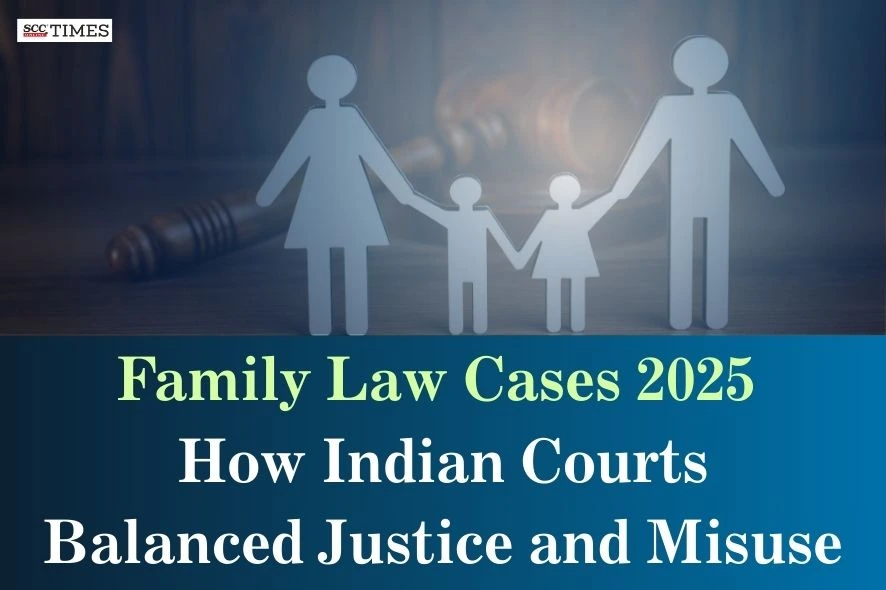
The landscape of matrimonial and family disputes in India saw significant judicial developments in 2025, making it a landmark year for Family Law Cases 2025. Courts across the country, including the Supreme Court and various High Courts, delivered key judgments on issues ranging from spousal rights, alimony, and divorce, to inheritance, adoption, and the misuse of Section 498-A IPC. These rulings not only clarified legal principles but also highlighted the balance between protecting individual rights and preventing abuse of legal provisions, shaping the future trajectory of family law in India.
Top Stories of the Year
- Privacy vs. Evidence: Supreme Court allows secretly recorded spousal conversations as admissible evidence in matrimonial disputes
- Supreme Court emphasises on caution and consideration of pragmatic realities by courts while dealing with matrimonial cases
- Supreme Court directs States/UTs to frame rules under Anand Marriage Act to facilitate registration of marriages solemnised by Anand Karaj
- Bombay High Court interprets Will and four Codicils of Ratan Naval Tata
- Madhya Pradesh HC sets aside 25-year-old Trial Court order concerning Saif Ali Khan’s ancestral property; Remands matters for fresh trial
- Calcutta High Court enhances interim maintenance; Orders cricketer Mohammed Shami to pay ₹4 lakhs monthly to ex-wife
- Bombay HC waives statutory cooling-off period for divorce of Yuzvendra Chahal & Dhanashree Verma; Directs Family Court to decide divorce plea by 20th March
Section 498-A IPC Misuse
SUPREME COURT | Wife & her family members directed to tender apology to husband & in-laws for cases filed
In a divorce case, the Division Bench of B.R. Gavai, CJ., and Augustine George Masih*, J., deemed it fit to invoke the power under Article 142 of the Constitution and dissolved the marriage between the parties and directed the wife, an IPS Officer, and her parents to tender unconditional apology to the husband and his family members for physical and mental trauma caused to them due to cases filed by the wife, which led to the husband and his father languishing in jail for 109 days and 103 days respectively. The Court further held that guidelines framed by Allahabad High Court in Mukesh Bansal v. State of U.P., 2022 SCC OnLine All 395, vis-a-vis ‘Constitution of Family Welfare Committees’ for safeguards regarding misuse of Section 498A of the IPC, shall remain in effect and be implemented by the appropriate authorities. [Shivangi Bansal v. Sahib Bansal, 2025 SCC OnLine SC 1494] Read more HERE
SUPREME COURT | ‘Allegations are generic and rather ambiguous’; S. 498A IPC case against husband and in-laws for lack of prima facie evidence, quashed
In a set of two criminal appeals against Delhi High Court’s decision, whereby the Trial Court’s decision to discharge the accused-husband of the offences under Sections 498-A of the Penal Code, 1860 (‘IPC’) was set aside, the Division Bench of B.V. Nagarathna and Satish Chandra Sharma, JJ. held that the allegations made by the wife were generic and unsubstantiated, and no prima facie case of cruelty was made out. It further clarified that the complaint filed in 2002 was within the limitation period as per Section 468 of the CrPC and quashed the proceedings in exercise of powers under Article 142 of the Constitution. Read more [Ghanshyam Soni v. State (NCT of Delhi), 2025 SCC OnLine SC 1301]
Read more HERE
SUPREME COURT | Husband acquitted in 498A IPC case, concern expressed over misuse of dowry and cruelty provisions
In an appeal filed by the convict against the order passed by the Allahabad High Court, which had upheld the convict’s conviction under Section 498-A of the Penal Code, 1860 (‘IPC’), and Section 4 of the Dowry Prohibition Act, 1961 (‘DP Act, 1961’), the Division Bench of B.V. Nagarathna and Satish Chandra Sharma*, JJ. expressed concern over the misuse of Sections 498A IPC and Sections 3 and 4 of the DP Act, 1961. The Court highlighted a growing trend where complainant-wives indiscriminately array aged parents, distant relatives, and married sisters living separately as accused in matrimonial disputes. The Bench observed that such practices undermine the credibility of the allegations and vitiate the very core intent of these protective legal provisions. The Court further emphasised that the term “cruelty” under Section 498A IPC is often subject to misuse and cannot be established by general or vague allegations alone. It must be supported by specific instances detailing the time, date, and manner of the alleged cruelty. The Court remarked that invoking these penal provisions without providing clear, concrete instances significantly weakens the prosecution’s case and raises serious doubts about the credibility of the complainant’s version. Given these considerations, the Court allowed the appeals, set aside the judgment passed by the High Court, and acquitted the convict of all charges under Section 498A IPC and Section 4 of the DP Act, 1961. [Rajesh Chaddha v. State of U.P., 2025 SCC OnLine SC 1094]
Read more HERE
BOMBAY HIGH COURT | Wife filing false case under S. 498-A IPC to correct husband’s behaviour amounts to cruelty
The present appeal was filed by appellant-wife against the judgment and decree dated 05-03-2018 passed by the Judge, Family Court, Thane whereby the decree of divorce filed by respondent-husband on the ground of cruelty was allowed. The Division Bench of G.S. Kulkarni* and Advait M. Sethna, JJ., opined that the action of resorting to false prosecution, on the wife’s part, was a sufficient ground to entitle the husband for a divorce on the ground of cruelty under Section 13(1)(i-a) of the Hindu Marriage Act, 1955 (‘the 1955 Act’). The Court rejected the appeal as it did not find any perversity in the observations by the Judge of the Family Court in passing the impugned judgment and order. [X v. Y, 2025 SCC OnLine Bom 58 ] Read more HERE
DELHI HIGH COURT | Apathy towards aged in-laws, prolonged denial of intimacy and false complaints against husband amounts to cruelty
In an appeal filed against an order dated 30-9-2021 (‘impugned order’), wherein the Family Court had granted a decree of divorce under Section 13(1)(ia) of the Hindu Marriage Act, 1955 (‘HMA’) on the grounds of cruelty against the husband and his family, the Division Bench of Anil Kshetarpal and Harish Vaidyanathan Shankar*, JJ, held that prolonged denial of marital intimacy, false allegations of harassment against husband and apathy towards aging in-laws amounts to cruelty under the HMA. Thus, the Court dismissed the appeal and upheld the impugned order. [X v. Y., 2025 SCC OnLine Del 6112] Read more HERE
MADHYA PRADESH HIGH COURT | ‘False allegations cause mental agony, doom marriage’; Divorce granted to husband over wife’s false claims of his illicit relationships
In an appeal filed by a husband against the Trial Court’s judgment dismissing his divorce petition and granting him a lesser relief of a decree of judicial separation, the Division Bench of Vishal Dhagat and Anuradha Shukla*, JJ., allowed the appeal on the ground of cruelty, holding that the wife had failed in establishing her allegations against the husband’s illicit relationships and such false allegations amounted to cruelty by wife. [X32 v. Y4, 2025 SCC OnLine MP 7782] Read more HERE
Also red: Section 498-AIPC: A Double-Edged Sword — Protecting Dignity or Enabling Misuse? Supreme Court Rulings explored
ADOPTION
KARNATAKA HIGH COURT | Biological father’s consent for adoption inferred from his refusal to take a definite stand
In a writ petition filed by the petitioners against the communications from the Central Adoption Resource Agency (‘CARA’) and State Adoption Resource Agency (‘SARA’) insisting on the consent of the biological father in case of adoption of minor child, a Single-Judge Bench of B.M. Shyam Prasad, J., while disposing of the petition, directed the respondents to complete the adoption process. The Court held that when the biological father has not taken a definite stand on the issue, despite an opportunity being given to him, consent could be inferred in favour of the adoption, as the best interest of the minor child is paramount. [X v. Central Adoption Resource Agency, 2025 SCC OnLine Kar 19487] Read more HERE
GUJARAT HIGH COURT | In absence of adoption’s registered document, adoptive parents must establish that child is adopted before 15 years of age with wife’s consent
In a petition filed by the petitioners under Articles 226 and 227 of the Constitution seeking declaration of their adoptive son, X as legally valid and quash and set aside the impugned order dated 24-11-2017 (‘the impugned order’) passed by the Additional District Judge, Mehsana., a Single Judge Bench of Devan M. Desai, J., stated that the deed was legally invalid, as X was approximately 25 years old, making the adoption itself untenable as per Section 10 of the Hindu Adoption and Maintenance Act, 1956 (‘the 1956 Act’). The Court found no reason to interfere in the impugned order and opined that for a valid adoption, in absence of a registered document of adoption, any ceremony performed prior to the registration of a deed of adoption was of no value in the eye of law, unless by a clinching evidence, adoptive parents establish a fact that the child was adopted before the completion of 15 years of age and with wife’s consent. [Patel Sureshbhai Babulal v. Patel Pravinbhai Babubhai, 2025 SCC OnLine Guj 2826] Read More HERE
PUNJAB AND HARYANA HIGH COURT | ‘Adoption of Hindu child into Hindu family can be made even without a registered deed’; Appeal against compassionate appointment to adopted daughter, rejected
In an appeal filed by the Union and the Railways against the order passed by the Central Administrative Tribunal (‘the Tribunal’) whereby the respondent’s application was allowed and the State was directed to consider her for compassionate appointment within three months, the Division Bench of Sanjeev Prakash Sharma* and Meenakshi I. Mehta, JJ., denied the appeal holding that the adoption of a Hindu child in a Hindu family could be made by way of a registered-deed or even without it. Additionally, the Court held that the adopted daughter could not be denied compassionate appointment because of a school certificate that mentioned the names of the original parents and not the deceased employee, due to the non-presentation of a registered adoption deed for change of parents’ names in school records. [Union of India v. Sukhpreet Kaur, 2025 SCC OnLine P&H 781] Read more HERE
MADRAS HIGH COURT | Juvenile Justice Act prevails over Muslim Personal Law; Adopted child entitled to same status as biological child
In the present petition, the petitioner sought direction for the registering authority to register an adoption deed for a child from within the family, which was allegedly refused on the ground that, being Muslims, the parties were required to follow the procedure under the Juvenile Justice Act, 2015 (‘JJ Act’) and the Adoption Regulations, 2022 (‘2022 Regulations’), rather than relying on a simple deed. A Single Judge Bench of G. R. Swaminathan, J., while declining to issue the Mandamus, held that under the 2022 Regulations, the District Magistrate not the Court was the competent authority to issue the adoption order, and only upon such issuance can the adoption process be considered complete. The Court further held that a combined reading of Section 1(4) and Section 63 of the JJ Act, considering Article 15(3) of the Constitution, led to the conclusion that the JJ Act prevailed over Muslim Personal Law. [K. Heerajohn v. District Registrar, 2025 SCC OnLine Mad 9155] Read more HERE
BOMBAY HIGH COURT | Parents of two children suffering from disabilities can adopt a third normal child
In a case wherein, the petitioners having two biological children suffering from disabilities, wanted to adopt a third normal child, but their application was rejected, the Division Bench of G.S. Kulkarni and Advait M. Sethna, JJ. opined that in complex and emotional mindset, the parents of the children with disabilities naturally would have an intense dedication, desire, and happiness to receive a normal child in adoption to balance their life and to have an experience to raise a normal child, which they were missing. The Court opined that it could never be the intention of the statutory mandate that a couple which already had disabled children could be barred from adopting a normal child. The Court thus directed the respondents to reconsider the petitioners’ application in accordance with law and by applying the power of relaxation under Regulation 63 of the Adoption Regulations, 2022 (‘the 2022 Regulations’). [Bronson Barthol Dias v. Central Adoption Resource Authority, 2025 SCC OnLine Bom 1117]
Read more HERE
ALIMONY
SUPREME COURT | Can spouse of void marriage under S. 11 of HMA claim permanent alimony or maintenance under S. 25?
In a set of two civil appeals wherein reference was made to a Larger Bench to deal with conflicting views on the applicability of Sections 24 and 25 of the Hindu Marriage Act, 1955, (‘1955 Act’) whether alimony can be granted where marriage has been declared void, the Three Judge Bench of Abhay S. Oka*, Ahsanuddin Amanullah and Augustine George Masih, JJ., answered the issue in the affirmative. The Court held- A spouse whose marriage has been declared void under Section 11 of the 1955 Act is entitled to seek permanent alimony or maintenance from the other spouse by invoking Section 25 of the 1955 Act. The grant of relief of permanent alimony can be granted or not always depends on the facts of each case and the conduct of the parties, as it is always discretionary. Even if a Court comes to a prima facie conclusion that the marriage between the parties is void or voidable, pending the final disposal of the proceeding under the 1955 Act, the Court is not precluded from granting maintenance pendente lite provided the conditions mentioned in Section 24 are satisfied.[Sukhdev Singh v. Sukhbir Kaur, 2025 SCC OnLine SC 299]
Read more HERE
JHARKHAND HIGH COURT | ‘Alimony not intended to penalize husband or wife but to ensure child’s well-being’: Father ordered to pay Rs 40 Lakh alimony for daughters
In an appeal filed under Section 19(1) of the Family Courts Act, 1984, by the wife demanding alimony for her two daughters from her husband, the Division Bench of Sujit Narayan Prasad* and Arun Kumar Rai JJ., ordered the husband to pay Rs 40,00,000 (Rs 20,00,000 each for two daughters) within four months considering the needs of two daughters and their future survival including food, shelter, clothing, education, healthcare, extracurricular activities as well as marriage. Further, the Court disposed of the appeal and opined that the alimony was not intended to penalize the husband or the wife but to ensure the child’s well-being and financial security. [Vandana Kumari v. Greesh Babu Mathur, 2025 SCC OnLine Jhar 3141] Read more HERE
MADHYA PRADESH HIGH COURT | Spouse can’t be directed to pay permanent Alimony without a formal application under S. 25 of Hindu Marriage Act
In an appeal pertaining to the issue of whether a Court can direct a spouse to pay permanent alimony in the absence of a formal application under Section 25 of the Hindu Marriage Act, 1955, a single-judge bench of Gajendra Singh,* J., held that permanent alimony cannot be granted unless a specific application is made and set aside the impugned order granting permanent alimony.[Ghanshyam Baser v. Jyoti, 2025 SCC OnLine MP 2858] Read more HERE
ANNULMENT OF MARRIAGE
BOMBAY HIGH COURT | Non-disclosure about cerebral palsy by wife’s family, entitles husband to annul marriage
The present writ petition was filed by the appellant-husband challenging the dismissal of his divorce petition which was filed on the ground of suppression of the disease of cerebral palsy by the family members of the respondent-wife. The Division Bench of Nitin B. Suryawanshi and Sandipkumar C. More*, JJ., opined that the Family Court erred in dismissing the petition of the husband on the ground that cerebral palsy only restricted the bodily movements and did not affect the behaviour of the person especially whether certificate obtained from the medical board clearly stated that it was a non-progressive intellectual deformity. The Court held that the Family Court ought to have considered the aspect of suppression of an incurable disease by the family members. Therefore, the Court quashed and set aside the order passed by the Family Court and declared the marriage between the couple as null and void as the couple had only stayed together for 6 months and the wife was unable to perform her marital duties due to her medical conditions. [X7 v. Y3, 2025 SCC OnLine Bom 3324] Read more HERE
CHILDREN
KERALA HIGH COURT | Couples may be divorced as husband and wife, but never as parents, their responsibilities continue for life
In a contempt case filed by a father under the impression that the mother is not allowing the child to interact with him, in spite of the directions in the judgment earlier delivered, the division bench of Devan Ramachandran* and M.B. Snehalatha, JJ. issued the following directions: (a) The contempt case was closed. (b) The father was granted full liberty to participate in the child’s therapy sessions and to monitor her educational progress and personal life. However, the Court made it clear that this must be done without causing the child any distress, and with the understanding that the father’s obligation was to provide her with the utmost care and protection, free from any threat or intimidation. [Navin Scariah v. Priya Abraham, 2025 SCC OnLine Ker 3941] Read more HERE
ORISSA HIGH COURT | ‘Love, company, protection and guidance of both parents are basic human rights and need of child’; Father’s visitation right, upheld
In a civil writ petition by a woman against Trial Court’s decision granting visitation rights to the father, the Single Judge Bench of G. Satapathy, J. prioritising the child’s emotional security and best interests, upheld the Trial Court’s decision. [X v. Y, 2025 SCC OnLine Ori 1928] Read more HERE
KERALA HIGH COURT | KeLSA authorized to lead awareness campaign against child marriages in Wayanad’s tribal communities
In a suo motu petition concerning the practice of child marriage prevalent among the members of the tribal communities in Wayanad District, the division bench of Nitin Jamdar*, C.J and S. Manu, J. directed the State to implement the action plan by conducting awareness programs against child marriage in all upper primary, high, and higher secondary schools in Wayanad District within three months, with support from the Education and Tribal Departments. These departments are tasked with ensuring that every student attends at least one session per year. Additionally, similar awareness programs are to be conducted in tribal settlements within three months, with the involvement of the Tribal Department, Scheduled Tribe promoters, and para-legal volunteers. These programs are to be continued annually, utilizing the Gothra Vardhan Scheme to ensure better implementation. The Court also suggested screening films that address the issue of child marriage at various venues during these awareness programs and circulating posters highlighting the harmful effects of child marriage in tribal settlements and schools. [Suo Motu v. State of Kerala, 2025 SCC OnLine Ker 1363] Read more HERE
CRUELTY
MADHYA PRADESH HIGH COURT | “Allegations of spending habits, household contribution, or mobile usage, without proof of severe mental harassment, not cruelty”
In an appeal filed by the husband against the Family Court’s judgment whereby his application for divorce on the grounds of cruelty and desertion was rejected, the Division Bench of Vishal Dhagat and B. P. Sharma*, JJ., upheld the impugned judgment, holding that there was no error or perversity warranting interference and the Family Court correctly held that the husband had failed to prove the grounds of cruelty and desertion. [C v. D, 2025 SCC OnLine MP 8458] Read More HERE
KERALA HIGH COURT | Wife ill-treating stepchildren constitutes mental cruelty against husband under S. 10(1)(x) Divorce Act; Divorce upheld
The present appeal and revision petition was preferred against the common judgment passed by the Family Court, by which the husband’s petition for dissolution of marriage and the wife’s case for maintenance were allowed. The Division Bench of Sathish Ninan and P. Krishna Kumar*, JJ., while allowing the divorce, observed that mistreating children amounted to mental cruelty against the husband under Section 10(1)(x) of the Divorce Act, 1869 (‘Divorce Act’). However, after considering the nature of husband’s job, the Court enhanced the amount of maintenance from Rs 6000 to Rs 15,000. [E v. V, 2025 SCC OnLine Ker 9454] Read more HERE
CHHATTISGARH HIGH COURT | Insulting and humiliating spouse during time of financial vulnerability amounts to mental cruelty
In an appeal filed by an advocate against the judgment passed by the Family Court whereby his divorce application filed under Section 13(1) (1-b) of the Hindu Marriage Act, 1955 (‘HMA’), was rejected, the Division Bench of Rajani Dubey and Amitendra Kishore Prasad*, JJ., allowed the appeal, holding that the husband had clearly suffered mental cruelty and was deserted by the wife. [A v. S, 2025 SCC OnLine Chh 8144] Read more HERE
MADHYA PRADESH HIGH COURT | “Deriving pleasure from difficulties & tension of other is cruelty”: Divorce granted to woman after husband’s refusal despite irretrievably broken marriage
In an appeal filed by the wife against the Family Court’s judgment whereby her divorce petition on the grounds of cruelty and desertion was rejected, the Division Bench of Vishal Dhagat* and B.P. Sharma, JJ., allowed the appeal as well as the divorce petition, holding that the husband was treating the wife with cruelty by not giving her an option to live her life freely according to her choice and unnecessarily opposing the divorce when she was already living with another man. However, their marriage was invalid. [X37 v. Y6, 2025 SCC OnLine MP 8678] Read More HERE
DELHI HIGH COURT | Making derogatory and defamatory complaints to spouse’s employer amounts to cruelty
The Division Bench of Renu Bhatnagar* and Navin Chawla JJ., stated that the complaints made by wife to her husband’s employer, especially those involving unsubstantiated claims of adultery, could not be treated to address the issues of any wrong done to her, as the husband’s employer had nothing to do with all such wrongs. The Court stated that irrespective of the merits of these complaints, making such derogatory and defamatory remarks in the form of complaints to the spouse’s employer were nothing but cruelty. Thus, the Court stated that there was no infirmity in the impugned judgment passed by the Family Court and accordingly, dismissed the appeal. [A v. N, 2025 SCC OnLine Del 5073] Read more HERE
KERALA HIGH COURT | ‘Serious mental cruelty’; Divorce granted to wife subjected to constant unfounded suspicion, monitoring, and forced job resignation
In an appeal filed by a wife against the judgment of Family Court, which declined the relief of divorce sought by her under Section 10(1)(x) of the Divorce Act, 1869, the division bench of Devan Ramachandran and M.B. Snehalatha*, JJ. held that the wife had satisfactorily proved that the husband’s conduct of monitoring movements and forcing her to resign amounted to cruelty, creating a reasonable apprehension that it would be harmful for her to continue living with him. Consequently, the Court allowed the appeal, set aside the Family Court’s judgment, and dissolved the marriage under Section 10(1)(x) of the Divorce Act, effective from the date of the judgment. [X70 v. X12, 2025 SCC OnLine Ker 10999] Read more HERE
BOMBAY HIGH COURT | Wife’s threat to commit suicide and then attempting it, is cruelty against husband and his family members, qualifies as ground for divorce
The present appeal was filed under Section 100 of the Civil Procedure Code, 1908 (‘CPC’) against the judgment and decree passed in a case filed by the respondent-husband seeking divorce on the ground of cruelty, and decree was passed for dissolution of their marriage. The said decree was challenged unsuccessfully and hence, the present appeal was preferred. A Single Judge Bench of R.M. Joshi, J., opined that the wife’s act of threatening her husband and his family members that she would send them to jail by committing suicide and thereafter, attempting it, would amount to cruelty, and it was a ground for divorce.[X3 v. Y2, 2025 SCC OnLine Bom 679] Read more HERE
KERALA HIGH COURT | Compelling wife to adopt husband’s spiritual practices, causing emotional distress, amounts to mental cruelty
In an appeal filed by the husband against the judgment and decree of Family Court, which granted a decree of divorce sought by the wife under Section 13(1)(ia) of the Hindu Marriage Act, 1955, the division bench of Devan Ramachandran and M.B. Snehalatha*, JJ., held that compelling the wife to adopt the husband’s spiritual practices, which caused her emotional distress, amounted to mental cruelty. Further, the Court concluded that the evidence on record demonstrated that mutual love, trust, and care between the spouses had been lost, and the marriage had become irretrievably broken, as rightly determined by the Family Court. Thus, the Court upheld the impugned judgment.[X10 v. X3, 2025 SCC OnLine Ker 1818] Read more HERE
MADHYA PRADESH HIGH COURT | Spouse indulging in vulgar conversation with opposite gender, despite objections, amounts to Mental Cruelty
In an appeal challenging the decree of divorce granted on the ground of mental cruelty, a Division Bench of Vivek Rusia* and Gajendra Singh, JJ., affirmed the divorce decree and held that a spouse engaging in vulgar conversations with individuals outside marriage amounts to mental cruelty. [R v. S, 2025 SCC OnLine MP 2064]
Read more HERE
MADRAS HIGH COURT | ‘Wife watching porn privately, engaging in self-pleasure do not constitute cruelty to husband’; Divorce denied to husband
In a civil miscellaneous appeal filed against the judgment passed by the Family Court, wherein the Court dismissed the divorce petition of the husband concluding that the ground under Section 13(1)(ia) and (v) of the Hindu Marriage Act, 1955,(‘HMA’) had not been established, the division bench of G.R. Swaminathan* and R. Poornima, JJ. while upholding the Family Court’s judgment, held that: Indulging in self-pleasure could not be grounds for the dissolution of marriage. This could not be considered cruelty to the husband. It was not sufficient to merely show that the wife was suffering from a venereal disease, Section 13(1)(v) of HMA must have been interpreted to ensure that the afflicted party had been allowed the opportunity to prove that their condition had not been caused by any fault of their own. [L v. T, 2025 SCC OnLine Mad 1668]
Read more HERE
MADHYA PRADESH HIGH COURT | Compelling wife to discontinue her studies is equivalent to destroying her dreams & amounts to Mental Cruelty
In two appeals, arising from two separate judgments of the Family Court, challenging the dismissal of the wife’s petition for divorce on grounds of cruelty and the decree in favor of the husband for restitution of conjugal rights, a Division Bench of Vivek Rusia and Gajendra Singh,* JJ., set aside the both the order and decree and dissolved the marriage on the ground of cruelty under Section 13(1)(ia) of the Hindu Marriage Act, 1955 (Hindu Marriage Act). [Bhuribai v. Bheemsingh, 2025 SCC OnLine MP 1742]
Read more HERE
CHHATTISGARH HIGH COURT | Divorce due to cruelty by wife who concealed her infertility, upheld
In an appeal filed by the wife against the judgment whereby the Family Court granted divorce decree in favour of the husband under Section 13(1)(a) of the Hindu Marriage Act, 1955 (“HMA”), the Division Bench of Rajani Dubey* and Amitendra Kishore Prasad, JJ., upheld the impugned judgment, holding that the Family Court had rightly ruled in favour of the husband. [H v. B, 2025 SCC OnLine Chh 12054]
Read more HERE
CUSTODY
SUPREME COURT | Kerala HC order granting children’s custody to father, citing lack of home-cooked food and companionship, reversed
In an appeal challenging the Kerala High Court’s order granting interim custody of the children to the father, a three-judge bench comprising Vikram Nath, Sanjay Karol, and Sandeep Mehta*, JJ., held that the High Court had clearly erred in granting interim custody for 15 days every month. The Court observed that the High Court’s decision was not based on a thorough evaluation of the pros and cons of the situation. It emphasized that the periodic division of custody was detrimental to the children’s physical, mental, and emotional well-being. The Court noted that such an arrangement could ultimately prove harmful and lead to irreversible psychological trauma for both children. As a result, the Court concluded that the High Court’s order granting interim custody to the father for 15 days each month was unsustainable. [Arathy Ramachandran v. Bijay Raj Menon, 2025 SCC OnLine SC 981]
Read more HERE
BOMBAY HIGH COURT | ‘Emotional bond does not confer superior right to custody over that of biological parents’: 5-year old’s custody to grandmother, denied
In a habeas corpus petition filed to seek the custody of child from her paternal grandmother, by the petitioner-biological father of the child, the Division Bench of Ravindra V. Ghuge and Gautam A. Ankhad*, JJ., opined that welfare of the child is of paramount importance in the custody dispute therefore, emotional bond with the child does not confer upon her a superior right to custody over that of the biological parent. Thus, the Court directed the police to take the custody of the child from the grandmother and hand him over to the father. The Court also gave directions to smoothen transition for the child while giving visitation rights to the grandmother for three months. [Pravin Nathalal Parghi v. State of Maharashtra, 2025 SCC OnLine Bom 3100] Read more HERE
ALLAHABAD HIGH COURT | “Gender-sensitive, emotionally intelligent, & child-centered judicial approach required in custody of minor girls”: Minor daughter’s custody granted to mother
In an application filed by the applicant-wife against the rejection of her appeal filed against the Trial Court’s orders granting the wife only visitation rights for her minor daughter (‘the child’), the Single Judge Bench of Vinod Diwakar, J., allowed the application, granting the custody of the child to the wife. The Court held that the husband first orchestrated a fabricated story to remove the child from wife’s care and then made the wife move out of the couple’s home solely to connivingly retain custody of the child. [X v. State of UP, 2025 SCC OnLine All 3269] Read more HERE
GUJARAT HIGH COURT | ‘Child becomes unintended victim in custody battles’: Relief refused to be granted to father who claimed custody after previously agreeing to give child to mother
In a civil revision application filed by the petitioner-mother against the rejection of her application filed under Order 7 Rule 11 of Code of Civil Procedure, 1908 (‘CPC’) against the respondent-father’s petition filed under Section 25 of the Guardian and Wards Act, 1890 (‘GWA’), a Single Judge Bench of Sanjeev J. Thaker, JJ., allowed the petition, holding that the custody of the minor child was with the mother by a valid agreement between the parties and since no application was made under Section 26 of the Hindu Marriage Act, 1955 (‘HMA’), no relief could be granted to the father under Section 25 of the GMA.[X v. Y, 2025 SCC OnLine Guj 894]
Read more HERE
PUNJAB AND HARYANA HIGH COURT | ‘Indian Courts not for sidestepping jurisdictional proceedings by foreign nationals’; Custody granted to Canadian woman whose husband allegedly abducted their son
In a habeas corpus petition filed by a Canadian national seeking custody of her minor son from her husband who had come to India with their son but overstayed in violation of court orders passed by the Ontario Family Court (‘Canadian Court’), a Single Judge Bench of Manjari Nehru Kaul, J., allowed the petition, holding that the continued retention of the minor son by the husband was unjustified, contrary to the orders of a competent foreign Court, violative of the principles of comity of Courts, and not conducive to the welfare of the child. The Court also held that the minor son ought to be repatriated to Canada in the custody of the wife. [Camila Carolina De Matos Vilas Boas v. Union of India, 2025 SCC OnLine P&H 2192] Read more HERE
DIVORCE
SUPREME COURT | Divorced Muslim Women can reclaim Gifts and Property Given at Marriage: Social Justice stressed while interpreting 1986 Act
In a significant judgment reinforcing the rights of divorced Muslim women, the bench of Sanjay Karol and N. Kotiswar Singh, JJ has held that the interpretation of the Muslim Women (Protection of Rights on Divorce) Act, 1986 must be done, keeping at the forefront equality, dignity, autonomy and the lived experiences of women where particularly in smaller towns and rural areas, inherent patriarchal discrimination is still the order of the day. The Court observed that the object of the Muslim Women (Protection of Rights on Divorce) Act is to secure the dignity and financial protection of a Muslim women post her divorce which aligns with the rights of a women under Article 21 of the Constitution of India. [Rousanara Begum v. S.K. Salahuddin, 2025 SCC OnLine SC 2602] Read more HERE
SUPREME COURT | Article 142 invoked to dissolve marriage on grounds of irretrievable breakdown; Wife granted visitation rights with daughter
In an appeal filed against the judgment of the Jharkhand High Court, which had upheld the Family Court’s decision for dissolution of marriage under Sections 13(1)(ia) and 13(1)(iii) of the Hindu Marriage Act, 1955, a Three-Judge Bench comprising Vikram Nath*, Sanjay Karol, and Sandeep Mehta, JJ., held that the marriage between the parties had completely and irrevocably broken down. The Court noted that multiple attempts at reconciliation through mediation had failed and that neither party had demonstrated any willingness or inclination to restore the marital relationship. The parties had lived separately for over a decade, with no existing marital ties. In its considered view, continuation of such a marriage would have only perpetuated hardship and served no meaningful purpose. [Ramanuj Kumar v. Priyanka, 2025 SCC OnLine SC 867] Read more HERE
BOMBAY HIGH COURT | Statutory cooling-off period for divorce of Yuzvendra Chahal & Dhanashree Verma, waived; Family Court directed to decide divorce plea by 20th March
In a writ petition filed by cricketer Yuzvendra Chahal against the order of the Family court rejecting his application seeking waiver of the statutory cooling-off period of six months under Section 13-B(2) of the Hindu Marriage Act, 1955 (‘HMA’) and grant of immediate decree of divorce (‘the application’), a Single Judge Bench of Madhav J. Jamdar, J., allowed the petition holding that the parties had genuinely settled their differences and the Family Court’s reliance on the Marriage Counsellor’s report to observe that the consent terms had not been complied with and that the counselling was incomplete, was clearly erroneous. In light of the fact that Chahal would not be available after 21-03-2025 due to the Indian Premier League (‘IPL’), the Court directed the Family Court to decide the divorce petition by 20-03-2025. [Yuzvendra Chahal v. Nil, 2025 SCC OnLine Bom 642] Read more HERE
KERALA HIGH COURT | Return of Mahar can be shown by parties’ statements and not merely through Khula Nama
In the present appeal, the appellant-husband challenged the divorce granted by the Family Court to the respondent-wife, arguing that there was no conciliation attempt between parties before the wife issued the Khula Nama and that the there was no mention of offer of return of Mahar in the Khula Nama. The Division Bench of Devan Ramachandran* and M.B. Snehalatha, JJ., dismissed the appeal and observed that the return of Mahar could be ascertained not just from the Khula Nama but also from the statement of the parties made before the Family Court. [Mohd. Ashar K. v. Muhsina P.K., 2025 SCC OnLine Ker 11000, decided on 13-10-2025] Read more HERE
CALCUTTA HIGH COURT | [Constructive Desertion] Divorce granted to husband due to his foundational deceit and concealment of prior marriages, set aside
In an appeal filed by the appellant (wife) challenging the judgment and decree dated 21-11-2019 and 18-12-2019, issued by the Additional District Judge in a matrimonial suit wherein the marriage was dissolved between the parties by divorce, the Division Bench of Sabyasachi Bhattacharyya and Uday Kumar, JJ. set aside the decree of divorce and held that divorce decree cannot be granted to a party (petitioner) who perpetrated foundational cruelty (e.g., deliberate marital deception) of greater magnitude than any alleged misconduct by the other spouse, even if the marriage is irretrievably broken down, as it would constitute a miscarriage of justice and violate the principle of “clean hands”. [Kamalika Majumdar Nee Das v. Subhapriya Majumdar, 2025 SCC OnLine Cal 4835] Read more HERE
ORISSA HIGH COURT | Divorce upheld on husband being called ‘nikhatu, kempa’ by wife for his physical infirmity
A Division Bench comprising of B.P. Routray* and Chittaranjan Dash, JJ., dealt with a matrimonial application wherein the appellant-wife was accused of using derogatory remarks towards her husband-the respondent ridiculing him over his disability. The Court upheld the Family Court’s decision granting divorce which stated derogatory terms like “Nikhatu” and “Kempa” constituted mental cruelty, which was a valid ground for divorce. [X v. Y, 2025 SCC OnLine Ori 2325] Read more HERE
TELANGANA HIGH COURT | Muslim Woman have absolute right to demand divorce by khula
In a petition filed by the husband seeking to declare the impugned order passed by Respondent 2, wherein the marriage between him and his wife was dissolved, as null and void, the Division Bench of Moushumi Bhattacharya, J.* and B.R. Madhusudhan Rao, stated that the wife’s right to demand khula was absolute and does not have to be predicated on a cause or acceptance of the demand by the husband. Therefore, the Court found the petition to be misconceived and contrary to established legal principles, and accordingly, dismissed the same. [Mohammed Arif Ali v. Smt. Afsarunnisa, 2025 SCC OnLine TS 368] Read more HERE
DELHI HIGH COURT | Customary Divorce to be proved with cogent evidence; Second Marriage held void after woman fails to prove Customary Divorce from Prior Marriage
In an appeal challenging the family’s court decree of divorce, a Division Bench of Anil Kshetarpal* and Harish Vaidyanathan Shankar, JJ., upheld the Family Court’s declaration that the appellant’s marriage with respondent 1 was null and void, as the appellant failed to establish that she had obtained a valid customary divorce prior to their marriage. [Sushma v. Rattan Deep, 2025 SCC OnLine Del 8663] Read more HERE
MADHYA PRADESH HIGH COURT | “An Ideal Hindu Wife”: Woman lauded for living with in laws despite husband deserting her for 19 years; denied relief to husband
In an appeal filed by a police officer against the judgment passed by the Family court rejecting his divorce plea filed under Section 13(1)(1-a)(1b) of Hindu Marriage Act, 1955 (‘HMA’), the Division Bench of Vivek Rusia and Binod Kumar Dwivedi*, JJ., rejected the appeal, holding that there was nothing which could form a basis for inferring cruelty on the part of the wife, rather it was the husband, who inflicted cruelty on her by deserting her. [X23 v. Y2, 2025 SCC OnLine MP 5507] Read more HERE
GUJARAT HIGH COURT | Written agreement not necessary for divorce by ‘Mubaraat’ under Muslim Law
In an appeal against the Family Court order dated 19-4-2025, wherein the appellants’ plea for declaration of dissolution of marriage by ‘Mubaraat’ was dismissed, the Division Bench of A.Y. Kogje* and N.S. Sanjay Gowda, JJ, held that an agreement of ‘Mubaraat’ was not required to be in a written format to be considered a valid procedure for divorce by mutual consent.Thus, the Court remanded the case back to Family Court, holding that the Family Court had jurisdiction under Section 7 of the Family Courts Act, 1984 (the Act) to adjudge the suit. [X v. Y, 2025 SCC OnLine Guj 3339] Read more HERE
ALLAHABAD HIGH COURT | 35-year-old marriage dissolved over wife’s refusal to cohabit and abandonment of husband for over 23 years
In an appeal filed by a husband under Section 19 of the Family Courts Act, arising from judgment and order passed by Ist Additional District Judge, Ghazipur in Divorce Petition, whereby the Court has dismissed the divorce suit instituted by him, the division bench of Saumitra Dayal Singh and Donadi Ramesh, JJ. while setting aside the impugned judgment, dissolved the marriage between the parties, and said that given that the parties have lived separately for more than 23 years and barely cohabited during their 35 years of marriage, it is evident that the wife is unwilling to revive the matrimonial relationship. Her refusal to live with the husband may itself constitute an act of cruelty, as it appears she is only seeking to maintain the legal fiction of marriage, without any substantial reason to continue the relationship. This conduct of the wife may be seen as contributing to the irretrievable breakdown of the marriage. [Mahendra Prasad v. Bindu Devi, 2024 SCC OnLine All 7729] Read more HERE
DOMESTIC VIOLENCE
BOMBAY HIGH COURT | Refusal to allow brother’s widow to reside in shared household constitutes domestic violence
In the present revision application, the applicant challenged the judgment and order passed by the Additional Sessions Judge, Nagpur whereby the non-applicants were allowed to reside in the shared household with costs of Rs 20,000 to be paid to the applicant. The applicant alleged that the non-applicant never shared or resided in the house with her husband. A Single Judge Bench of Urmila Joshi Phalke, J., while partly allowing the application to the extent that the non-applicant, along with her son, was entitled to reside in the shared household, held that the words “has lived together at any point of time” covered past cohabitation, and any other interpretation would defeat the object of the provisions. The Court emphasised that, as long as the relationship existed and the parties had lived together at any point, the application was maintainable. [Ashish v. Mohini, 2025 SCC OnLine Bom 3206] Read more HERE
DELHI HIGH COURT | In -law’s’ right to residence is not subordinate to that of daughter-in-law
In an appeal filed by the daughter-in-law challenging the judgment passed by the Single Judge whereby the parents-in-law, who were senior citizens, were granted a decree of mandatory injunction directing her to vacate the property while providing alternate accommodation in terms of Section 19(1)(f) of the Protection of Women from Domestic Violence Act, 2005 (‘Domestic Violence Act’), the Division Bench of Anil Kshetarpal* and Harish Vaidyanathan, JJ., upheld the judgement and stated that the senior citizens’ right to live peacefully with dignity in their own home could not be subordinated to the residence right of the daughter-in-law. Accordingly, the Court dismissed the appeal and stated that the right of residence was meant to ensure safety and stability, not to perpetuate the occupation of a large family home at the cost of the lawful owners. [Manju Arora v. Neelam Arora, 2025 SCC OnLine Del 7280] Read More HERE
DELHI HIGH COURT | Right to Residence under Domestic Violence Act ends upon divorce, unless a contrary statutory right persists
An appeal was filed under Section 19 of the Family Courts Act, 1984 assailing the correctness of order dated 22-3-2024 (‘Impugned Order’) passed by the Family Court, whereby the suit for possession, damages, use and occupation charges, permanent as well as mandatory injunction was passed in favour of the respondent, whereby the Family Court had stated that the appellant’s right if any in the suit property was that of a gratuitous licensee, whose right of residence stood revoked through the notices. The Family Court after taking note of the divorce decree observed that the appellant had no enforceable right to remain on the premises and the appellant was granted six months to vacate the property. A Division Bench of Anil Kshetarpal* and Harish Vaidyanathan Shankar JJ., observed that once the marriage stood dissolved by a valid decree of divorce, the domestic relationship came to an end. Thus, the substratum upon which the right of residence is founded under Section 17 DV Act, no longer survives, unless a contrary statutory right is shown to persist. The Court finding no infirmity in the impugned order passed by the Family Court dismissed the appeal. [K v. S, 2025 SCC OnLine Del 5593] Read more HERE
GUARDIANSHIP
MADRAS HIGH COURT | Man’s plea seeking grandchild maintenance from former daughter-in-law rejected; Father’s duty as natural guardian, affirmed
While hearing a petition filed under Section 125 Criminal Procedure Code, 1973 (‘CrPC’), wherein the paternal grandfather sought maintenance from the mother for the minor grandson, a Single Judge Bench of L. Victoria Gowri, J., held that since the natural guardian, the father was alive, financially capable, and bound by the divorce decree to maintain the child, the grandfather lacked locus standi to pursue the claim. Thus, the Court dismissed the petition, emphasising that former in-laws cannot intrude into the privacy of a remarried spouse by instituting repeated litigations under the pretext of child welfare when the legal guardian is alive and responsible. [V v. P, 2025 SCC OnLine Mad 9914] Read more HERE
BOMBAY HIGH COURT | ‘Courts cannot be mute spectators’; Two daughters appointed as legal guardian of their bedridden father, who suffered severe brain injury
In a case wherein, the petitioners filed the present petition before this Court to appoint them as a guardian of their father, who suffered from Hypoxis Ischemic Encephalopathy, a brain injury and was incapable of communication and taking care of his basic personal needs, a Single Judge Bench of Abhay Ahuja, J., held that the condition of the petitioners’ father was of mental illness, disorder, disability, and incapacity and a person in a state of lunacy who was incapable of taking care of himself or managing his property, over whose person and estate, this Court could exercise power and authority under Clause XVII of the Letters Patent. The Court thus appointed the petitioners, acting jointly and/or severally, as the Guardians of the person and the Managers of the properties of their father. [Vahbiz Pervez Dumasia, In re, 2025 SCC OnLine Bom 2045] Read more HERE
DELHI HIGH COURT | Directions issued for considering guardianship application and protection of children’s properties
In a petition filed by the minor petitioners, who had lost their parents, stating that the properties belonging to the parents of the petitioners were being frittered away and that they had no other alternative but to approach the present Court and invoke parens partriae jurisdiction to secure their interest, Subramonium Prasad, J., stated that the case of children who were helpless victims of circumstances must be dealt with compassion and a sympathetic attitude and approach must be adopted by the Courts. Thus, the Court issued directions for considering the applications for guardianship and for protection of the properties of the children.[X v. State (NCT of Delhi), 2025 SCC OnLine Del 2203] Read more HERE
LIVE-IN-RELATIONSHIP
ALLAHABAD HIGH COURT | Protection to live-in couple without dissolution of marriage would amount to protection against bigamy
In a writ petition filed by the petitioners seeking directions for Respondent 4, Petitioner 1’s husband, to not interfere in their peaceful life and to provide protection, a Single Judge Bench of Vivek Kumar Singh, J., held that if the said protection was granted, it would amount to granting protection against commission of offences under Sections 494 and 495 of the Penal Code 1860 (‘IPC’). Thus, the Court dismissed the petition. [Sonam v. State of UP, 2025 SCC OnLine All 7539]. Read More HERE
ALLAHABAD HIGH COURT | ‘Adult parents are entitled to live together, even without formal marriage’: Police protection granted to interfaith live-in couple amid threats
In a writ petition filed by a child alleging threats from the former in-laws of her mother to her parents, who are in a live-in relationship, the Division Bench of Shekhar B. Saraf and Vipin Chandra Dixit, JJ. viewed that, under the constitutional framework, both parents, as adults, were entitled to live together, even without formal marriage. Hence, the Court directed the Superintendent of Police, Sambhal, to ensure that the First Information Report (‘FIR’) is registered, should the child’s parents approach the station. The Court also instructed the Superintendent of Police to assess whether any security measures were necessary for the protection of the child and her parents, in accordance with the law. [X v. State of U.P., 2025 SCC OnLine All 2107] Read More HERE
RAJASTHAN HIGH COURT | Are married individuals, in live-in-relationships with others, entitled to police protection? Matter referred to larger bench
While deciding the issue related to whether protection orders should be granted in live-in relationships involving married individuals, a single-judge bench of Anoop Kumar Dhand, J., referred the matter to larger bench due to presence of many conflicting judgments in order to resolve the conflict and provide clarity. [Reena v. State of Rajasthan, 2025 SCC OnLine Raj 205] Read more HERE
ALLAHABAD HIGH COURT | Runaway couples must learn to face society, cannot claim security as a matter of course or right
In a writ petition filed seeking a direction to the respondents not to interfere in the peaceful marital life of the petitioners, Saurabh Srivastava, J. found that there was no serious threat perception to the petitioners, and accordingly held that there was no necessity to pass any order for providing police protection to them. In light of the above, the Court found no ground to warrant its indulgence in respect of the reliefs sought in the writ petition. Accordingly, the petition was disposed of. [Shreya Kesarwani v. State of U.P., 2025 SCC OnLine All 2123] Read More HERE
PUNJAB AND HARYANA HIGH COURT | ‘Allowing such petitions would promote bigamy’; Police protection to live-in couple where one of them was married & had kids, refused
In a criminal writ petition filed by the petitioners, living together in live-in relationship, seeking directions to the State for the protection of their life and liberty, the Single Judge Bench of Sandeep Moudgil, J., dismissed the application holding that the petitioners could not have entered a live-in relationship while being fully aware that one of them was still married and they did not meet the conditions required for their relationship to be granted sanctity of a relationship akin to marriage. The Court also stated that if such protection was granted it would mean indirectly giving assent to such a relationship which was otherwise illegal as it amounted to bigamy. [X2 v. State of Punjab, 2024 SCC OnLine P&H 14823] Read More HERE
MAINTENANCE
SUPREME COURT | Children can be evicted from senior citizen’s property in case of breach of obligation to maintain
While considering this appeal wherein a senior citizen (appellant) was aggrieved by Bombay High Court’s decision to set aside the eviction order passed against his eldest son by the Maintenance Tribunal (the Tribunal); the Division Bench of Vikram Nath and Sandeep Mehta, JJ., reiterated that the Tribunal is well within its powers to order eviction of a child or a relative from the property of a senior citizen, when there is a breach of the obligation to maintain the senior citizen. [Kamalkant Mishra v. Additional Collector, 2025 SCC OnLine SC 2077] Read more HERE
MADHYA PRADESH HIGH COURT | ‘Emotional affection without physical relations does not constitute Adultery’; Interim maintenance order upheld
In a criminal revision filed by husband under Sections 397 and 401 of the Criminal Procedure Code, 1973 (CrPC) against Family Court’s order dated 20-04-2024 awarding interim maintenance of ₹4,000/- per month to the wife under Section 125 of the CrPC, a single-judge bench of G. S. Ahluwalia, J., upheld the trial court’s order granting interim maintenance of ₹4,000/- under Section 125 CrPC. [Amit Kumar Khodake v. Madhuri, 2025 SCC OnLine MP 976] Read more HERE
BOMBAY HIGH COURT | ‘No concern of his obligation to maintain wife and daughters’; Husband sentenced to Civil prison for 6 months over contempt of maintenance order
The Division Bench of G.S. Kulkarni and Advait M. Sethna, JJ. stated that the husband-respondent (‘the contemnor’) was fully aware of the binding nature of the orders passed by this Court, and his obligation to pay maintenance to his wife-petitioner and his two daughters, as directed by this Court, in its order dated 10-4-2019. The Court opined that the present case was certainly not a case of a bonafide litigant and a reasonable, fair, and natural concern to maintain the petitioner and his own daughters was wholly lacking and deliberately neglected by the contemnor. The Court held that the contemnor was guilty of willful disobedience of the order dated 10-4-2019 and thus sentenced him to be detained in Civil prison for a period of six months. [Sangira Manish Ganvir v. Manish Bapurao Ganvir, 2025 SCC OnLine Bom 542] Read more HERE
ORISSA HIGH COURT | ‘Law never appreciates those wives who remain idle despite high qualifications’; Quantum of maintenance reduced
In a revision application by the husband against the Family Court’s decision directing the husband to pay Rs.8,000/- per month to the wife for her maintenance in an application under Section 125 of the Code of Criminal Procedure, 1973 (‘CrPC’), the Bench of G. Satapathy, allowed the application taking into account the admitted income of the husband and balancing it with the requirement of the husband together with his dependent mother and taking into consideration the responsibility of the husband to maintain his wife, who at the time of filing of the application for grant of maintenance was jobless, but has definite prospect to work and earn her livelihood, reduced the quantum of maintenance by Rs.3,000/- per month. [Madan Kumar Satpathy v. Priyadarshini Pati, 2025 SCC OnLine Ori 316] Read more HERE
MADHYA PRADESH HIGH COURT | “If husband has duty towards parents, he also has duty to empower wife”: Maintenance granted to Homeopathy doctor pursuing MD
In a criminal revision petition filed by the wife against the Trial Court judgment wherein her application for maintenance was rejected, the Single Judge Bench of Gajendra Singh, J., allowed the petition, holding that the wife was presently pursuing her MD (Homeopathy) and required support. The Court further held that the husband has duty to empower wife and since he was serving in a public sector undertaking and earning a handsome salary of Rs 74,000, he shall pay Rs 15,000 per month as maintenance to the wife. [V v. S, 2025 SCC OnLine MP 7787] Read more HERE
GUAHATI HIGH COURT | Relief granted to woman driven out of matrimonial home due to lighter complexion of child
In an application seeking quashing of the impugned order whereby the Sessions Court denied maintenance to the petitioner-wife for the child, the Single Judge Bench of Parthivjyoti Saikia, J., allowed the application, holding that the wife was driven out of the matrimonial house due to the child’s complexion not matching the parents and thus, the wife had shown sufficient reason for living separately. [Mustt. Lozzatan Begum v. Shahidul Islam, 2025 SCC OnLine Gau 2898] Read more HERE
KERALA HIGH COURT | Wife can claim maintenance despite prior compromise agreement if unable to maintain herself
In an appeal filed against the order rejecting an application for maintenance by the wife and minor child (the appellants) against the husband, the Division Bench of Sathish Ninan and P. Krishna Kumar*, JJ. held that a wife who voluntarily relinquished her right to maintenance is not precluded from seeking it at a later stage if there is a change in circumstances. The Court concluded that the wife was entitled to claim maintenance from the husband, notwithstanding the terms of the earlier compromise agreement, either under Section 37 of the Divorce Act, 1869 (‘the Act’) or under Section 125 of the Code of Criminal Procedure, 1973 (‘CrPC’) provided she was unable to maintain herself during the relevant period. Further, the power to vary, modify or rescind any order passed by the court for permanent alimony and maintenance at the instance of either party inherits in the Court even under Section 37 of the Act, when there is a change in circumstances. [Sheela George v. V.M. Alexander, 2025 SCC OnLine Ker 3501] Read more HERE
KERALA HIGH COURT | Divorced Muslim woman not entitled to maintenance under S. 125 CrPC without proof of Halala-compliant remarriage
In a revision challenging the Family Court’s maintenance order under Section 125 of the Criminal Procedure Code, 1973 (CrPC), a Single-Judge bench of Dr. Kauser Edappagath, J., set aside the impugned order and held that maintenance under Section 125 CrPC cannot be claimed by a divorce by a Muslim women based on alleged remarriage or cohabitation unless she proves — lawful dissolution of the intervening marriage, compliance with the doctrine of Nikah Halala, and valid solemnisation of remarriage. [V.P Abdurahiman v. C. Safiya, 2025 SCC OnLine Ker 13608] Read more HERE
ORISSA HIGH COURT | ‘Chastity of woman is priceless possession, if husband doubts wife’s character without proof, she has enough reason to live separately’; Maintenance order upheld
In a revision petition challenging the Family Court’s decision directing the revisionist-husband to pay Rs. 3000/- per month as maintenance to the wife, the Single-Judge Bench of G. Satapathy*, J. dismissed the petition and upheld the Family Court’s decision. [Indrajit Mohanta v. Mamuni Mohanta, 2025 SCC OnLine Ori 69] Read more HERE
BOMBAY HIGH COURT | Wife entitled to dignified living; Maintenance raised to Rs 3.5 lakhs after finding husband suppressed financial strength
In the interim application filed by a woman seeking enhancement of maintenance from Rs 50,000 to Rs 5 lakhs per month, citing her living expenses and responsibility for the daughter’s upbringing, alleging that the husband was a chronic defaulter and that the amount awarded was unreasonably low compared to the family’s substantial business interests, the Division Bench of Justice B. P. Colabawalla and Somasekhar Sundaresan*, JJ., held that the wife is entitled to lead a life of dignity and provide her daughter a life of dignity. Accordingly, the Court directed aggregate monthly maintenance of Rs 3,50,000, noting that the husband did not come with clean hands, having suppressed financial strength and made misstatements about being a person of poor means. [Purvi Mukesh Gada v. Mukesh Popatlal Gada, 2025 SCC OnLine Bom 4371] Read More HERE
‘ORISSA HIGH COURT | Educated Wives cannot be generalised as idle women burdening husbands with maintenance
In the present revision, the petitioner husband sought to challenge the order passed by the Family Court, which had allowed the petition filed under Section 125 of Criminal Procedure Code, 1973 (‘CrPC’) by the opposite parties, his wife (OP 1) and daughter (OP 2), for maintenance at Rs 5,000 each per month. The husband alleged that the wife was earning more than him and had voluntarily deserted him without any cause and therefore was not entitled to maintenance. A Single Judge Bench of G. Satapathy, J., while dismissing the revision, emphasised that it could not have universal application in all cases that a wife with high qualification was intentionally avoiding work to harass the husband and saddle him with liability, unless there was material evidence to that effect. [G. Debendra Rao v. G. Puspa Prabha Rao, 2025 SCC OnLine Ori 3571] Read more HERE
CALCUTTA HIGH COURT | Interim maintenance enhanced; Cricketer Mohammed Shami ordered to pay ₹4 lakhs monthly to ex-wife
A revisional application was filed by the ex-wife of cricketer Mohammed Shami challenging the judgment and order dated 18-01-2023 passed by the Additional District Judge, Fast Track Court, Alipore, in Criminal Appeal arisen from an order passed by the Magistrate in her application under Section 23 of the Protection of Women from Domestic Violence Act, 2005, wherein the Magistrate had refused her prayer for interim monetary relief, granting such relief only to her minor daughter. Ajoy Kumar Mukherjee, J., held that a sum of ₹1,50,000/- per month to be paid by the opposite party to the wife and ₹250,000 to the daughter as monthly maintenance to ensure financial stability for both the petitioners, till disposal of the main application. [Hasin Jahan v. State of West Bengal, 2025 SCC OnLine Cal 5452] Read more HERE
CALCUTTA HIGH COURT | Maintenance is no longer a mere handout for subsistence, but rather a tool to maintain/preserve lifestyle
In two revision applications filed by the husband and the wife, assailing the order dated 30-12-2023, wherein the Judicial Magistrate reduced the quantum of maintenance granted to the wife from Rs. 30,000 per month to Rs. 20,000 per month, the Single Judge Bench of Bibhas Ranjan De, J, through a common judgement, held that maintenance is not merely a handout for subsistence but rather a tool to maintain lifestyle. The Court further directed the husband to pay Rs. 25,000 per month as maintenance with a 5 per cent hike every two years to account for inflation. [X v. Y, 2025 SCC OnLine Cal 5923] Read more HERE
DELHI HIGH COURT | Granting interim maintenance to qualified unemployed wife doesn’t mean breeding a class of idle woman: Plea against maintenance order, dismissed
In the present case, a revision petition was filed under Section 438 read with Section 442 of the Bhartiya Nagarik Suraksha Sanhita, 2023 (‘BNSS’) and Section 397 of the Code of Criminal Procedure, 1973 (‘CrPC’) by the petitioner-husband, challenging the order dated 9-5-2025 of the Family Court, New Delhi (‘the Trial Court’), which granted ad-interim maintenance of Rs 1,00,000/- per month to the respondent-wife. A Single Judge Bench of Neena Bansal Krishna, J., observed that raising objections at this stage to the grant of maintenance despite the wife’s earning capacity, and stating that it would be like breeding a class of idle women dependent on their husband, was premature and unwarranted. The Court stated that the order dated 9-5-2025 was only ad-interim in nature, which was meant to provide immediate relief until the interim maintenance application was finally decided. The Court, thus, dismissed the petition for devoid of merits and stated that both the parties were at liberty to make contentions before the Trial Court during the consideration of the interim maintenance application. [Gurpratap Singh v. Aashna Kaur, 2025 SCC OnLine Del 5078] Read more HERE
PATNA HIGH COURT | Section 125 CrPC | Levirate Marriages validated by custom, cohabitation, social acceptance, and the birth of children, must be treated as valid
In a criminal revision petition challenging the Family Court’s order that dismissed petitioner’s maintenance application under Section 125 of the Criminal Procedure Code, 1973 (‘CrPC’) on the ground that she was not the legally wedded wife of the respondent (being the widow of his brother), a Single-Judge Bench of Bibek Chaudhuri, J., set aside the Family Court’s order and observed that the glaring inconsistency in disowning the petitioner solely because the marriage was a levirate marriage, while simultaneously accepting her children as part of the family, reflected not just a legal contradiction but also a moral and social injustice. The Court remanded the matter to the Family Court, directing it to restore the maintenance petition and proceed in accordance with law, giving due opportunity to both parties to lead evidence, particularly on the question of custom and cohabitation. [Sangeeta Devi v. Pawan Kumar Singh, 2025 SCC OnLine Pat 2383] Read more HERE
DELHI HIGH COURT | ‘Domestic Violence Act does not distinguish between first and subsequent marriage for maintenance’; Rs 1 lakh per month maintenance, upheld
In a criminal revision petition filed by the petitioner-husband for setting aside the judgment dated 6-4-2024 (impugned judgment), wherein the Additional Sessions Judge had directed payment of Rs. 1 lakh per month as maintenance, a Single Judge Bench of Dr. Swarana Kanta Sharma, J., while upholding the impugned judgment, had stated that the Protection of Women from Domestic Violence Act, 2005 (‘DV Act’) did not distinguish between first and subsequent marriage for purposes of entitlement to maintenance. [X v. Y, 2025 SCC OnLine Del 4923] Read More HERE
PATNA HIGH COURT | Maintenance order of ‘qualified’ wife who concealed facts about alimony from previous marriage, quashed
In a criminal revision petition filed by the petitioner challenging a final order of maintenance passed by the learned Principal Judge, Family Court, a Single-Judge Bench of Bibek Chaudhuri, J., while quashing and setting aside the maintenance order, held that the trial court failed to consider suppression of material facts, income of the parties, their source of income, their assets and liabilities and other similar factors, which are required to be considered for determination of maintenance allowance. [Ravi Prakash Saxena v. Priyanka Rani, 2025 SCC OnLine Pat 2793] Read more HERE
MADRAS HIGH COURT | No interim maintenance for “affluent” wife with sufficient dividend income and assets
In a Civil Revision Petition initiated by the petitioner-husband, challenging an order of the Family Court, which had directed payment of interim maintenance to his “affluent” respondent-wife and minor son under Section 24 of the Hindu Marriage Act, 1955 (‘HMA’), a Single Judge Bench of P. B. Balaji, J., while partly allowing the revision, held that the wife did not require any further amounts by way of interim maintenance to lead a comfortable lifestyle. The husband had alleged that the wife was affluent and the Family Court had mechanically passed the order without considering the pleadings in the maintenance application. The High Court emphasised that it could not sustain the order of the Family Court awarding interim maintenance to the wife, which was wholly unnecessary considering the substantial income that had accrued to the respondent by way of dividends and her ownership of valuable immovable properties. [X v. Y, 2025 SCC OnLine Mad 5294] Read more HERE
CALCUTTA HIGH COURT | ‘Able-bodied husband’s unemployment no excuse to evade legal duty to maintain wife’; Family Court’s order set aside
In the present petition, the wife challenged the Family Court’s judgment rejecting her request for maintenance under Section 125 of the Criminal Procedure Code, 1973 (‘CrPC’). The husband argued that he was unemployed after being dismissed from his job and claimed that the wife earned enough to cover her daily expenses. A Single Judge Bench of Dr. Ajoy Kumar Mukherjee, J., while allowing the petition, held that Section 125 CrPC aims to ensure the wife’s sustenance at the same status and strata as the husband, not merely animal sustenance. The Court observed that the wife’s earning of Rs 12,000 per month could not justify refusal of maintenance, especially since the husband admitted his economic status was higher. [Rinki Chakraborty Nee Das v. State of West Bengal, 2025 SCC OnLine Cal 7647] Read more HERE
BOMBAY HIGH COURT | ‘Maintenance has to be proportionate to children’s needs & not husband’s income’; Wife’s claim of Rs 1 lakh per child, dismissed
In a case deciding whether the interim maintenance awarded by the Family Court was adequate, and whether it should be payable from the date of the application or only from the date of the order, a Single Judge Bench of Manjusha Deshpande, J., held that the maintenance awarded was insufficient and clarified that the word ‘each’ in the operative order must be interpreted to mean that the wife and both daughters are individually entitled to Rs 50,000 per month. The Court also held that maintenance must be awarded from the date of the application, not from the date of the order. The Court further stated that the amount of maintenance should be in proportion to children’s needs and not dependent upon a proportional division of the husband’s income. [X v. Y, 2025 SCC OnLine Bom 5387] Read more HERE
DELHI HIGH COURT | ‘Not uncommon for husbands to suppress actual income’; Wife allowed to summon witnesses to prove husband’s concealed financial status
In the present case, a petition was filed under Section 482 of the Criminal Procedure Code, 1973 (‘CrPC’) read with Article 227 of the Constitution, challenging the order dated 7-6-2024 passed by Judge, Family Court, Dwarka Courts, Delhi, whereby applications preferred by the petitioner-wife for summoning of witnesses including bank authorities, to establish the respondent-husband’s actual financial position, were dismissed. A Single Judge Bench of Ravinder Dudeja, J., observed that the financial status, including income, assets and means of the husband were of relevant consideration in determining the quantum of maintenance in a petition under Section 125 CrPC. Thus, denying the wife an opportunity to prove the same would frustrate the objective of maintenance proceedings. The Court set aside the impugned order and directed the Family Court to permit the wife to summon the witnesses concerned with the relevant record. [X v. Y, 2025 SCC OnLine Del 5126] Read more HERE
DELHI HIGH COURT | Cessation of employment by wife to raise her child cannot be viewed as voluntary abandonment of work; Wife entitled to maintenance
In a revision petition filed by the petitioner (‘husband’), seeking to set aside the order dated 21-10-2023, passed by the Family Judge, North District, Rohini Courts, Delhi (‘Family Court’), Swarana Kanta Sharma, J.*, stated that it is well settled that the responsibility of caregiving to a minor child fell disproportionately upon the parent with custody, often limiting their ability to pursue full-time employment, especially in cases where there was no family support to take care of the child. In such circumstances, the cessation of employment by the respondent (‘wife’) could not be viewed as voluntary abandonment of work but consequently necessitated by the paramount duty of childcare. The Court found no perversity or legal infirmity in the said assessment by the Family Court and further stated that, while awarding interim maintenance, the Family Court had rightly considered the needs of the child, and the standard of living to which the parties were accustomed. [X11 v. Y1, 2025 SCC OnLine Del 3258] Read more HERE
ALLAHABAD HIGH COURT | “Income from YouTube not quantified”: YouTuber wife’s maintenance claim, allowed
In a criminal revision filed, against the Family Court’s order rejecting a YouTuber wife’s maintenance claim, the Single Judge Bench of Harvir Singh, J., allowed the revision, holding that the impugned order was liable to be set aside since the income details were not fully assessed as only a reference was made to the husband’s income and the wife’s income from YouTube was not quantified. [Farha Naz v. State of U.P., 2025 SCC OnLine All 8133] Read more HERE
DELHI HIGH COURT | Working mothers can’t be compelled exhaust themselves while fathers evade responsibility of their children
In a Revision Petition challenging the impugned maintenance order, a Sigle-Judge bench of Dr. Swarana Kanta Sharma*, J., affirmed the concurrent findings of the Trial Court and the Sessions Court regarding the petitioner’s obligation to provide maintenance of minor children and modified the quantum of interim maintenance from ₹30,000 per month to ₹25,000/- per month for all three children collectively. The Court further held that “Obligation to maintain minor children is not only a statutory duty but also a legal, moral, and social responsibility of both parents.” [H v. R, 2025 SCC OnLine Del 9664] Read more HERE
FAMILY PROPERTY, SUCCESSION AND INHERITANCE
MADHYA PRADESH HIGH COURT | 25-year-old Trial Court order concerning Saif Ali Khan’s ancestral property, set aside; Matter remanded for fresh trial
In a set of two appeals filed by actor Saif Ali Khan’s family against a Trial Court judgment which dismissed the partition suits preferred by the appellants, the Single Judge Bench of Sanjay Dwivedi, J., allowed the appeals, holding that the Trial Court had dismissed the suits while placing reliance on an overruled decision of the Allahabad High court without considering other aspects. The Court accordingly remanded the cases to the Trial Court to be decided afresh. [Begum Suraiya Rashid v. Begum Mehr Taj Nawab Sajida Sultan, 2025 SCC OnLine MP 4819] Read more HERE
CHHATTISGARH HIGH COURT | Mitakshara Law| Daughter can claim right in father’s property only if he died before 1956 and has no sons
In a second appeal filed against the Appellate Court’s judgment affirming the Civil Court’s decision wherein the appellant was denied a share in her late father’s property, the Single Judge Bench of Narendra Kumar Vyas, J., dismissed the appeal, holding that the parties were governed by the Hindu Mitakshara Law as the appellant’s father died before 1956. Hence, on his death, his self-acquired property would devolve entirely upon defendant 1’s father, who had rightly conveyed his rights over the suit property to the defendants. [Ragmania v. Jagmet, 2025 SCC OnLine Chh 10013] Read more HERE
RAJASTHAN HIGH COURT | Section 2(2) of Hindu Succession Act must be amended to give Scheduled Tribe daughters succession rights
In a civil writ petition filed by the petitioner against an order of the Board of Revenue holding that the petitioner, as a Scheduled Tribe daughter, did not have succession rights, the Single-Judge Bench of Anoop Kumar Dhand, J., while setting aside the Board’s order, held that the denial of succession rights to a schedule tribe daughter on the basis of her gender is a violation of her fundamental right to equality. The Court emphasized that when daughters belonging to non-Scheduled Tribe communities are entitled to an equal share, there is no justification for denying the same right to a daughter of a Scheduled Tribe community. The Court further noted that the provisions contained under Section 2(2) of the Hindu Succession Act, 1956 (‘the Act of 1956’) which lays down that the Act of 1956 does not apply to Scheduled Tribes must be amended to safeguard and promote the rights of Female Members of the Scheduled Tribe community. [Manni Devi v. Rama Devi, 2025 SCC OnLine Raj 3772] Read more HERE
MADRAS HIGH COURT | Sale deed not binding: Daughter entitled to half share in ancestral property under Hindu Succession Act
In an appeal suit for partition of ancestral properties, a Single Judge Bench of R. Sakthivel, J., held that the daughter is entitled to ½ share under the Hindu Succession Act, 1956 (‘Hindu Succession Act’). The Court clarified that the father’s presence on 09-09-2005 is not a prerequisite for enforcement of co-parcenery rights under the Hindu Succession (Amendment) Act, 2005 (‘2005 Amendment’). Rejecting the defendants’ plea of ouster and adverse possession, the Court observed that mere mutation of records or creation of mortgages cannot dislodge the presumption of joint possession among co-owners. Consequently, the Trial Court’s dismissal was set aside and the appeal allowed, with a preliminary decree recognising the plaintiff’s ½ share in the suit properties. [Sellammal v. Palanisamy, 2025 SCC OnLine Mad 12152, decided on 11-12-2025] Read more HERE
PATERNITY
ALLAHABAD HIGH COURT | “DNA test cannot be ordered in routine manner”: Husband’s plea challenging child’s paternity”, rejected
In a revision filed by the husband against the order passed by the Additional Sessions Judge in a criminal appeal under Section 29 of the Protection of Women from Domestic Violence Act 2005 (‘Domestic Violence Act’) rejecting the DNA test, a Single Judge Bench of Chawan Prakash, J., held that it is settled principles of law that an order for DNA test could not be given in routine manner and could be directed in specific circumstances where any person proved that there was no chance for cohabitation between the parties during the relevant period. Thus, the Court upheld the impugned order. [Ramraj Patel v. State of UP, Criminal Revision No. — 3271 of 2021, decided on 21-11-2025]. Read More HERE
BOMBAY HIGH COURT | “Courts must act as custodian of child’s rights”; Bombay High Court refuses DNA Profiling Test to establish paternity
The present writ petition was filed by the petitioner-wife, challenging the order of the Family Court which accepted the respondent-husband’s request for conducting DNA Profiling Test to decide the legitimacy of the child born to them. A Single Judge Bench of R.M. Joshi, J., set aside the Family Court order and held that it was the duty of the Court to consider pros and cons before calling upon the minor to undergo a blood or DNA test. [S v. S, 2025 SCC OnLine Bom 2623] Read More HERE
PRACTICE AND PROCEDURE
SUPREME COURT | Emphasised on caution and consideration of pragmatic realities by courts while dealing with matrimonial cases
While considering the present appeal challenging the refusal to quash proceedings against the accused persons (appellant) for offences under Sections 323 and 498A of the Penal Code, 1860 (“IPC”) and Sections 3 and 4 of the Dowry Prohibition Act, 1961 (“Dowry Act”); the Division Bench of B.V. Nagarathna* and R. Mahadevan, JJ., emphasised that Courts have to be careful and cautious in dealing with matrimonial complaints and must take pragmatic realities into consideration while dealing with matrimonial disputes where the allegations have to be scrutinized with great care and circumspection in order to prevent miscarriage of justice and abuse of process of law. [Shobhit Kumar Mittal v. State of UP, 2025 SCC OnLine SC 2059] Read more HERE
MADHYA PRADESH HIGH COURT | “Unjust benefit given to husband”: Family Court deprecated for granting divorce without framing issues and recording evidence
In an appeal filed against the order passed by the Family Court whereby the suit was dismissed under Order VII Rule 11 of the Civil Procedure Code (“CPC”) holding that divorce between the parties had already taken place as the divorce notice annexed to the plaint had been received by the wife, the Division Bench of Vivek Rusia* and Binod Kumar Dwivedi, JJ., allowed the appeal, holding that the Family Court gave unjust benefit to the husband by granting divorce without framing issues and recording evidence and treating the notice of divorce as served. [Y v. Z, 2025 SCC OnLine MP 8064]. Read More HERE
TELANGANA HIGH COURT | ‘Court’s power cannot be run down by seeking random directions, where there is legal course’; Husband’s habeas corpus plea for wife’s production, rejected
In a habeas corpus petition filed by a husband seeking production of his wife who had left the home due to alleged physical abuse by the petitioner-husband, the Division Bench of Moushumi Bhattacharya and Madhusudhan Rao Bobbili Ramaiah, JJ., dismissed the writ petition while holding that the Court must circumspect cases where the disappearance was voluntary or detention satisfied due process. The Court also reiterated that in such cases, the appropriate course of action was to register a missing person case. [N. Kiran v. State of Telangana, 2025 SCC OnLine TS 146] Read more HERE
ALLAHABAD HIGH COURT | Any marriage solemnized in Arya Samaj Mandir as per Vedic procedure is valid marriage under Hindu Marriage Act
In an application filed under Section 482 of the Code of Criminal Procedure, 1973 (‘CrPC’), for quashing the entire criminal proceeding pending in the court of Additional Chief Judicial Magistrate, for a case under Sections 498-A, 506 of the Penal Code, 1860 (‘IPC’), the Single Judge Bench of Arun Kumar Singh Deshwal, J. held that when a marriage between two Hindus (male and female) is performed in accordance with the applicable rites and ceremonies of Hinduism, such a marriage will be valid, even if it is performed in an Arya Samaj Mandir, in a temple, house, or any open place. The place of the marriage is irrelevant under Section 7 of the Hindu Marriage Act. What is critical for the validity of the marriage is the adherence to Hindu customs and rites.[Maharaj Singh v. State of U.P., 2025 SCC OnLine All 2133] Read more HERE
REGISTRATION OF MARRIAGE
SUPREME COURT | States/UTs directed to frame rules under Anand Marriage Act to facilitate registration of marriages solemnised by Anand Karaj
In a significant decision, the Division Bench of Vikram Nath and Sandeep Mehta, JJ., while considering this petition seeking directions for the States and Union Territories (Respondents) to frame and notify rules under Section 6 of the Anand Marriage Act, 1909 (as amended in 2012) to facilitate registration of marriages solemnised by the Sikh rite commonly known as Anand Karaj, laid down the general directions for the States and Union Territories. [Amanjot Singh Chadha v. Union of India, 2025 SCC OnLine SC 2017] Read more HERE
KERLA HIGH COURT | Registrar cannot cancel marriage certificate unless registration is proven fraudulent or improper
In a matter concerning the cancellation of marriage registration as the marriage was not solemnized under any personal or special law, the Single Judge Bench of CS Dias, J. held that a Registrar of Marriages cannot cancel a marriage certificate unless it is proved that the registration was either fraudulent or improperly made. [Hussain v. State of Kerala, 2025 SCC OnLine Ker 3811] Read more HERE
ALLAHABAD HIGH COURT | Hindu Marriage valid even if unregistered; Family Court cannot mandate registration certificate for mutual divorce
In a petition challenging the order passed by the Family Court, wherein the Court rejected the petitioner’s application for a waiver from submitting the marriage registration certificate, a Single Judge Bench of Manish Kumar Nigam, J., held that a Hindu marriage does not become invalid merely because it is not registered. Therefore, the Family Court cannot insist on the production of a marriage registration certificate in a mutual divorce petition. The Court clarified that the petition for divorce had been filed under Section 13(B) of the Hindu Marriage Act, 1955 (‘the Act, 1955’), seeking divorce by mutual consent. There was no dispute between the parties regarding the fact of the marriage, as both parties had admitted it. The Court found the insistence of the Family Court for the filing of the marriage registration certificate, based on Sub-rule 3(a) of the Hindu Marriage and Divorce Rules, 1956 (‘Rules, 1956’), to be unnecessary and unwarranted. The Court emphasised that such a requirement applied only when the marriage had been registered under Section 8 of the Hindu Marriage Act, which was not the case here.[ Sunil Dubey v. Minakshi, 2025 SCC OnLine All 5391] Read more HERE
KERALA HIGH COURT | First wife not a silent spectator; Must be heard before registration of Muslim man’s second marriage
In a significant ruling concerning the registration of marriages under Muslim Personal Law, a Single Judge Bench of P.V. Kunhikrishnan, J., held that an opportunity of being heard must be given to the first wife before the registration of Muslim man’s second marriage, and if the first wife objects, the Registrar must not register the second marriage and refer the parties to a competent Court. [Mohd. Shareef C. v. State of Kerala, 2025 SCC OnLine Ker 11796] Read more HERE
RIGHT TO PRIVACY
SUPREME COURT | Privacy vs. Evidence: Secretly recorded spousal conversations allowed as admissible evidence in matrimonial disputes
In an appeal against the judgment passed by the Punjab and Haryana High Court, where the High Court had ruled that recorded conversations between a husband and wife could not be the basis for deciding a petition under Section 13 of the Hindu Marriage Act, 1955 the Division Bench of BV Nagarathna* and Satish Chandra Sharma, JJ. held that spousal communications were deemed privileged under Section 122 for the purpose of protecting the sanctity of the marital relationship, and not for safeguarding individual privacy rights. As a result, the Court set aside the impugned order of the High Court and restored the Family Court’s order. [Vibhor Garg v. Neha, 2025 SCC OnLine SC 1421] Read More HERE
CHHATTISGARH HIGH COURT | Husband compelling wife to share phone or bank account passwords amounts to violation of privacy
In a writ petition filed by a husband challenging the order passed by the family Court wherein his application seeking a direction to produce call detail records (‘CDR’) of his wife’s phone number was rejected, the Single Judge Bench of Rakesh Mohan Pandey, J., rejected the petition, holding that allowing the husband’s application would lead to a violation of the wife’s right to privacy and the right to life and personal liberty guaranteed under Article 21 of the Constitution. [X v. Y, 2025 SCC OnLine Chh 7394] Read more HERE
STRIDHAN
ALLAHABAD HIGH COURT | Return of ‘Stridhan’ must be decided within matrimonial proceedings, not via separate application under Section 27 HMA
In an appeal filed against the judgment passed by Family Court, wherein, the husband was directed to pay Rs.10,54,364/- in lieu of returning ‘stridhan’ articles, the division bench of Arindam Sinha* and Avnish Saxena,JJ. held that the distribution of properties of the parties, including the return of stridhan, must be determined within the framework of proceedings instituted under the Hindu Marriage Act, 1955 (‘HMA’), and not by way of a separate and independent application filed under Section 27 HMA. Hence, the proceedings under Section 27 HMA cannot be treated as independent or standalone proceedings to result in a decree. [Krishna Kumar Gupta v. Priti Gupta, 2025 SCC OnLine All 3190] Read more HERE
DELHI HIGH COURT | Gifts received from parental home, Stridhan not source of income to deny maintenance claim
In an appeal filed by the husband against the order dated 8-1-2025 (‘impugned order’) wherein the Sessions Judge had upheld the order of maintenance granted by the Trial Court, the Single Judge Bench of Dr. Swarana Kanta Sharma, J, held that gifts received by the wife from her parents and relatives, including stridhan, could not be construed as a source of income for the purposes of a claim of maintenance. Accordingly, the Court upheld the order of grant of maintenance of Rs. 50,000 per month to the wife. [X v. Y., 2025 SCC OnLine Del 9239] Read more HERE
KERALA HIGH COURT | Gold Ornaments given to bride constitute ‘stridhan’; Rigid legal proof not required in claims for its return
In an appeal challenging the correctness, legality, and propriety of the judgment and decree of the Family Court, Ernakulam, which had dismissed the wife’s claim for the return of gold ornaments and other personal belongings, the Division Bench comprising Devan Ramachandran and M.B. Snehalatha*, JJ., held that the gold ornaments and cash given to the bride at the time of marriage constituted the woman’s ‘Stridhan’, meaning her exclusive property. Highlighting the prevalence of cases where such valuable possessions were misappropriated by the husband or in-laws, the Court observed that the private and often informal nature of these transfers made it nearly impossible for women to produce documentary evidence to prove ownership or misappropriation. In such circumstances, the courts were required to rely on the principle of preponderance of probabilities to ensure justice. Accordingly, the Court directed the husband to return 59½ sovereigns of gold ornaments or its market value as on the date of return to the wife. [R v. V, 2025 SCC OnLine Ker 2661] Read more HERE
SURROGACY
SUPREME COURT | Age limit under Surrogacy Act not applicable to couples who froze embryos prior to commencement of law
In the present case, common grievance of the petitioners and applicants was regarding upper age limit for the ‘intending couple’, since the female could not be over and above 50 years of age and the male could not be over and above 55 years of age. The Division Bench of B.V. Nagarathna* and K.V. Viswanathan, JJ., opined that the Surrogacy (Regulation) Act, 2021 (‘the Surrogacy Act’) was enforced when the intending couples in the present case, were in the midst a crucial phase i.e., at the stage of creation of embryos and freezing the same. The Court stated that the provision could not apply retrospectively because there was no age restriction when the intending couples commenced the surrogacy procedure. The Court stated that age restriction under Section 4(iii)(c)(I) of the Surrogacy Act would not be applicable to couples who froze embryos prior to commencement of law i.e., 25-01-2022. Thus, the Court held that Section 4(iii)(c)(I) of the Surrogacy Act did not have retrospective operation and would not apply in the present case. [Vijaya Kumari S. v. Union of India, 2025 SCC OnLine SC 2195] Read more HERE
MADRAS HIGH COURT | Petitions under Surrogacy Act must be treated with ‘sensitivity, responsibility, and compassion’, not as routine applications
In a petition filed under Section 4(iii)(a)(II) of the Surrogacy (Regulation) Act, 2021 (‘the Act’) seeking judicial approval for parentage and custody of the child to be born through surrogacy, along with approval of the intended procedure, wherein the arrangement was altruistic in nature and supported by the consent and medical fitness of the surrogate mother, a Single Judge Bench of A.D. Jagadish Chandira, J., held that the Judicial Magistrate had erroneously and repeatedly returned the petition without appreciating the sensitivity involved, thereby frustrating the parties and acting contrary to the intent of the beneficial legislation. Thus, the Court held that the intending couple’s request for parentage and custody of the child born through the surrogate mother, along with approval of surrogacy, was permissible in law, and accordingly allowed the petition. [S. Prasanna v. M. Jothika, 2025 SCC OnLine Mad 9957]. Read More HERE
KERALA HIGH COURT | Female can have a surrogate child only after 23 years of age and before completing 50 years; Section 4(c) of Surrogacy Act clarified
In a petition filed to declare that the petitioners fall within the age limit prescribed under Section 4(c) of the Surrogacy (Regulation) Act, 2021 (‘the Act’) and direct Respondent 3 to issue the eligibility certificate for surrogacy to the petitioners, C.S. Dias, J., stated that the terms ‘between’ and ‘to’ used in Section 4(c)(I) of the Act reflected a restriction indicating that a female could have a surrogate child only after attaining the age of 23 years and before completing the age of 50 years, with a similar restriction for males aged between 26 to 55. Thus, considering the facts and legal principles, the Court stated that Respondent 3 had rightly concluded that the wife was ineligible for an eligibility certificate under Section 4(c) of the Act since she had attained the age of 50 years. Consequently, the petitioners’ prayer to declare the wife eligible for an eligibility certificate was rejected. [Rajitha P.V. v. Union of India, 2025 SCC OnLine Ker 907] Read more HERE
WILLS
SUPREME COURT | Rajasthan’s claim over Khetri Estate dismissed; Validity of Raja Sardar Singh Will and Probate in favour of Khetri Trust, affirmed
In an appeal filed by the State of Rajasthan against the judgment passed by the Delhi High Court, wherein the Court upheld the validity of the Will of Late Raja Bahadur Sardar Singh of Khetri, holding that there had been due compliance with Section 63 of the Succession Act, 1925 and that the Will had been duly proved in accordance with Section 68 of the ‘Evidence Act, 1872, the division bench of B.V. Nagarathna and Satish Chandra Sharma, JJ. held that a State has no locus to challenge a Probate granted to a Will. The Court further clarified that Section 29 of the Hindu Succession Act (which allows for escheat of property to the Government) would apply only in the event of a failure of heirs upon intestate succession. Therefore, until such a situation arises, the Government remains a stranger to both probate proceedings and succession under personal law. [State of Rajasthan v Ajit Singh, 2025 SCC OnLine SC 1992] Read more HERE
BOMBAY HIGH COURT | Will and four Codicils of Ratan Naval Tata interpreted
A Single Judge Bench of Manish Pitale, J., dealt with an originating summon under Rule 238 of the Bombay High Court (Original Side) Rules, 1980 (‘the said Rules’), which was related to the Will and the Codicils executed by Ratan Naval Tata (‘the deceased’). Though there was no dispute amongst the parties, the Court interpreted the said Will and the Codicils as the parties wanted clarity on few questions as to the effect of the fourth Codicil on the Will and the way the Will was to be read along with the four Codicils. [Shireen Jamsetjee Jejeebhoy v. Jamsheed Mehli Poncha, 2025 SCC OnLine Bom 2405] Read more HEREJamsheed Mehli Poncha, 2025 SCC OnLine Bom 2405] Read more HERE
MADHYA PRADESH HIGH COURT | Tehsildar can’t decide mutation applications based on disputed testamentary documents, particularly a Will
In a reference to a larger bench due to conflicting decisions by different benches of the High Court regarding mutation of agricultural land based on Wills, a 3-judges bench of Suresh Kumar Kait, CJ., Sushrut Arvind Dharmadhikari and Vivek Jain*, JJ., held that the Tehsildar cannot reject a mutation application at the threshold solely because it is based on a Will. However, if the Will is contested, mutation cannot be granted without Civil Court adjudication. [Anand Choudhary v. State of M.P., 2025 SCC OnLine MP 977] Read more HERE
Legislation Updates
CARA directs States to implement counselling provisions at all stages of adoption
On 7-7-2025, the Central Adoption Resource Authority (‘CARA’) issued a memorandum for “implementation of Counselling Provisions under Adoption Regulation 2022” directing all the State Adoption Resource Agencies (‘SARAs’) for effective implementation of counselling provisions at the pre- adoption, during adoption, and post adoption stages. Read more HERE
Frequently Asked Questions (FAQ)
Are recorded spousal conversations admissible as evidence in matrimonial disputes?
Yes, in a recent decision the Supreme Court held that spousal communications were deemed privileged under Section 122 of the Evidence Act, 1872, for the purpose of protecting the sanctity of the marital relationship, and not for safeguarding individual privacy rights. Accordingly, secretly recorded spousal conversations may be admissible in matrimonial disputes, subject to relevance and judicial scrutiny.
Is Section 498-A IPC a misused provision?
Various Courts, including the Supreme Court, have attempted to answer this question, with some agreeing that the provision is heavily misused and others batting for a cautious approach. In a recent article, we have attempted to shed light on such recent decisions, which provide significant clarity on the scope and limitations of this provision, reaffirming its importance while addressing safeguards to prevent abuse.
Does filing false cases against one’s spouse amounts to cruelty?
As per a recent case, the Bombay High Court opined that the action of resorting to false prosecution, on the wife’s part, was a sufficient ground to entitle the husband for a divorce on the ground of cruelty under Section 13(1)(i-a) of the Hindu Marriage Act, 1955. Various other Courts have ruled that making false allegations or complaints against one’s spouse indeed amounts to cruelty.
Are live-in couples entitled to police protection?
The High Courts are regularly approached by live-in couples seeking police protection against their family, relatives and others. While some courts grant such protection citing validity of live-in relationships, others refuse stating that security could not be claimed as a right. The Rajasthan High Court recently referred this question to a larger bench.
Can a spouse of void marriage under S. 11 of HMA claim permanent alimony or maintenance under S. 25?
Yes. In the case of Sukhdev Singh v. Sukhbir Kaur, 2025 SCC OnLine SC 299, the Supreme Court held that a spouse whose marriage has been declared void under Section 11 is entitled to seek permanent alimony or maintenance from the other spouse by invoking Section 25. The grant of relief of permanent alimony can be granted or not always depends on the facts of each case and the conduct of the parties, as it is always discretionary. Read more HERE
Can divorced women reclaim gifts and property given at marriage?
Yes. In a significant judgment reinforcing the rights of divorced Muslim women, the Supreme Court held that the interpretation of the Muslim Women (Protection of Rights on Divorce) Act, 1986, must be done, keeping at the forefront equality, dignity, autonomy and the lived experiences of women where particularly in smaller towns and rural areas, inherent patriarchal discrimination is still the order of the day. The Court observed that the object of the Muslim Women (Protection of Rights on Divorce) Act is to secure the dignity and financial protection of a Muslim women post her divorce which aligns with the rights of a women under Article 21 of the Constitution of India. Similarly, Hindu women too can reclaim their Stridhan without strict proof or evidence.
Is Khula an acceptable form of divorce for Muslim women in India?
Yes, Muslim women have absolute right to demand divorce by Khula as per a recent decision of the Telangana High Court in Mohammed Arif Ali v. Smt. Afsarunnisa, 2025 SCC OnLine TS 368. Read more HERE
Are scheduled tribes included under the Hindu Succession Act, 1956?
Yes. In a recent case, the Rajasthan High Court held that the denial of succession rights to a scheduled tribe daughter on the basis of her gender is a violation of her fundamental right to equality. The Court emphasized that when daughters belonging to non-Scheduled Tribe communities are entitled to an equal share, there is no justification for denying the same right to a daughter of a Scheduled Tribe community.
Is the age limit under Surrogacy Act applicable to couples who froze embryos prior to commencement of law?
No, the Supreme Court in Vijaya Kumari S. v. Union of India, 2025 SCC OnLine SC 2195, held that age limit under Surrogacy Act was not applicable to couples who froze embryos prior to commencement of law. Read more HERE
Where can I read detailed analysis of Family Law Cases 2025?
A comprehensive analysis of Family Law Cases 2025, including landmark Supreme Court and High Court judgments, trends, and case briefs, is available on SCC Times.
Other Yearly Roundups
- Tax Law Year in Review 2025: Landmark Judgments, Legislative Updates and Key Developments
- AI Deepfakes to Trademark Wars: The Biggest Digital, Tech and IPR Stories of 2025
- Important Legislations 2025: Complete Yearly Roundup of Key Central Laws & Reforms
- Year in Review 2025: Defining Landmark Supreme Court Judgments of 2025
- Parliament Winter Session 2025 Wrap-Up: Key Laws, Big Reforms, and Bills That Matter