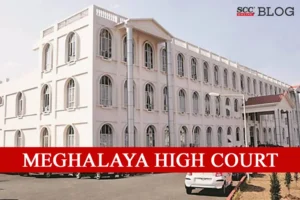
Meghalaya High Court: In a Public Interest Litigation Petition filed by Advocate A.H. Hazarika against delayed repair and construction of the Agia-Medhipara-Phulbari-Tura (‘AMPT’) Road, the Division Bench of Sanjib Banerjee, CJ., and W. Diengdoh, J., said that the AMPT Road is an arterial road of great importance and thus the road should be in top condition without excuses such as rain to explain away its pitiable condition.
Background
The petitioner had brought to the attention of the Court that the AMPT Road, which is one of the key roads linking the western part of the State to the rest of the State and even other parts of the country, there was lack of maintenance of the road. The road is maintained by the State Public Works Department (‘PWD’) but has been neglected for a long time. The State had submitted that the total stretch of 133 Kms of AMPT road has been divided into 8 sections and construction/repair works of the road was in full swing.
In the previous order of the Court dated 15-05-2023, the State was directed to ensure that the patch repair work undertaken for the 9 km stretch between 33 km to 41 km was constantly monitored and ensure that huge potholes do not impair the movement of traffic. It was also directed that necessary steps should also be taken to ensure a proper reconstruction of the stretch, as expeditiously as possible.
The petitioner had brought to the attention of the Court that nothing concrete was done since the previous order of the Court and potholes have developed which seriously affect the movement of the traffic along the stretch and that there is massive waterlogging along large stretches which have completely eroded the black topping of the road and makes it difficult for trucks and almost impossible for smaller vehicles to navigate such stretches.
Court’s Order
The Court said that the AMPT Road is an arterial road of great importance already and with the bridge across the Brahmaputra river from Dhubri to Phulbari scheduled to be completed in the next three or four years, Phulbari will develop as a major trading hub and roads to and from Phulbari will have to endure much greater traffic than can be imagined at present. Therefore, the Court also said that the AMPT Road has to be in top condition without excuses such as rain to explain away its pitiable condition. The Court also added that though some progress was made on some stretches, it did not appear that the work undertaken had any lasting value. The Court directed the State PWD (Roads) to look into the matter and instead of spending over and over again for patch work or repair work, undertake a complete overhauling of the road, whether or not in conjunction with the National Highways Authority of India (‘NHAI’) so that the road can cater to the increased pressure upon the Dhubri to Phulbari bridge over the Brahmaputra being completed.
Further, the Court directed the State PWD to consult with NHAI or its arm, the National Highways and Infrastructure Development Corporation Limited, and, possibly, seek funds from the North-Eastern Council for the strengthening, widening and year-round maintenance of the AMPT Road as a part of the extension of the Dhubri to Phulbari flyover.
The Court also said that the patchwork that is immediately required should not be ignored. The Court also expressed its concern that despite it being well known that Meghalaya is one of the wettest places in the world, the same excuse of rain was given by the State or other authorities to justify the poor conditions of some of the roads, however, there are several other roads in the State which can endure the monsoon and remain unaffected by the heavy rains. The Court directed that a report should be filed by the State regarding the measures taken, including how the road should be in the coming four or five years.
[A.H. Hazarika v. State of Meghalaya, 2023 SCC OnLine Megh 370, Order dated: 10-07-2023]
Advocates who appeared in this case :
For the petitioner: Advocate A.H. Hazarika;
For the Respondents: Government Advocate R. Gurung, Government Advocate S. Shyam, Government Advocate A. Thungwa, Central Government Counsel R. Debnath.