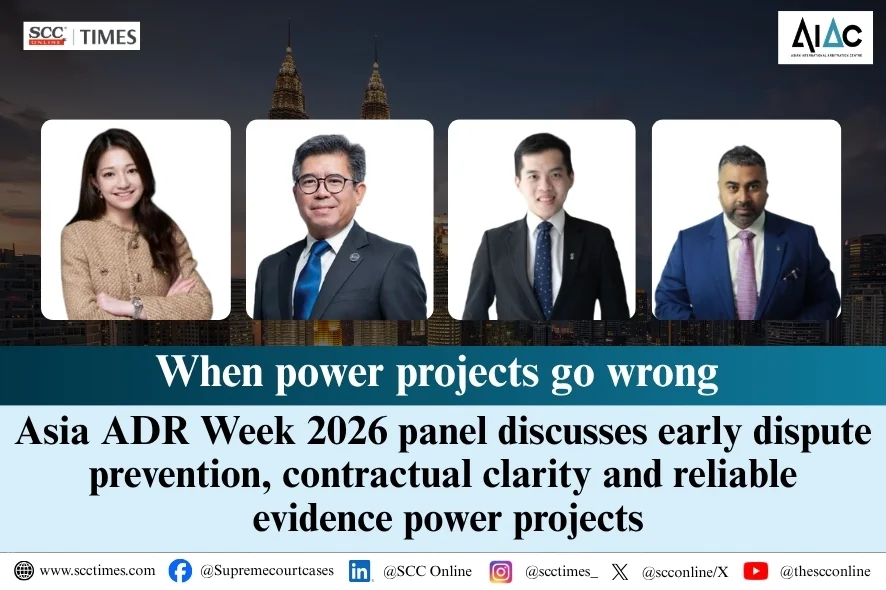
At Day 2 of Asia ADR Week 2026, power projects session titled “When Power Projects Go Wrong”, panellists examined how project owners, contractors, legal teams and technical experts can identify warning signs, protect contractual entitlements and prevent disagreements from escalating into costly proceedings.

[In picture from left to right: Ms Crystal Wong Wai Chin, Mr George Chapman, Mr Darshendev Singh and Mr Lim Chee Yong]
Moderated by Ms Crystal Wong Wai Chin, Partner, Lee Hishammuddin Allen & Gledhill (LHAG), the session featured Mr George Chapman, Senior Vice President, Sarawak Energy Berhad, Mr Lim Chee Yong, Partner, LHAG and Mr Darshendev Singh, Partner, LHAG. The discussion focused on the practical challenges that arise during the lifecycle of power and infrastructure projects, emphasising the importance of early communication, coordinated project governance, timely contractual notices, accurate documentation and effective dispute resolution mechanisms.
Early warning signs of a dispute often emerge before legal teams become involved
Opening the discussion on how project teams can identify when a project is drifting off track, Mr Lim Chee Yong explained that performance data often reveals emerging problems before the parties recognise that a dispute is developing. Referring to construction delays, he identified work schedules, project programmes and punch lists as important indicators. However, the number of outstanding items is not necessarily the most significant factor. Instead, the trend may reveal whether a project is progressing towards completion or encountering increasing difficulties.

[In picture: Mr Lim Chee Yong]
An expanding punch list, for instance, may indicate that defects are accumulating rather than being resolved. Similarly, if defects are repeatedly associated with a particular work package, subcontractor or vendor, the pattern may signal a problem requiring further attention. Mr Lim also highlighted changes in project correspondence as an important operational warning sign. When a project proceeds smoothly, site engineers and project managers typically resolve matters through routine communications. However, the introduction of legal counsel into correspondence, detailed chronologies, formal reservations of rights and increasingly elaborate written communications may indicate that the parties are beginning to anticipate a dispute.
Explaining this shift, he observed:
“The data is always already present there before people realise that that’s a dispute.”
He further explained that ordinary project records may gradually give way to correspondence drafted with future proceedings in mind. Recognising these changes early can help project teams investigate the underlying problems before their positions become entrenched.
Project governance requires legal, commercial and technical teams to work together
The discussion also examined the importance of involving the relevant stakeholders throughout a project’s lifecycle rather than treating contractual and legal considerations as matters to be addressed only when a dispute arises.
Mr George Chapman explained that project delivery teams, asset owners, legal and commercial personnel, finance teams and other relevant stakeholders should remain involved in decisions affecting the project. Although a particular team may lead the resolution of an issue, other stakeholders should be consulted where the decision could have wider contractual or commercial implications.

[In picture: Mr George Chapman]
For instance, a design issue may primarily concern the asset owner and technical team, but it may also affect the parties’ contractual obligations. Similarly, a land-related issue may require the involvement of the relevant land team while keeping the commercial and project delivery teams informed. Mr Chapman emphasised the importance of ensuring that these stakeholders remain aligned and work towards a collective decision.
The discussion highlighted that effective governance involves more than assigning responsibility for individual tasks. It requires coordination between those focused on delivering the project and those responsible for managing its contractual, financial and legal dimensions.
Contractors must protect contractual rights without damaging commercial relationships
Addressing the balance between maintaining a commercial relationship and preserving contractual entitlements, Mr Darshendev Singh cautioned against assuming that parties must choose between cooperation and protecting their legal position.

[In picture: Mr Darshendev Singh]
He explained that contractors may hesitate to raise concerns about delayed instructions, late handover of sites or delayed approvals because they fear that doing so could strain their relationship with the employer or main contractor. However, failing to address these issues at the appropriate time may create greater difficulties as the project approaches completion. A contractor may subsequently face delay damages or discover that it has not issued the notices required to support an extension-of-time claim. Similar difficulties may arise in claims for loss and expense or variations if the relevant contractual requirements have not been followed.
Mr Singh explained that where additional work is requested, contractors should discuss its valuation and whether it falls outside the original scope, while continuing to address the requirements of the project. He stressed that protecting contractual rights need not mean adopting an unnecessarily adversarial approach. As he put it:
“The trick is…, being commercially cooperative does not mean that you should proceed without any clarity.”
He added that the best way to preserve a commercial relationship is not to avoid difficult conversations but to address them before the issues become more complicated.
“The goal is to have the conversation early, openly, and with the contract in mind.”
The emphasis, therefore, was on raising concerns promptly, complying with contractual notice requirements and discussing the commercial implications of emerging issues without allowing disagreements to disrupt the project unnecessarily.
Performance guarantees require clear testing conditions and early discussions
Mr Lim explained that commissioning and performance testing involve detailed technical requirements. For a solar power plant, these may include the expected irradiance levels and the cleaning of solar panels before testing. For gas turbines and conventional power plants, gas flow rates and other operating conditions may affect the assessment of whether a performance guarantee has been satisfied. When a guarantee is not met, the parties may take different positions on responsibility. A contractor may argue that the owner did not provide the necessary conditions or access to conduct the tests. Alternatively, the parties may disagree over whether a defective component identified on a punch list affected the plant’s ability to meet the prescribed performance standards.
Mr Lim stressed that these questions should be discussed before performance testing begins. Parties should clarify the applicable testing conditions, the status of outstanding defects and the potential consequences of those defects instead of waiting until a performance failure gives rise to competing claims.
Ms Wong Wai Chin reinforced the importance of communication between operational teams and management. A shared understanding of the relevant contractual clauses, performance guarantees, performance ratios and grid compliance requirements can help narrow the issues that ultimately require resolution.
Where parties have not properly discussed these matters, several distinct disagreements may be combined into a much broader dispute. Clarifying the technical and contractual issues at an early stage can help prevent that outcome.
Ambiguous contracts can make settlement more difficult
Drawing on his experience of a dispute involving differing interpretations of a contract, Mr Chapman described how the parties had been unable to reach a solution because their respective management teams and boards interpreted the contractual provisions differently.
He explained that the parties eventually proceeded to arbitration after informal discussions failed to resolve the disagreement. In retrospect, he considered that mediation might have offered an opportunity to settle the matter before it reached a full arbitration. The experience illustrated the importance of clear contractual drafting and open communication when disagreements arise. Where the parties cannot reconcile their interpretations, even an established commercial relationship may not be sufficient to resolve the dispute.
Ms Wong Wai Chin observed that the effectiveness of negotiation and settlement strategies may also depend on the structure of the organisations involved and the authority of those participating in the discussions. Understanding who can make decisions and whether the relevant representatives have the ability to agree to a settlement is therefore an important consideration when determining how to approach a dispute.

[In picture: Ms Crystal Wong Wai Chin]
The discussion underscored that informal discussions can be valuable, but their effectiveness depends on the parties’ willingness and ability to resolve the underlying disagreement.
Technical evidence must be clear, reasoned and connected to the contractual claim
Turning to arbitration preparation, Mr Singh emphasised that construction disputes often involve substantial volumes of documentation, but the quantity of material does not necessarily establish the strength of a party’s case. Mr Singh said that the volume of documents alone does not win a case.
He explained that parties must use their documents to establish the facts relevant to their claims or defences. Where a plant fails to meet a performance standard, for example, it is necessary to examine whether the failure resulted from a design defect, a construction defect, an installation problem or a performance test that was not conducted in accordance with the prescribed procedures and conditions.
Mr Singh stressed that expert evidence should be presented clearly, supported by relevant documents and based on a transparent methodology. A lengthy expert report may not be persuasive if its reasoning is difficult to understand or does not adequately explain the underlying technical issue. He said that experts must also address the opposing party’s case rather than concentrate exclusively on supporting the position of the party that appointed them. Engaging with the other side’s explanation allows the tribunal to understand why one position should be preferred over the other.
Credibility, he noted, is an important part of persuasion. An expert’s conclusions must be supported by evidence and reasoned analysis rather than merely asserted. Mr Singh also highlighted the role of legal counsel in connecting technical evidence with the contractual issues in dispute. The expert may explain the technical cause of a failure, but the legal team must establish how that conclusion relates to the parties’ contractual rights and the remedies being sought. Without that connection, technical evidence may fail to advance the legal case effectively.
Missing project data and inaccurate records can complicate delay claims
Mr Lim highlighted the importance of preserving the underlying data used to prepare and assess project schedules, particularly in delay disputes. He explained that a baseline programme may be available as a PDF, but the format can obscure important information about the critical path, predecessor activities and logical links between tasks. The native file, such as a Primavera or Microsoft Project programme, may be necessary to examine the logic underlying the schedule.
Where the native file has not been retained, a delay expert may have to make assumptions to fill gaps in the available information. Even where those assumptions are disclosed, questions may arise over whether they accurately reflect the intentions of the person who prepared the original programme. Mr Lim then emphasised that retaining records is not enough if the records themselves are inaccurate.
“But sufficient records on its own is insufficient. The accuracy of these records are equally important.”
To illustrate the point, he discussed a dispute involving ruptured pigtail tubes supported by spring hangers inside a furnace. Following a two-year shutdown, some tubes ruptured. One party’s case was that the tubes had suffered from fabrication defects, while the opposing position was that adjustments to the spring hangers had introduced additional stress, causing the ruptures.
The parties examined maintenance records, but an email referring to the dismantling of scaffolding raised questions about whether access had been provided to the relevant areas. Further investigation established that scaffolding had been erected to inspect lower-level tubes, not the spring hangers several floors above. The issue required additional investigation before expert analysis established that there was no correlation between the misalignment of the spring hangers and the locations of the ruptures.
The example demonstrated how an incomplete or imprecise record can create an unnecessary evidentiary issue, requiring the parties to spend time and resources investigating matters that may not ultimately determine the outcome. Mr Lim’s central point was that project records should accurately reflect what occurred on site during the relevant period. Reliable contemporaneous documentation can help parties establish the facts and avoid unnecessary disputes over the sequence of events.
Early legal involvement can prevent avoidable disputes
In his concluding remarks, Mr Singh returned to the importance of dealing with issues early and maintaining reliable documentation. He cautioned that project participants may remember events differently from how they were recorded at the time. When a dispute arises, the documents may not support the account subsequently given by a project team. Record keeping must therefore accurately reflect what was said, what was intended and what occurred.
Mr Singh also encouraged project owners and contractors to involve experienced legal counsel and consultants while the project is still underway. Project teams focused on delivering the work may overlook the contractual implications of correspondence, decisions or emerging technical problems. Legal counsel can help identify those implications, ensure that appropriate responses are made and preserve the party’s position. He explained that lawyers should not be viewed solely as professionals who become involved after a dispute has arisen. Their role can also be preventive, helping parties address contractual issues before they develop into more serious disagreements.
Comparing early legal support to preventive healthcare, Mr Singh observed that investing in advice at the outset can help avoid greater costs and complications later. He concluded:
“So if you can invest in yourself to avoid complications and higher legal costs, why can’t you invest in a good lawyer up front?”
The point was that early legal involvement should be considered part of project risk management rather than merely a response to the prospect of arbitration.
Adjudication, expert determination and Dispute Avoidance Boards offer alternatives during ongoing projects
During the question-and-answer session, an audience member asked whether digital mediation and virtual technical panels could help parties resolve interim disputes involving payments, delays and technical issues without disrupting the progress of a project.
Mr Singh explained that informal settlement mechanisms require both parties to approach the process with a genuine intention to resolve the disagreement. Where one party is unwilling to settle, repeated meetings may not produce a meaningful outcome. He referred to Malaysia’s statutory adjudication framework for construction payment disputes, explaining that adjudication provides a mechanism through which a party seeking payment for work done can pursue a claim within a defined timeframe. The process is intended to protect cash flow while reducing the risk that payment disputes will jeopardise ongoing construction work.
The discussion also addressed contractual arrangements under which work continues while outstanding matters are resolved through the final accounts. Mr Chapman observed that such arrangements depend, in part, on the parties having sufficient confidence that justified claims will be addressed.
Ms Wong Wai Chin highlighted expert determination and Dispute Avoidance Boards as additional mechanisms that parties may consider, particularly for long-term and cross-border projects. These arrangements can provide avenues for addressing technical or contractual disagreements before they develop into full-scale arbitration.
She also noted that virtual platforms and remote participation can facilitate the involvement of suitably qualified individuals from different jurisdictions. Where appropriate mechanisms are incorporated into the contract, parties may be able to address disputes while maintaining project continuity and preserving their commercial relationship.
The discussion distinguished between mechanisms that depend on voluntary settlement and processes that provide a more structured route for resolving particular disputes. The appropriate approach will depend on the nature of the disagreement, the contractual framework and the parties’ willingness to engage.
Concluding remarks
The session highlighted that the effective management of power project disputes begins well before arbitration. Monitoring performance indicators, coordinating project stakeholders, complying with contractual notice requirements and clarifying technical obligations can help parties identify problems before they escalate.
The panellists also emphasised that documentary evidence must be both comprehensive and accurate, while expert analysis must be clear, transparent and connected to the contractual issues in dispute. Early legal involvement, together with suitable dispute resolution mechanisms such as adjudication, expert determination and Dispute Avoidance Boards, can help parties address disagreements without unnecessarily disrupting ongoing projects.
Ultimately, the discussion underscored the importance of addressing issues when they arise, preserving contractual rights through clear communication and reliable records, and treating dispute prevention as an integral part of project management.
SCC Times is the official media partner for AIAC Asia ADR Week 2026. Read more about AIAC Asia ADR Week 2026: