The Central Asia Dispute Resolution Association (CADRA) International Arbitration Summer School 2026 continued with another session, “Constitution of the Arbitral Tribunal: Appointment, Independence, Impartiality, and Challenges”, held on 18 August 2026. The session featured Kevin Nash, Director General, London Court of International Arbitration (LCIA), and Maria Jonker, Counsel, LCIA. The discussion was facilitated by Bokhodir Dadaev, President, CADRA.
The speakers examined how arbitral tribunals are constituted in institutional arbitration, the role of party autonomy in selecting arbitrators, the factors institutions consider when making appointments, and the importance of independence, impartiality and disclosure. The session also addressed challenges and replacement of arbitrators, diversity in appointments, third party funding and practical questions from participants concerning strategic challenges and the first appointment of aspiring arbitrators.
Kevin Nash on party autonomy and choosing the right arbitrator
Opening the substantive discussion, Kevin Nash emphasised that one of the fundamental advantages of arbitration is the parties’ ability to participate in choosing the person who will decide their dispute. He explained that when parties choose arbitration, they generally value speed, cost effectiveness, flexibility, confidentiality, limited avenues of appeal and enforceability under the New York Convention. Most importantly, arbitration allows parties to have a say in the selection of their decision maker.

Kevin cautioned parties against using an even number of arbitrators and explained that the usual structures are a sole arbitrator or a three member tribunal. The choice depends upon the complexity and value of the dispute, as well as considerations of time and cost. He observed that, in his experience, once a dispute reaches approximately USD 20 to 25 million, parties may begin moving from a sole arbitrator towards a three member tribunal.
He also discussed the tactical problem of burning a candidate, where a party proposes arbitrators whom the opposing side is unlikely to accept, ultimately leaving the institution to make the appointment. For three member tribunals, Kevin stressed the importance of setting out the nomination procedure clearly in the arbitration agreement. He also discussed emergency arbitrator appointments and appointments made on behalf of non-participating parties, including the importance of preserving the parties’ ability to participate in constituting the tribunal.
Kevin emphasised that institutional appointment is not simply a mechanical exercise. Institutions must consider the seat, governing law, nationality, sector, complexity, availability and conflicts but also whether an arbitrator understands the commercial realities of the dispute.
“There really is an art to appointments.”
He explained that institutions become better at appointments through extensive experience and that an arbitrator must not only appear fair but must also understand the commercial realities of the jurisdictions involved. He particularly stressed the importance of this for disputes involving Central Asia and other regions where commercial practices may differ from those familiar to arbitrators from other legal systems.
Diversity and developing the next generation of arbitrators
Kevin further highlighted the importance of geographical, gender and generational diversity in arbitral appointments. He noted that LCIA had parties from 161 jurisdictions over the preceding six years and argued that the diversity of arbitrators should reflect the diversity of the institution’s users.
He recalled appointing a young arbitrator in a small value dispute as an opportunity to give a rising practitioner a first appointment, explaining that institutions have an important role in developing the next generation of arbitrators.
Kevin also highlighted the increasing international character of LCIA appointments. Responding later to a participant’s question on appointments from the Global South, he said that he had seen a clear trend towards a broader global pool and observed that 75 per cent of LCIA Court appointments in 2025 were of arbitrators who were not from the UK. He stressed that arbitrators should understand both the dispute and its local realities.
He further argued that young arbitrators should not have to market themselves simply to obtain appointments.
“We should be able to appoint the best arbitrators in the world wherever they are in the world.”
According to Kevin, institutions have a responsibility beyond administering existing cases: they should also help develop the next generation of arbitrators.
Maria Jonker on the LCIA’s appointment framework
Maria Jonker explained the institutional structure through which LCIA tribunals are constituted and described tribunal formation as one of the most consequential processes in an arbitration. She outlined the LCIA’s three tier structure comprising the LCIA Board, LCIA Court and LCIA Secretariat, explaining that the LCIA Court is the final authority for applying the rules and formally appointing tribunals, while also determining challenges to arbitrators and arbitration costs.

Maria noted the international character of the LCIA’s caseload, stating that cases included 99 substantive laws and 70 different seats. Only 15 per cent of parties came from the UK, meaning that 85 per cent were from outside the UK.
She explained that LCIA maintains an internal database containing thousands of arbitrator profiles but is not restricted to that database when searching for a suitable candidate. In 2024, LCIA made 455 appointments involving 318 arbitrators, with appointments covering 47 nationalities. Maria also noted that 54 per cent of appointments were to three member tribunals and 46 per cent to sole arbitrators.

On costs, Kevin explained that the duration of an arbitration is often more significant than marginal differences between institutional fee schedules. He noted that institutional fees represent only around 3 to 4 per cent of overall arbitration costs, arbitrator fees around 17 per cent, while legal costs constitute approximately four fifths of the total. A needless challenge that adds months to proceedings can therefore substantially increase the overall cost.
Party autonomy and the constitution of the tribunal
Maria explained that party autonomy is the starting point under the LCIA Rules. Parties can determine the number of arbitrators, the selection procedure and subject to the rules, qualifications such as language, specialist knowledge and experience.
“The starting point is party autonomy.”
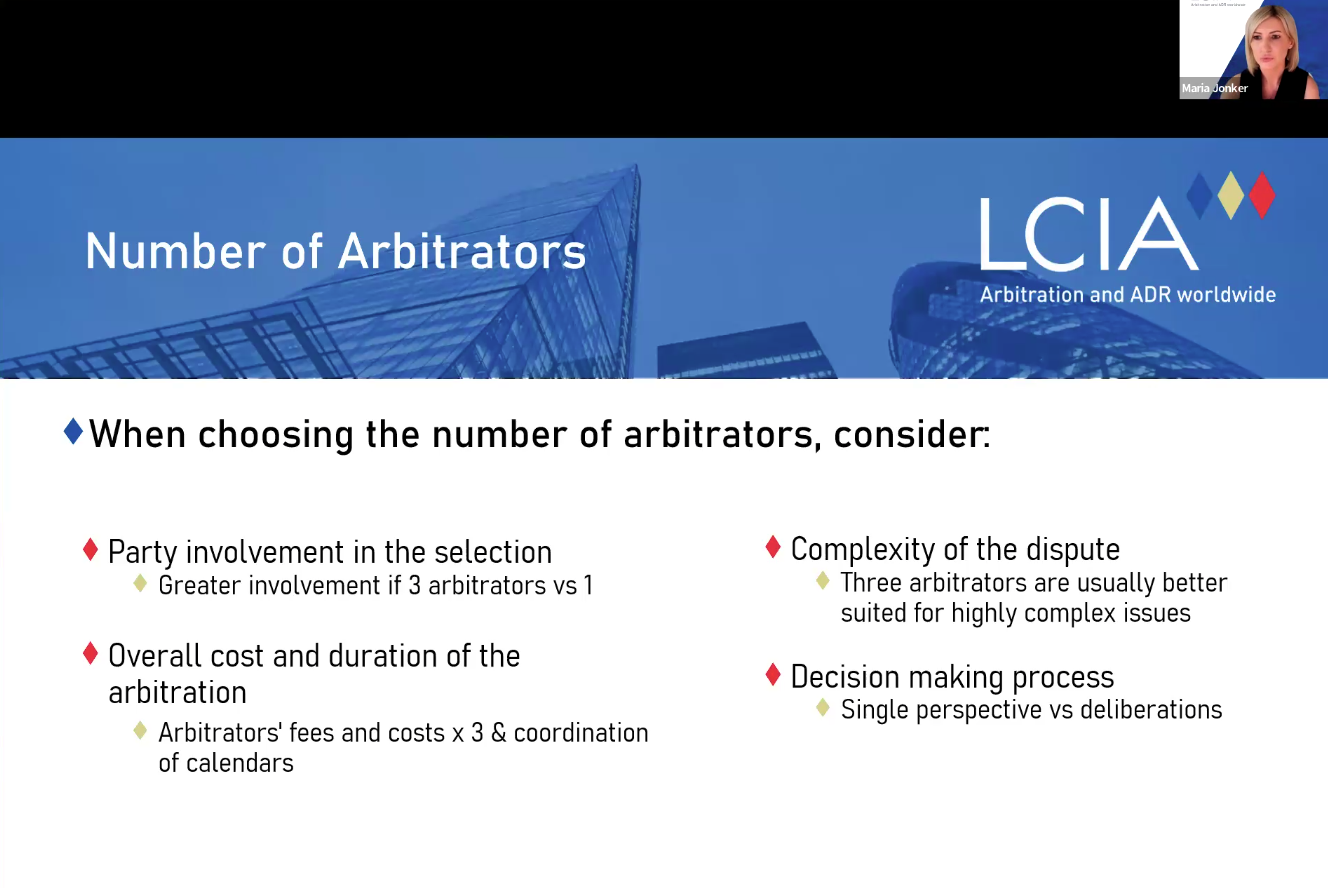
She explained that parties may provide for one or three arbitrators, with the LCIA Rules providing a sole arbitrator as the default unless the LCIA Court determines that a three-member tribunal is more appropriate. The choice should take account of party involvement, costs, duration, complexity and the need for particular technical, legal or regional expertise.
Maria also cautioned against overly restrictive qualifications in arbitration clauses. Although parties may specify particular expertise, excessively detailed requirements can make it difficult to find a suitable arbitrator. Kevin added that parties should consider proposing preferred qualifications rather than turning them into rigid contractual requirements, because failure to comply with an agreed qualification could potentially expose an award to challenge at the set aside or enforcement stage.
The speakers also discussed the appointment of the presiding arbitrator. Kevin noted that different institutional and national regimes approach the appointment of the chair differently, and parties often fail to consider at the drafting stage who should ultimately appoint the presiding arbitrator.
He also discussed list and rank and strike procedures, warning that such mechanisms require a proper tie breaker provision to avoid disputes over rankings.
Independence, impartiality and disclosure obligations
Turning to independence and impartiality, Maria drew an important distinction between the two concepts. Under the LCIA Rules, arbitrators must remain impartial and independent throughout the proceedings. She explained that independence is concerned with objective circumstances, while impartiality relates to actual or apparent bias.
Every prospective arbitrator is required to make a written declaration concerning circumstances that could give rise to justifiable doubts about their independence or impartiality. The assessment is based on the perspective of an objective and reasonable observer.
Maria stressed that disclosure is not a one-time obligation. Arbitrators must continue to disclose relevant circumstances even after appointment if something arises during the proceedings.
“The impartiality and independence is something that is an ongoing requirement.”
Under the LCIA Rules, a challenge may be submitted within 14 days of the tribunal’s formal appointment or within 14 days of the party learning of the circumstances giving rise to the challenge. The LCIA Court may determine the challenge where the parties do not agree, or the arbitrator does not resign voluntarily.
Kevin highlighted the importance of the LCIA’s publication of anonymised challenge decisions. He noted that 84 challenge decisions had been published and argued that this provides practitioners with useful guidance on the circumstances in which challenges have succeeded or failed. He explained that a successful challenge can cause serious disruption, including the possibility of repeating hearings, making proper disclosure and careful appointment practices critical to the integrity and efficiency of arbitration.
Challenges and replacement of arbitrators
Maria explained that the LCIA Court also has authority to revoke an arbitrator’s appointment and appoint a replacement. Circumstances may include resignation, serious illness, inability or unfitness to act, or justifiable doubts concerning impartiality and independence. The Court may also give parties an opportunity to nominate a replacement depending on the circumstances. Importantly, a challenge does not necessarily result in an automatic stay of the arbitration.
Kevin observed that strategic challenges can present one of the most difficult administrative problems for arbitral institutions because they can threaten to turn the arbitration into a trial within the trial. The challenge process, therefore, has to be handled quickly without compromising genuine concerns about independence and impartiality.
Participants raise questions on diversity, funding and strategic challenges
Opening the floor to participants, Kevin identified securing a first appointment as one of the most difficult questions facing aspiring arbitrators, observing that there was no magic trick for obtaining that first opportunity.
A participant asked whether LCIA was witnessing a trend towards appointing arbitrators from the Global South and how this related to diversity. Kevin responded that the expanding global caseload made it necessary to build a genuinely global pool of arbitrators who understand local realities. Another participant asked about the impact of the rise of third-party funding on arbitrator appointments. Kevin stressed the importance of transparency to prevent conflicts between arbitrators and funders from emerging later in the proceedings. He referred to his experience helping establish Singapore’s third-party funding regime and noted that third party funding was likely to feature in future updates to the LCIA Rules.
A further question concerned how institutions could prevent strategic arbitrator challenges from delaying proceedings while ensuring that genuine concerns about impartiality were addressed. Kevin said there might not be a way to prevent tactical challenges entirely, making expeditious handling particularly important. Maria similarly stressed the need for hands on case administration and smooth internal processes so that challenges reach the Court quickly.
Kevin acknowledged that in large, complex and high value cases, tactical challenges may sometimes be expected. However, he distinguished genuine concerns from challenges based merely on dissatisfaction with procedural decisions. He pointed to the published LCIA challenge decisions as a useful resource for assessing whether similar grounds have previously succeeded.
A further question concerned the diversity of party nominated arbitrators. Kevin observed that institutions have access to a much broader pool of data than individual law firms and encouraged parties to move away from traditional, repetitive choices.
“You sometimes hear jokes about arbitrator lists that look like they’re from the 1990s.”
Maria added that improving diversity also requires educating parties and counsel because institutions may have limited ability to alter a nomination once it has been made. She noted that parties can consider equally experienced emerging arbitrators who may have greater availability and willingness to devote time to a case.
Kevin then offered his own approach to party nominations, suggesting that parties should look for a combination of work and weight. An arbitrator must have both the standing to contribute meaningfully to the tribunal and the time and willingness to engage with the case. An arbitrator with reputation but no availability may be as problematic as someone willing to do the work but lacking sufficient standing.
Finally, a participant asked what the most frequent ground for arbitrator challenges before the LCIA Court currently is and how high the threshold for revoking an appointment remains. Maria explained that the standard is high and highly fact specific, with no single universal rule beyond the requirements of independence and impartiality. Kevin pointed to failure to disclose as an important source of challenges and referred to the evolving proactive disclosure obligations applicable to London seated arbitration.
Closing Remarks
At the close of the session, Bokhodir Dadaev observed that participants from around the world had gained practical insight into LCIA practice concerning the constitution of arbitral tribunals, appointment of arbitrators, impartiality and independence, and challenges.

He said the session had contributed to legal education and the development of arbitration communities, particularly in Central Asia, and expressed hope for further collaboration.
The session demonstrated that constitution of an arbitral tribunal is not merely a preliminary procedure. The choice of arbitrators, the preservation of party autonomy, proper disclosure, diversity, and an efficient challenge mechanism can directly affect the fairness, efficiency and enforceability of the arbitration. As the speakers emphasised, a well constituted tribunal requires not only appropriate expertise, but also independence, impartiality, availability and an understanding of the dispute and its commercial context.