


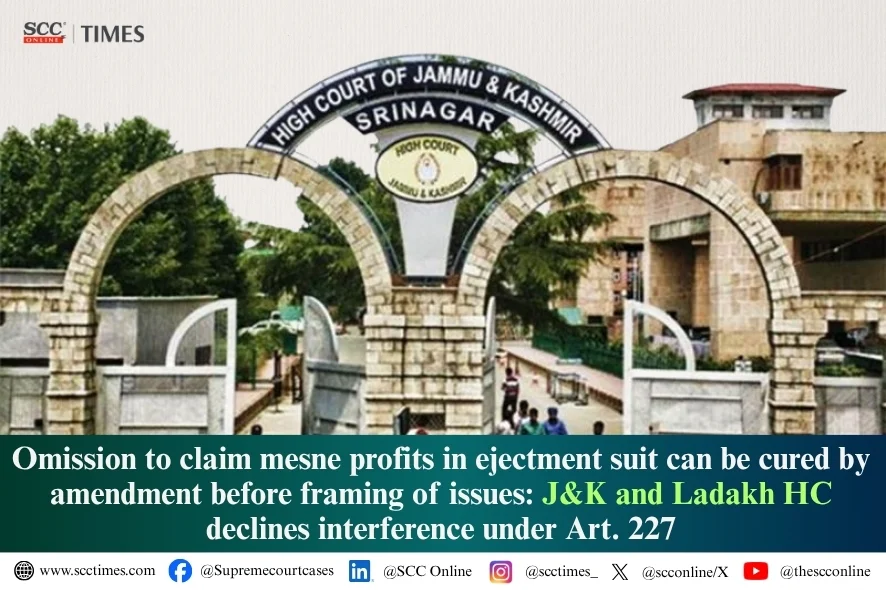
Jammu & Kashmir and Ladakh High Court: In a petition filed under Article 227 of the Constitution of India challenging the order dated 12 February 2024 passed by the 3rd Additional Munsif, Srinagar, whereby the plaintiff’s application under Order VI Rule 17 Civil Procedure Code, 1908 (CPC) seeking amendment of the plaint was allowed, a Single Judge Bench of M.A. Chowdhary, J., held that the Trial Court had properly exercised its discretion in permitting the amendment. The Court found that the trial had not commenced as the issues were yet to be framed, and that the proposed amendment did not introduce a new or foreign cause of action or cause irremediable prejudice to the defendant. Finding no jurisdictional error, perversity or patent illegality in the impugned order, the Court declined to interfere in its supervisory jurisdiction under Article 227 and dismissed the petition.
Background
The plaintiff instituted a suit seeking ejectment of the petitioner (defendant) from a shop at Munawarabad, Srinagar, along for a decree of permanent injunction. The petitioner occupied the shop under a rent deed executed on 27 August 2011 and registered on 4 October 2011.
During the pendency of the suit, the plaintiff sought to amend the plaint to incorporate a claim of mesne profits at Rs 50,000 per month, with consequential changes to the valuation and prayer clauses. The petitioner opposed the application, contending that the written statement had already been filed, that the proposed amendment sought to introduce a new case, and that the application was intended to delay proceedings. He further contended that the plaintiff could not seek eviction in view of the defence raised by him.
The trial court allowed the amendment, observing that trial had not yet commenced and, therefore, the proviso to Order VI Rule 17, CPC was not attracted, and that the amendment was necessary to determine the real questions in controversy. Aggrieved by this, the petitioner approached the High Court.
Issues and Analysis
The Court was called upon to determine whether the trial court was justified in allowing the plaintiff’s application to amend the plaint under Order VI Rule 17 CPC.
The first question to be considered was whether the proviso to Order VI Rule 17 CPC barred the amendment, the Court noted that the proviso restricts amendments after commencement of trial unless the party shows that, despite due diligence, the matter could not have been raised earlier. In the present case, the Court noted that the issues had not yet been framed when the amendment application was filed. Accordingly, the trial had not commenced, and the restriction contained in the proviso was not attracted.
The Court next considered whether the proposed amendment introducing a claim for mesne profits amounted to a new cause of action. It held that it did not. The underlying dispute already concerned the petitioner’s continued occupation of the suit premises after the expiry of the lease/rent deed and the plaintiff’s claim for recovery of possession. The original pleadings had also referred to notices issued to the petitioner and asserted the plaintiff’s entitlement to mesne profits. The proposed amendment therefore arose from the same transaction and subject matter and could not, at that stage, be regarded as introducing an entirely new or unrelated cause of action.
The Court further clarified that the merits of the mesne profits claim were not to be examined while deciding an application for amendment. Questions as to whether the plaintiff was actually entitled to mesne profits, whether the claimed amount of ₹50,000 per month was justified, and the period for which such relief could be granted were all matters to be determined by the trial court independently on the basis of the pleadings and evidence.
The Court also rejected the petitioner’s contention that the amendment would cause prejudice. The petitioner would have an opportunity to file an amended written statement and contest the amended pleadings. All available legal defences would remain open to him. Since the petitioner failed to demonstrate that the amendment would fundamentally alter the nature of the suit or cause prejudice that could not be addressed through an appropriate opportunity to defend, the objection was found to be without merit.
In examining the exercise of its jurisdiction under Article 227 of the Constitution of India, the High Court reiterated that such jurisdiction is supervisory in nature. The Court does not ordinarily interfere with an interlocutory order merely because it may have arrived at a different view. Interference is justified where the subordinate court has acted without jurisdiction, failed to exercise jurisdiction vested in it, or acted with manifest illegality or perversity.
The Court also relied on the Supreme Court’s decision in Rajesh Kumar Aggarwal v. K.K. Modi, (2006) 4 SCC 385, which explains the scope of Order VI Rule 17 CPC and the purpose of allowing amendments necessary for determining the real questions in controversy. Applying these principles, the High Court found that the Trial Court had properly considered the amendment application and the objections raised by the petitioner and had exercised its discretion within the parameters of Order VI Rule 17 CPC.
Accordingly, the Court found no jurisdictional error, perversity or patent illegality in the trial court’s order dated 12 February 2024. The petition was dismissed, and the Trial Court’s order allowing the amendment was upheld. The interim direction dated 3 May 2024 was also vacated. The Court clarified that its observations were confined strictly to the question of amendment and would not affect the merits of the parties’ respective claims and defences, including the plaintiff’s entitlement to ejectment or mesne profits, the applicable rate or period of mesne profits, or any other issue arising in the suit.
Decision
The petition was dismissed, the interim direction dated 3 May 2024 was vacated, and the trial court was directed to proceed with the suit expeditiously. The Court clarified that its observations were confined to the question of amendment.
[Zahoor Ahmad Dar v. Mymoona, 2026 SCC OnLine J&K 758, decided on 18-09-2026]
Advocates who appeared in this case:
For the Petitioner: Adv. Irshad Ahmad with Adv. Umaiya Zehra
For the Respondents: Adv. A. M. Mir
Buy Constitution of India HERE






