The Gujarat High Court Arbitration Centre (Domestic & International) (GHAC), in collaboration with the Gujarat High Court, is holding the GHAC Arbitration Week 2026, a three-day programme dedicated to strengthening Gujarat’s institutional arbitration ecosystem and promoting the State as a leading destination for efficient, credible and institutionally driven dispute resolution.
The opening ceremony was held on 3 September 2026, ahead of the main three-day programme running from 4 September to 6 September 2026 at the prestigious GIFT City Club, Gandhinagar, on the theme “Building Gujarat’s Institutional Arbitration Ecosystem”. The event is envisaged as a significant platform for dialogue, professional engagement and knowledge exchange among the judiciary, legal profession, business and industry community, arbitrators and arbitral institutions.
Read more about the conference here: GHAC Arbitration Week 2026: A pivotal step towards building Gujarat’s Institutional Arbitration ecosystem
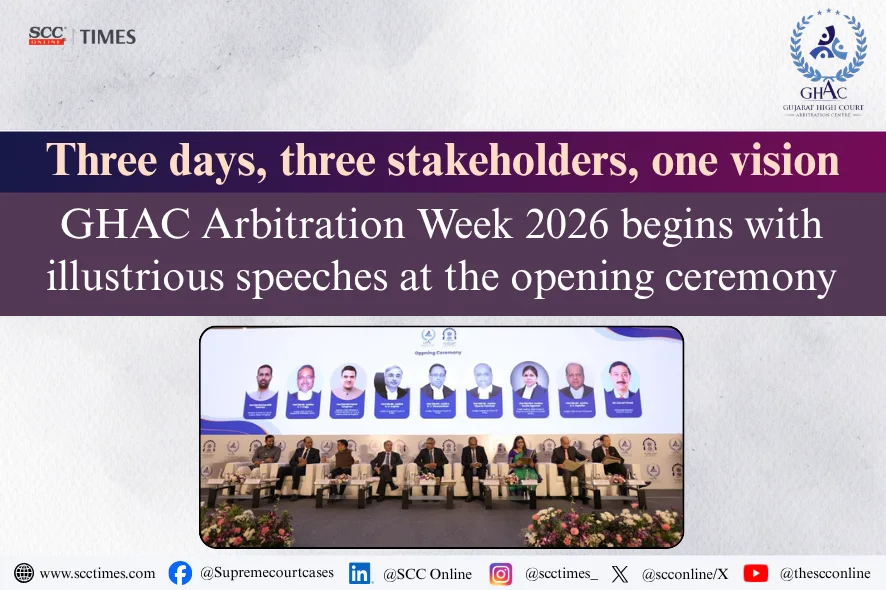
The event began with a distinguished Opening Ceremony consisting of esteemed dignitaries such as, Justice K. V. Viswanathan, Judge, Supreme Court of India; Justice N. V. Anjaria, Judge, Supreme Court of India; Justice Vipul M. Pancholi, Judge, Supreme Court of India; Shri Harsh Sanghavi, Deputy CM, Gujarat; Justice Sunita Agarwal, Chief Justice, Gujarat High Court and Patron-In-Chief of the GHAC; Justice Alpesh Y. Kogje, Judge, Gujarat High Court; Justice A. S. Supehia, Judge, High Court of Gujarat; Shri Kaushik Vekariya, Minister of State for Law and Justice, Gujarat; Kamal B. Trivedi, Advocate General of Gujarat; and several other members of the government and the legal fraternity. Though unable to attend in person, Justice P.S. Narasimha, Judge, Supreme Court of India, shared a message for the occasion.
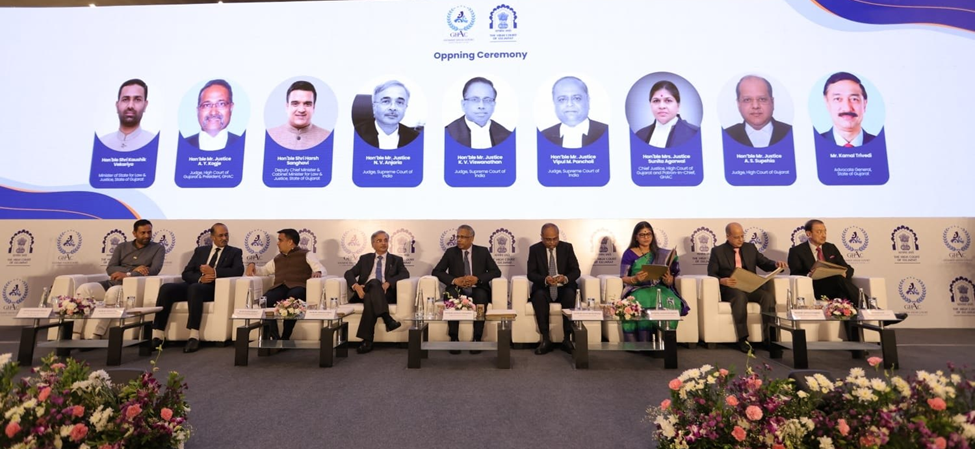
[In the picture from left to right: Kaushik Vekariya, Justice A.Y. Kogje, Deputy CM Harsh Sanghavi, Justice N.V. Anjaria, Justice K.V. Viswanathan, Justice Vipul M. Pancholi, Chief Justice Sunita Agarwal, Justice A. S. Supehia, Kamal Trivedi]
Kickstarting the opening ceremony, the hosts for the conference Advocate Harsh Parekh, Advocate High Court of Gujarat, and Advocate Nisha Ojha, Partner, Wadia Gandy & Co., welcomed the dignitaries and invited the guests of honor to light the lamp.
Welcome Address: Justice Sunita Agarwal
Beginning her address by welcoming the esteemed guests and audience, Justice Sunita Agarwal said the GHAC Arbitration Week 2026 was conceived not as an event that ends in 3 days, but as a pivotal step to strengthen the practice of institutional arbitration in Gujarat. “It brings together the bar, business, industry and law firms and the arbitral and institutional community, recognising that the growth of institutional arbitration depends upon the confidence and participation of all three.”
She reiterated the event’s catchline: three days, three stakeholders, one vision, to show that over the 3-day conference, each stakeholder will bring its own experience and perspective and engage with the others around a shared vision of building Gujarat’s institutional arbitration ecosystem.
Thereafter, she acknowledged the presence of each dignitary, namely, Justice K. V. Viswanathan, Justice N. V. Anjaria, Justice Vipul M. Pancholi, and Shri Harsh Sanghavi, and underscored their contribution to the conference.
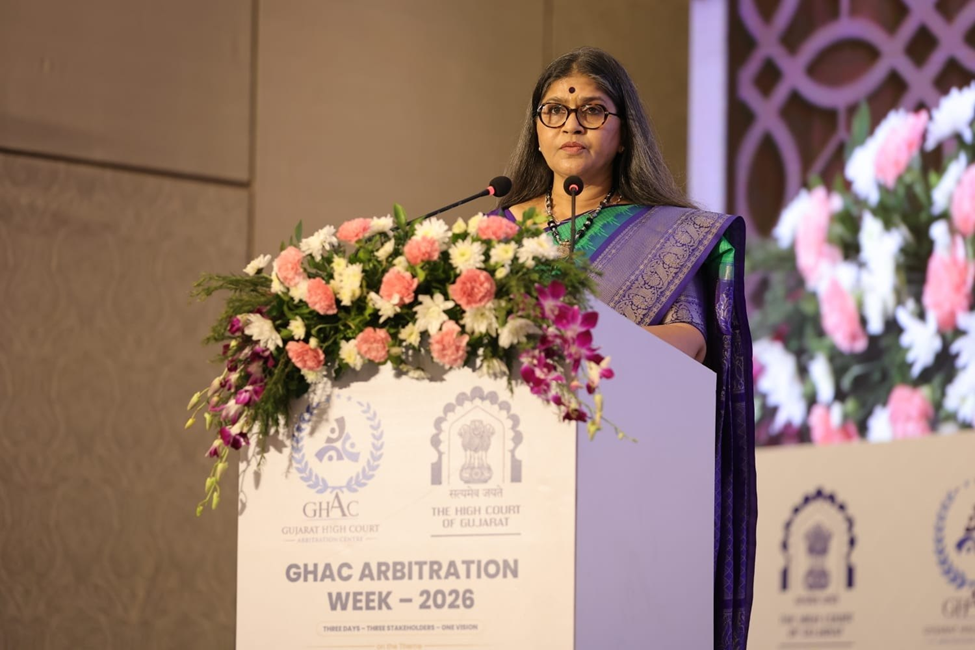
Highlighting the Gujarat Government’s strong support for GHAC, Justice Agarwal stated that with the growth of Gujarat’s economy, the scale and reach of its commercial life had also grown. Accounting for one-tenth of India’s GDP and 30 per cent of its exports, Gujarat was India’s principal gateway to global commerce due to its long industrial coastline, ports, and manufacturing base. With that growth, she emphasised, comes a corresponding need to preserve the commercial relationship that sustains such growth, and the strength of commercial relationships is tested the most when a transaction gives rise to a dispute.
“For a State so deeply engaged in domestic and international commerce, an efficient and dependable infrastructure for resolving complex commercial disputes is an essential part of the legal framework that supports commerce itself.”
In this background, she underscored the importance of institutional arbitration as it offers parties not merely an arbitrator, but also an organised process supported by professional administration and established procedures designed to reduce uncertainty and bring greater transparency, efficiency and predictability in dispute resolution.
On GIFT City, Justice Agarwal stated that it was an important aspect of Gujarat’s economic evolution as it is an emerging international financial centre connecting India with global capital and financial markets. With the development of this financial ecosystem, the legal infrastructure supporting it must develop with the same sense of purpose. In this context, she stated that the proposed international ADR Centre at GIFT City was significant as it would be a major step towards placing Gujarat on the map of international dispute resolution.
Thereafter, she reflected on the journey of GHAC, which had evolved from modest beginnings to its upcoming purpose-built facility with 16 arbitration conference halls, breakout rooms, private chambers for arbitrators, 7 mediation rooms and facilities for online dispute resolution. She added that GHAC’s Med-Arb centre, which integrates mediation with arbitration, was a vital step towards faster resolution of commercial disputes.
Commending GHAC’s efforts to strengthen its arbitration infrastructure and evolve with the needs of users, Justice Agarwal remarked, “At its heart, GHAC is intended to be more than a place where merely disputes are heard. Its larger purpose is to serve the society it caters to by making dispute resolution more accessible, efficient and trustworthy while upholding the values of fairness, integrity and justice.” Furthermore, such evolution and purpose reflect GHAC’s belief that a robust institutional ecosystem is built not just by the institutions of parties, advocates, arbitrators, institutions and courts, but also through professional administration, credible arbitral talent, modern rules, technology, and a culture of continuous and steady improvement.
With GHAC’s institutional role becoming more specialised, she stated that the Board of Governors has resolved to constitute an Arbitration Promotion Council to provide focused research, policy insight and professional guidance for institutional growth and its governance.
“The emerging GIFT City ADR Centre and the strengthening of Gujarat High Court Arbitration Centre are already laying the foundation for a strong institutional arbitration ecosystem in Gujarat.”
Concluding her address, Justice Agarwal emphasised the relevance of the GHAC Arbitration Week 2026, stating that it draws its real strength from the insights of the eminent resource speakers and the stakeholders. She also expressed her gratitude towards the Gujarat High Court’s staff and the gracious presence of each dignitary, speaker, audience member, organisers, and staff.
“An ecosystem is only as strong as those who choose to be part of it, and this breadth of participation reflects our shared commitment to strengthen institutional arbitration in India.”
ADR aids businesses and citizens: Shri Harsh Sanghvi, Deputy Chief Minister, Gujarat
In his address, Shri Harsh Sanghvi expressed his gratitude towards the judiciary for making Gujarat one of the safest States in India. He added that the judiciary reduced the average time needed for adjudicating cases and delivered landmark decisions.
Regarding arbitration, he mentioned that over the last few years, Justice Sunita Agarwal had not only encouraged and supported arbitration but also delivered crucial decisions, which benefitted the businessmen and citizens of Gujarat, and she continues to do so. He added that the Mediation Centre of Gujarat High Court, which seemed like a small initiative, immensely helped small businessmen from indigenous backgrounds and countless others to access justice.
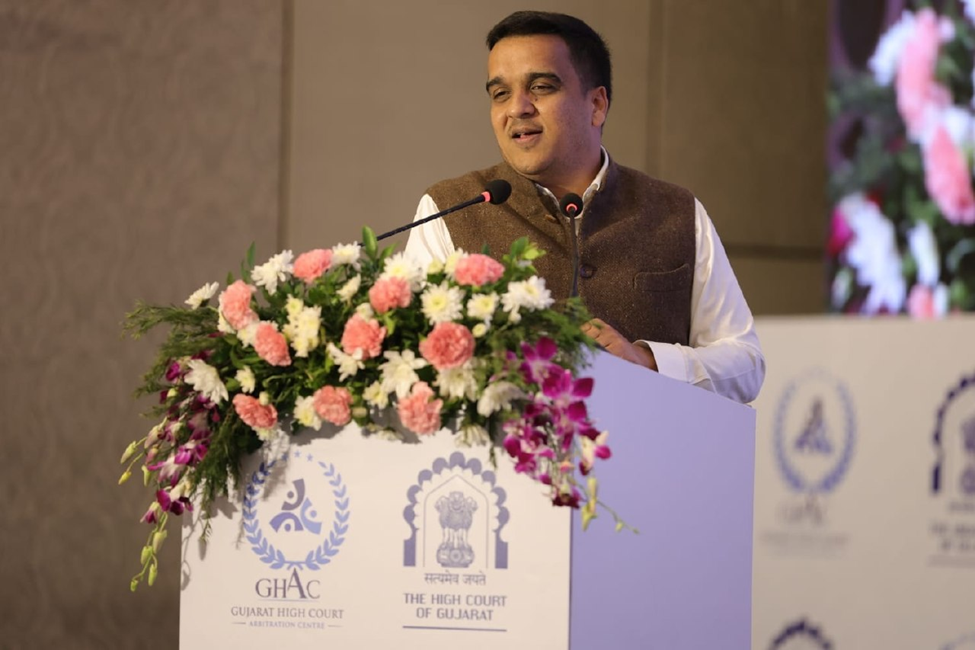
The Deputy CM commented that usually, an arbitration centre is viewed as an alternative to the court, but it should be viewed as the important mechanism that it is. To substantiate this, he said that GIFT City would benefit greatly from the proposed ADR Centre, as it heavily impacts international investments because foreign investors seek the rule of law and a robust arbitration mechanism. He stated that international investors opting for Singapore’s law was harming India, but the heavy promotion of India’s arbitration would benefit India in the coming years, especially Gujarat. This support would also create opportunities for India’s citizens and youth.
Arbitration centres, he added, were not just beneficial for companies but also for government contracts, which not only impact public services and utilities but also save government funds and resolve unfinished development projects by resolving disputes quickly.
Referring to an article he read, he reflected on Mahatma Gandhi’s practice in South Africa, wherein he resolved a pending case using arbitration and mediation outside court, which demonstrated the deep roots of ADR in India’s dispute resolution.
As a government representative, the Deputy CM assured that all government cases and pending projects would be resolved via arbitration. Furthermore, it is the Government’s responsibility to promote and support arbitration.
In conclusion, he thanked and encouraged members of the ADR community, including Justice Agarwal, for bringing new ideas and guiding the Government.
Following the addresses by the distinguished dignitaries, Justice A. Y. Kogje, Judge, High Court of Gujarat and President of the Gujarat High Court Arbitration Centre, was invited to deliver the vote of thanks. In his address, Justice Kogje reflected on the objectives of the Arbitration Week and the larger endeavour to build a strong institutional arbitration ecosystem in Gujarat.
Vote of thanks by Justice A.Y. Kogje
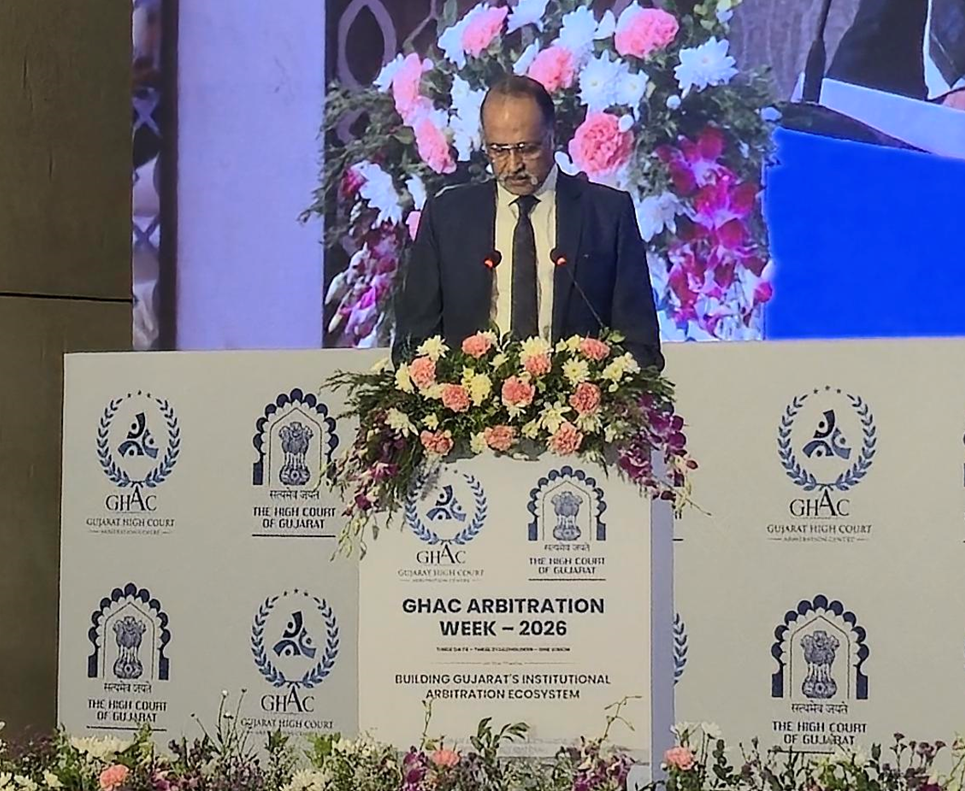
Delivering the vote of thanks at the opening ceremony of Gujarat High Court Arbitration Week 2026, Justice A.Y. Kogje, Judge, High Court of Gujarat and President of the Gujarat High Court Arbitration Centre (GHAC), said the initiative was conceived around the principle of “three days, three stakeholders, one vision”.
He said the broader objective was to bring the judiciary and legal profession, government and industry, and the wider dispute resolution community onto a common platform to help institutional arbitration develop as an efficient, credible and preferred mechanism for commercial dispute resolution in Gujarat.
Focus on institutional arbitration
Justice Kogje emphasised that arbitration could no longer be viewed merely as an alternative procedure. According to him, it had become an integral part of the legal and commercial infrastructure required by a modern economy.
He said the objective of the Arbitration Week therefore extended beyond conducting a successful conference. It included creating greater awareness about institutional arbitration, enhancing professional competence, and encouraging the use of appropriate institutional arbitration clauses in commercial contracts.
He further highlighted the need to build confidence among business and government institutions and to strengthen Gujarat’s position as a preferred destination for commercial arbitration.
“We must endeavour to create greater awareness about institutional arbitration, enhance professional competence, encourage appropriate institutional arbitration clauses in commercial contracts, build confidence amongst business and government institutions and ultimately strengthen Gujarat’s position as a preferred destination for commercial arbitration.”
Collective institutional effort
Justice Kogje placed on record his appreciation for the Board of Governors of GHAC, observing that the success of an institution was the result of collective wisdom and commitment.
He acknowledged the contributions of members of the Board and thanked the judges of the High Court of Gujarat for their continued encouragement and support for GHAC’s initiatives. He also thanked Chief Justice Sunita Agarwal, Patron-in-Chief of GHAC, for spearheading the initiative and for taking a keen and personal interest in the programme.
First such event in Gujarat
Justice Kogje described the Arbitration Week as the first event of its kind in Gujarat and said that the participation of distinguished speakers, senior advocates, members of the Bar, industry and corporate representatives, government officers, arbitrators, mediators, academicians and ADR professionals had provided a strong foundation for the initiative.
He linked this participation to the event’s guiding formulation of “three stakeholders, one vision”, with the different segments of the dispute resolution ecosystem coming together on a common platform.
Appreciation for organisers and participants
Justice Kogje also acknowledged the efforts of the Registrar General, GHAC’s Director, the Registry of the High Court of Gujarat, officers and staff of GHAC, the organising, protocol, administrative and information technology teams, and others involved in the arrangements.
He expressed gratitude to the partners of GHAC for their hospitality and logistical support and assistance with the planning and execution of the event. He also acknowledged those involved in security, transport, accommodation, reception, registration, hospitality, media and other arrangements.
Concluding his address, Justice Kogje expressed the hope that the discussions initiated during the Arbitration Week would translate into stronger institutions, better practices and a more effective dispute resolution ecosystem.
“May the conversations that begin here translate into stronger institutions, better practises and more effective dispute resolution ecosystem.”