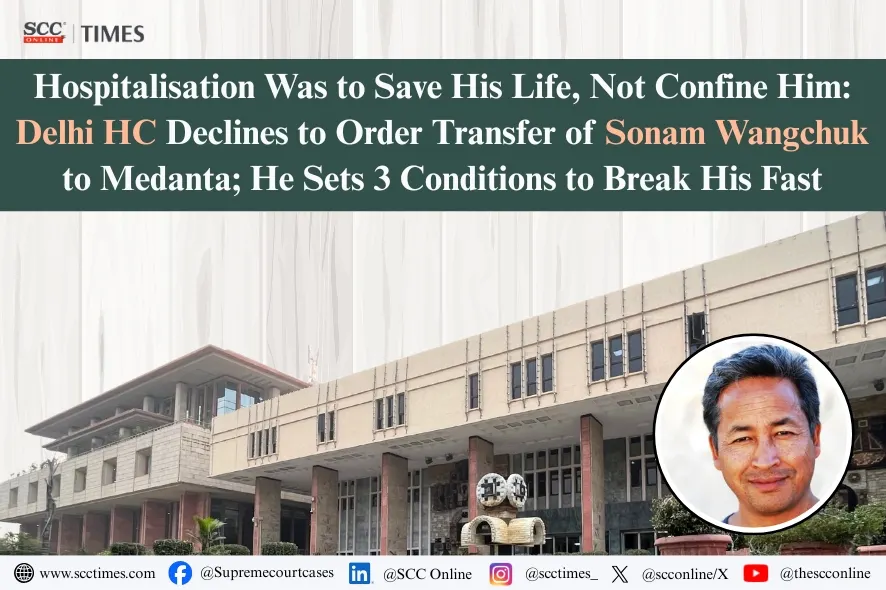
Delhi High Court: In a writ petition filed by petitioner, Sonam Wangchuk’s wife, challenging State’s decision to shift Sonam Wangchuk to Safdarjung Hospital, owing to his deteriorating health during a prolonged hunger strike as an arbitrary deprivation of liberty and seeking permission to shift him to any other medical facility of his choice, the Single Judge Bench of Mini Pushkarna, J., denied to issue interim orders at the present stage.
The Court held that the decision to shift Sonam Wangchuk to Safdarjung Hospital was a necessary response to his deteriorating medical condition and in compliance with the earlier directions of the Division Bench in Rakesh Kumar Saini v. Union of India, W.P.(C) 9498/2026, dated 16 July 2026, and therefore could not be regarded as arbitrary. Noting the alarming decline in his vital health parameters, the Court found no violation of bodily autonomy since only consented medical treatment had been administered. It further held that transferring him from the protest site to the hospital did not prima facie infringe his personal liberty, as the intervention was solely to preserve his life. Emphasising that “the government was under a bounden duty to take measures to ensure well-being of Mr Sonam Wangchuk”, the Court reiterated that “life of every citizen is precious” and must be protected.
Background
Sonam Wangchuk is a prominent Indian engineer, innovator, education reformer, and environmental activist from Ladakh. He joined the ongoing protest, on 28 June 2026, at Jantar Mantar which stemmed from systemic examination irregularities surrounding national-level exams like NEET, CUET, and CBSE and multiple high-profile paper leaks, most notably involving the NEET-UG medical entrance exam, which compromised the futures of millions of students. The protesters are explicitly demanding the resignation of the Union Education Minister, Dharmendra Pradhan, holding the ministry accountable for failing to secure the examination system.
Sonam Wangchuk, on 18 July 2026, was shifted to the Safdarjung Hospital for “essential medical care” on expert medical advice due to his deteriorating health condition.
The petitioner approached the Court under Article 226 of the Constitution seeking a direction permitting her husband to be shifted from Safdarjung Hospital, New Delhi, to Medanta Hospital, Gurugram, or any other medical facility of his choice.
Separately, and outside the scope of the present order, as of 20 July 2026, Sonam Wangchuk has publicly stated that he will break his fast only if three conditions are met:
-
The Central Government must publicly accept responsibility for the failures in the education system, particularly issues highlighted by recent examination controversies.
-
Leaders from political parties must meet him and assure him that they will raise the issue of education reforms and accountability during the Monsoon Session of Parliament.
-
There must be a clear commitment to discuss and address education-related concerns in Parliament, ensuring that meaningful action is taken instead of only making promises.
Parties’ Contentions
The petitioner asserted that the family had already coordinated with Medanta Hospital and had no objection if doctors from AIIMS and Safdarjung Hospital continued to participate in his treatment. It was submitted that Sonam Wangchuk had previously undertaken hunger strikes lasting 30—35 days and had the capacity to withstand prolonged fasting. The petitioner further contended that he had been confined to Safdarjung Hospital without his or his family’s consent despite not being under detention for any offence. The presence of police personnel around his hospital room was also questioned as an unjustified restriction on his liberty.
The Union of India opposed the plea, submitting that Sonam Wangchuk’s health had deteriorated significantly during his prolonged fast of approximately 17—18 days. His vital parameters were progressively worsening, necessitating immediate hospitalisation. Medical records signed by the Medical Board supervising his treatment were placed before the Court. The Government also relied upon an earlier Division Bench order, directing continuous medical monitoring and all necessary medical intervention to protect his life.
The Court was informed that Sonam Wangchuk’s sugar, sodium and potassium levels had fallen below normal, with potassium reaching dangerously low levels capable of causing life-threatening complications. At the same time, the doctors clarified that no intravenous fluids had been administered because he had not consented to such treatment. Only sugar-free oral electrolytes, syrup Potklor and potassium chloride were being administered with his consent.
Also Read: “NTA has not learnt its lesson yet”: Supreme Court issues notice to NTA in NEET Paper Leak case
Reasoning
The Court found that the State’s decision to shift Sonam Wangchuk to Safdarjung Hospital was taken because of his precarious medical condition and in compliance with the earlier directions issued by the Division Bench. Therefore, “the same cannot be considered to be as an arbitrary action”.
The Court observed that the medical evidence demonstrated serious deterioration in his health, including abnormally low sugar, sodium and potassium levels. Since only oral electrolytes and medicines had been administered with his consent, “it cannot be said that any force is being used against Mr Sonam Wangchuk or that his bodily autonomy is being violated in any manner, whatsoever”.
Rejecting the argument based on personal liberty, the Court held that taking him from the protest site to the hospital “does not prima facie infringe the personal liberty of Mr Sonam Wangchuk”, as the action was undertaken solely to protect his life in view of his vulnerable medical condition.
The Court further emphasised that where an individual refuses hospitalisation despite deteriorating health, “the government was under a bounden duty to take measures to ensure well-being of Mr Sonam Wangchuk”. Reiterating the Division Bench’s earlier observation that “life of every citizen is precious”, the Court concluded that “has to be taken care of”.
The Court also took note of the exceptional access granted to family members and found no material suggesting unlawful confinement or denial of visitation rights. Since the Medical Team was continuously monitoring the patient’s condition and treatment decisions remained guided by accepted medical protocols, no case for interim interference was made out.
Decision
The Court declined to grant interim relief and refused to direct the transfer of Sonam Wangchuk to another hospital at this stage. It directed the respondents to file a status report within 3 days.
The Court further directed the Medical Team to continue monitoring Sonam Wangchuk’s condition and take appropriate decisions strictly in accordance with medical protocols for protecting his life and ensuring his safety. Medical reports were to be shared with his family.
The matter was listed for 24 July 2026.
[Gitanjali J. Angmo v. Union of India, 2026 SCC OnLine Del 5183, decided on 19-7-2026]
*Judgment Authored by Justice Mini Pushkarna
Advocates who appeared in this case:
For the Petitioner: Mr. Kapil Sibal, Sr. Adv., Mr. Vivek Tankha, Sr. Adv., Mr. Akhil Sibal, Sr. Adv. with Ms. Bahuli Sharma, Ms. Susan Maria Mathew, Mr. Yoshit Jain, Mr. Suryaansh Kishan Razdan and Ms. Ridhi Arora, Advs.
For the Respondent 1: Mr. Tushar Mehta, Solicitor General of India, Mr. Chetan Sharma, Addl. Solicitor General of India, Mr. Ashish K. Dixit, CGSC with Mr. Umar Hashmi and Mr. Ayush Kumar, Advs. for R-1, 3 & 4, along with Dr. Charu Bamba (MS), Dr. Akshay Kumar (Prof. EMD), and Mr. Arin Choudhary, (Head EMD)
For the Respondent 2: Mr. Sameer Vashisht, Standing Counsel (Civil) GNCTD with Ms. Harshita Nathrani, Advs.