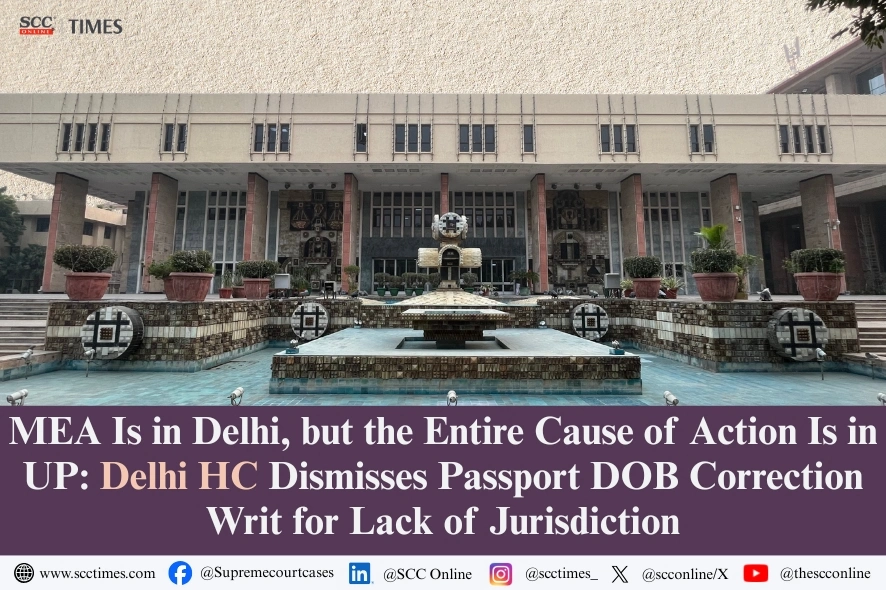
Delhi High Court: In a writ petition seeking correction of the petitioner’s date of birth in his passport and removal of the Emigration Check Required (ECR) status, a Single Judge Bench of Swarana Kanta Sharma, J., dismissed the petition as not maintainable for want of territorial jurisdiction. The Court held that the mere location of the Ministry of External Affairs in Delhi does not, by itself, confer territorial jurisdiction under Article 226(2) of the Constitution when the entire cause of action has arisen outside Delhi. Observing that the birth certificate was issued and corrected in Agra, the passport was issued and renewed by the Regional Passport Office, Ghaziabad, and the impugned communication also emanated from Ghaziabad, the Court concluded that no part of the cause of action had arisen within the territorial jurisdiction of the Delhi High Court and granted liberty to the petitioner to approach the appropriate forum, including the Allahabad High Court.
Background
The petitioner filed the present writ petition under Article 226 of the Constitution seeking correction of his date of birth in his passport and removal of the ECR status, while assailing the communication dated 4 August 2025 issued by the Regional Passport Office, Ghaziabad, rejecting his request. The petitioner submitted that though his actual date of birth is 9 November 2003, his birth certificate had erroneously recorded it as 9 September 2003, which was subsequently corrected by the Registrar (Births and Deaths), Agra, in 2006. However, owing to the inadvertent submission of the earlier erroneous birth certificate by his parents at the time of obtaining his passport, the incorrect date of birth continued to be reflected in the passport issued in 2011 and its subsequent renewals in 2016 and 2021. Upon attaining majority, the petitioner applied for renewal of his passport on the basis of the corrected birth certificate and other identity documents reflecting his correct date of birth, but the request was rejected, leading to the present petition.
At the outset, the respondents raised a preliminary objection to the territorial jurisdiction of the Delhi High Court. While the petitioner contended that the Court had jurisdiction since the Ministry of External Affairs, under whose administrative control the Regional Passport Office functions, is situated in Delhi, the respondents argued that the entire cause of action had arisen in Uttar Pradesh, where the impugned communication was issued and all relevant documents, including the birth certificate and passport, originated. The respondents, therefore, urged the Court to dismiss the petition for lack of territorial jurisdiction, leaving it open to the petitioner to approach the competent High Court.
Issue
Whether the High Court has territorial jurisdiction under Article 226 of the Constitution of India to entertain the present writ petition.
Analysis
The Court observed that the original birth certificate, though initially recording the petitioner’s date of birth incorrectly, had been corrected by the Registrar (Births and Deaths), Agra Municipal Corporation, in 2006. However, owing to the inadvertent submission of the earlier birth certificate at the time of applying for a passport, the incorrect date of birth continued to be reflected in the passport issued and subsequently renewed by the Regional Passport Office, Ghaziabad. The Court noted that both the authority which issued and corrected the birth certificate and the authority which rejected the petitioner’s request for correction were situated in the State of Uttar Pradesh and that the petitioner was also a resident of Uttar Pradesh. Consequently, the authorities directly connected with the petitioner’s grievance were located outside the territorial jurisdiction of the Delhi High Court.
Placing reliance on Kusum Ingots & Alloys Ltd. v. Union of India, (2004) 6 SCC 254; State of Goa v. Summit Online Trade Solutions (P) Ltd., (2023) 7 SCC 791, and its earlier decision in Suresh Kumar v. Union of India1, the Court reiterated that the mere location of the Ministry of External Affairs in Delhi could not, by itself, confer territorial jurisdiction under Article 226(2) of the Constitution. The Court held that territorial jurisdiction is determined by the place where the cause of action arises and not by the location of the seat of the Union Government or the authority administering the statute. Since the petitioner’s birth certificate was issued and corrected in Agra, the passport was issued and renewed by the Regional Passport Office, Ghaziabad, and the impugned communication also emanated from Ghaziabad, the entire bundle of material facts giving rise to the cause of action had arisen within the State of Uttar Pradesh.
Decision
Holding that no part of the cause of action had arisen within its territorial jurisdiction, the Court sustained the preliminary objection and dismissed the writ petition as not maintainable, while granting liberty to the petitioner to avail appropriate remedies before the competent forum, including the High Court of Judicature at Allahabad.
[Chintan Agrawal v. Union of India, W.P.(C) 8743 of 2026, decided on 9-7-2026]
Advocates who appeared in this case:
For the Petitioner: Manu Padalia, Advocate
For the Respondent: Vijay Joshi, CGSC Vinay Kaushik, GP
1. W.P. (C) 6172 of 2011.