


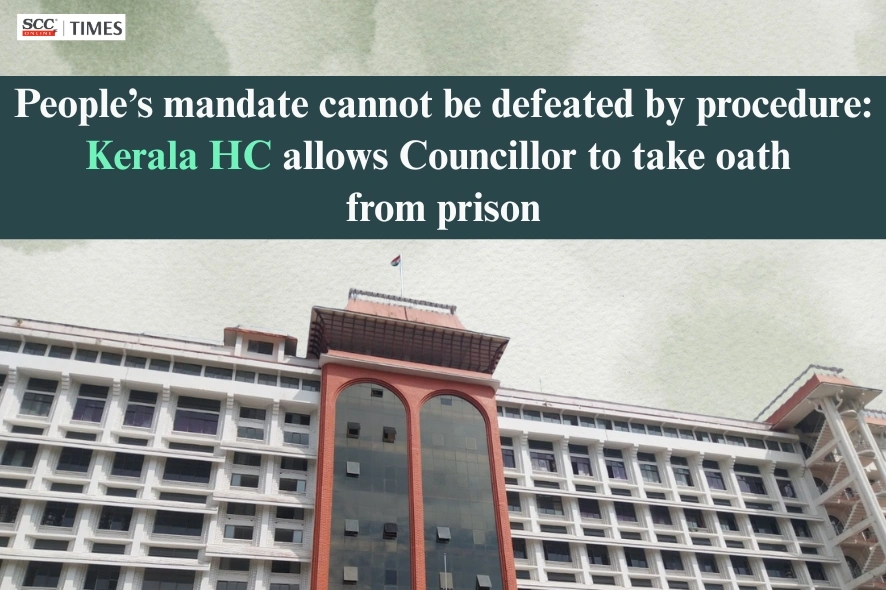
Kerala High Court: In a writ petition concerning the swearing-in of an elected Municipal Councillor detained under the Kerala Anti-Social Activities (Prevention) Act, 2007 (KAAPA), a Single Judge Bench of P.V. Kunhikrishnan, J., held that while a person detained under the Kerala Anti-Social Activities (Prevention) Act, 2007 (KAAPA) cannot be released from custody, the democratic mandate of the electorate cannot be frustrated due to procedural difficulties.
The Court directed that the petitioner’s fresh oath-taking ceremony be conducted inside the Central Prison, Viyyur, where he was detained under preventive detention, in the presence of the Mayor and the minimum required officials of the Corporation. The Court further permitted accredited media personnel to cover the swearing-in ceremony.
The Court stated that:
“Democracy, as envisaged under the constitution, is not a mere majoritarian exercise, but a structured process governed by established procedures and normative principles.”
Background
The petitioner, an elected Councillor from Ward No. 20 (Vazhottukonam) of the Thiruvananthapuram Municipal Corporation, was elected in the local body elections held on 9 December 2025, with the results declared on 13 December 2025. He had initially taken oath on 21 December 2025 and assumed office as a Councillor.
Subsequently, the High Court, in an earlier judgment, held that the oath administered to the petitioner and certain other Councillors was not in accordance with the provisions of the Kerala Municipality Act, 1994, and directed them to take a fresh oath within the prescribed period.
While other Councillors complied with the direction, the petitioner was unable to take the fresh oath as he was detained under a preventive detention order issued under KAAPA. Although the Judicial Magistrate granted interim bail to facilitate his oath-taking, he continued to remain in preventive detention and could not attend the scheduled ceremony at the Corporation office
Analysis and Decision
The Court observed that since the petitioner was detained under KAAPA, he could not be released from custody to attend the swearing-in ceremony. However, it noted that if the petitioner was unable to take the oath, the majority of the ruling party in the Corporation would be affected. Considering the importance of respecting the electorate’s mandate in a democracy, the Court directed the Director General of Prosecution (DGP) to explore the possibility of conducting the oath-taking ceremony inside the jail premises. The Court noted the submission of the DGP that, under Article 22(3) of the Constitution of India, a person detained under preventive detention cannot claim release from custody. However, if this Court orders, the State is ready make necessary arrangements for administering the oath inside the prison.
The Court observed that disallowing the petitioner from taking the oath would result in serious consequences and affect the democratic process. It held that while democratic procedures must be strictly followed, the mandate of the people cannot be defeated due to a procedural lapse.
The Court remarked that when extraordinary circumstances arise, extraordinary measures may be required to protect democratic principles and uphold the will of the electorate. Accordingly, the Court held that the present case was a fit instance where the petitioner should be permitted to take the oath inside the jail.“When the very pulse of democracy is made to collapse over a solitary, disputed oath, the duty of this court is to uphold the democracy.”
Accordingly, the Court disposed of writ with the following directions:
-
The Superintendent, Central Prison, Viyyur, shall make necessary arrangements for conducting the petitioner’s swearing-in ceremony inside the prison.
-
The Mayor and the minimum number of required officials of the Thiruvananthapuram Municipal Corporation shall be permitted to enter the prison for administering the oath
-
Accredited media personnel shall be allowed access to cover the swearing-in ceremony.
[Sugathan R. v. State of Kerala, 2026 SCC OnLine Ker 6779, decided on 13-7-2026]
Advocates who appeared in this case:
For the Complainant: Advocate Suvin.R.Menon, Vijayakumar, T.C.Krishna, Parshathy S.R., Govind P., AChuth Krishnan R., Cristy Therasa Suresh
For the Respondent: Advocate T. Asaf Ali, R.V. Srrejith