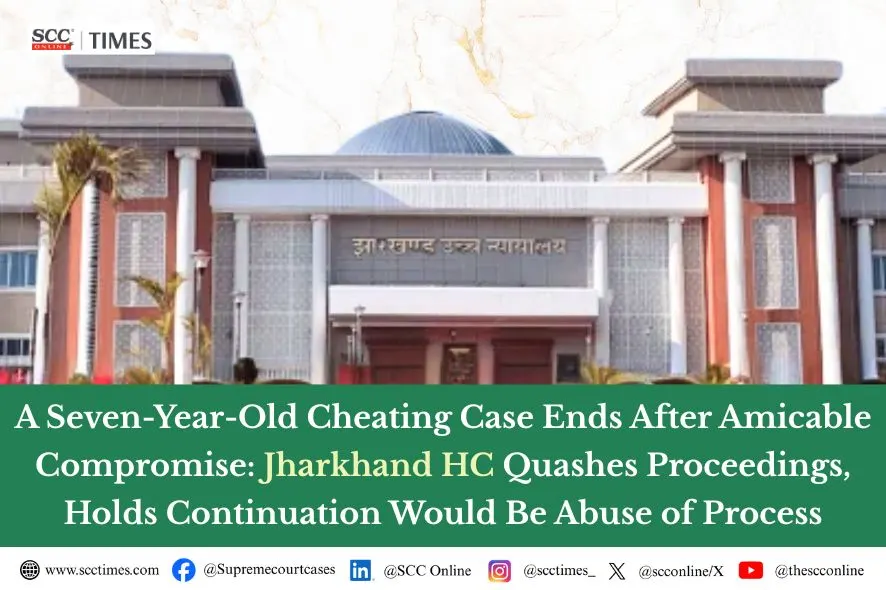
Jharkhand High Court: The Single Judge Bench of Anil Kumar Choudhary, J., quashed the criminal proceedings under Section 420, Penal Code, 1860 (IPC) after the parties amicably settled their private dispute during the pendency of the complaint case. The petitioner sought quashing on the basis of a genuine compromise, submitted by both the parties. The Court held that continuation of the criminal proceedings would amount to abuse of process of law.
Background
The case arose from a complaint filed for the offence punishable under Section 420 IPC against the petitioner. Following the complaint, a criminal proceeding was initiated against the accused-petitioner by the Judicial Magistrate First Class (JMFC), Dhanbad on 2 July 2019. While the case was still pending before the JMFC the petitioner and Respondent 2 (complainant’s wife) entered into a compromise after intervention of the friends as well as the well-wishers. As a result of compromise the petitioner filed a petition invoking the jurisdiction of the Court under Section 528, Nagarik Suraksha Sanhita, 2023 (BNSS), with the prayer to quash the entire criminal proceeding including order passed on 2 July 2019. The petitioner mentioned that the said case was still pending before the learned JMFC and the charge was not yet been framed in this case.
The parties in support of their submission, placed the reliance upon the interlocutory application accompanied by affidavits sworn by Respondent 2 as well as the Pairvikar-cum-nephew of the petitioner. The application categorically stated that the parties had amicably resolved their disputes through a compromise after the intervention of their friends and well-wishers. It was further stated that all disputes giving rise to the criminal proceedings had been settled. The petitioner submitted that the dispute between the parties was a private dispute and no public policy was involved in the case. It was argued that the compromise was genuine, voluntary, and not opposed to public policy. The petitioner next submits that in view of the compromise between the parties, the continuation of the criminal proceeding will amount to abuse of process of law and the chances of conviction of the petitioner was remote and bleak. Hence, it was submitted that the entire criminal proceeding be quashed and set aside.
The State also acknowledged the compromise entered into between the parties and fairly submitted that it had no serious objection to the quashing of the criminal proceedings. The prosecution recognised that the dispute had been amicably resolved and that continuation of the proceedings would not advance the cause of justice.
Decision and Analysis
The Court after carefully going through the materials available on record, proceeded to consider the legal principles governing the exercise of its inherent jurisdiction to quash criminal proceedings on the basis of compromise. The Court referred to the decision of the Supreme Court in Parbatbhai Aahir v. State of Gujarat, (2017) 9 SCC 641, wherein the Supreme Court comprehensively laid down the principles governing the exercise of inherent powers under Section 482, Criminal Procedure Code, 1973, which are now reflected in Section 528 BNSS. The Supreme Court held that criminal proceedings involving private disputes may be quashed where the parties have settled the matter, provided the offences are not heinous or of such a nature as to affect society or public interest.
The Court held that the offences involved in the case are not heinous offences nor does it constitute any offence of mental depravity rather the same relates to a petty private dispute between the parties. Due to the complete settlement between the petitioner and the respondent, the possibility of conviction of the petitioner was remote and bleak. The Court considered that the continuation of the criminal case would put the petitioner to great oppression and prejudice, which will be extreme injustice to him by not quashing the criminal case despite full and complete settlement with the victim.
The Court found that the compromise entered into between the petitioner and the complainant was genuine and complete, leaving no surviving grievance between them. The Court allowed the petition and quashed the entire criminal proceeding, including the order dated 2 July 2019 passed by the learned JMFC, Dhanbad taking cognizance under Section 420 IPC in the complaint. As a consequence, all proceedings pending against the petitioner in the said complaint case stood terminated.
[Pappu Kumar Saw v. State of Jharkhand, 2026 SCC OnLine Jhar 1002, decided on 25-6-2026]
*Judgment authored by: Justice Anil Kumar Choudhary
Advocates who appeared in this case:
For the Petitioner: Rahul Pandey, Kaushiki Mishra,
For the Respondent: Vishwanath Roy, Spl.P.P., Ankit Apurva, Advocate
Buy Penal Code, 1860 HERE

Buy Code of Criminal Procedure, 1973 HERE