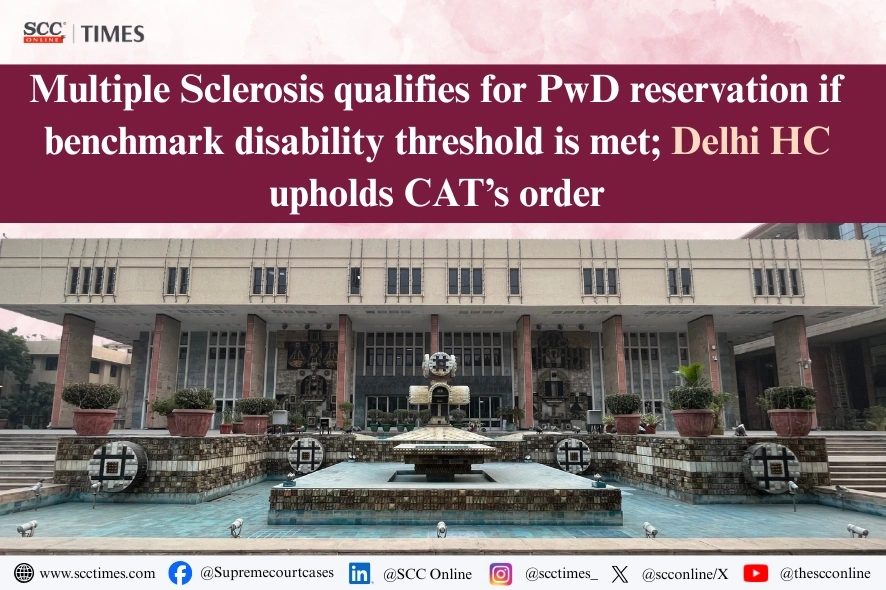
Delhi High Court: In a writ petition filed by Union of India against the decision passed by Central Administrative Tribunal (CAT), which had set aside the cancellation of a candidate’s candidature for appointment against a vacancy reserved for Persons with Disabilities (PwD), the Division Bench of C. Hari Shankar* and Vinod Kumar, JJ. upheld the impugned decision and held that a candidate suffering from multiple sclerosis, along with another specified disability, is entitled to the benefit of reservation under the Rights of Persons with Disabilities Act, 2016, (RPWD Act), provided the prescribed threshold for benchmark disability is satisfied.
Background
The Staff Selection Commission (SSC) issued a notification dated 23 December 2021 inviting applications for the Combined Graduate Level Examination (CGLE) 2021 for recruitment to various posts, including vacancies reserved for PwD.
The respondent suffers from multiple sclerosis of the brain along with low vision in both eyes. She possessed a disability certificate dated 5 October 2021 issued by the Department of Empowerment of Persons with Disabilities, Ministry of Social Justice and Empowerment. The certificate recorded that she had low vision resulting in 15% impairment and multiple sclerosis resulting in 30% impairment, with an overall disability of 45% (as recorded by the Court), thereby qualifying as a person with benchmark disability under the RPWD Act.
The respondent successfully cleared all stages of the selection process and was called for document verification. However, her candidature was rejected on the ground that “Multiple Sclerosis Disease was not admissible for reservation.” Consequently, her name was not included in the result declared on 13 May 2023.
Aggrieved by the rejection, the respondent approached the Central Administrative Tribunal (CAT), which allowed her application and directed consequential reliefs. The Union of India challenged the Tribunal’s decision before the Delhi High Court.
Issue
Whether a candidate suffering from multiple sclerosis, along with another specified disability, could claim reservation benefits under Section 34 Rights of Persons with Disabilities Act, 2016, if the combined disability percentage met the threshold of 40%.
Analysis and Decision
The Court observed that Section 34(1) RPWD Act contains two distinct components. The first part imposes a statutory obligation on establishments to reserve not less than 4% of vacancies for persons with benchmark disabilities. The second part merely explains the distribution of such reservation among different categories of disabilities. The Court held that the second part cannot restrict or narrow the scope of the first part.
The Court noted that a “person with benchmark disability” under Section 2(r) RPWD Act means a person with not less than 40% of a specified disability. A “specified disability” is defined under Section 2(z)(c) as disabilities mentioned in the Schedule to the Act.
The Court specifically relied on Clause 4(a)(i) of the Schedule, which recognises multiple sclerosis as a chronic neurological condition and therefore a specified disability under the RPWD Act.
The Court held that since multiple sclerosis is a specified disability, a person suffering from multiple sclerosis, either independently or along with another specified disability, would be entitled to reservation if the overall disability satisfies the benchmark disability threshold of 40%.
The Court further observed that the RPWD Act is a beneficial legislation intended to promote inclusion and equal opportunities for persons with disabilities. Relying on Supreme Court decisions including Vikash Kumar v. UPSC, (2021) 5 SCC 370, Ravinder Kumar Dhariwal v. Union of India, (2023) 2 SCC 209 and In Re: Recruitment of Visually Impaired in Judicial Services, 2025 SCC OnLine SC 481, the Court reiterated that provisions of the RPWD Act must receive an expansive interpretation rather than a restrictive one.
The Court further observed that “mental illness” is expressly included under Section 34(1)(d) RPWD Act and is defined in the Schedule to the Act. Relying on authoritative material published by the World Health Organization (WHO), which recognises neurodevelopmental disorders as including behavioural and cognitive disorders affecting intellectual, motor, language, or social functions, the Court held that multiple sclerosis, being at least a neurodevelopmental disorder, could also be treated as a form of “mental illness” for the purposes of Section 34(1) RPWD Act. The Court found no error in the Tribunal’s interpretation, noting that such an approach was consistent with the inclusive object and philosophy of the RPWD Act.
The Court also noted that the SSC’s own examination notification and disability certificate format included multiple sclerosis as one of the disabilities eligible for PwD reservation. Therefore, the SSC could not disregard a valid disability certificate issued by a competent authority under the RPWD Act.
The Court held that:
-
Multiple sclerosis is a specified disability under the RPWD Act, 2016.
-
A person suffering from multiple sclerosis, either alone or along with another specified disability, is entitled to PwD reservation if the disability percentage meets the statutory threshold.
-
The SSC was not justified in rejecting the respondent’s candidature on the ground that multiple sclerosis was not admissible for reservation.
-
The disability certificate issued by the competent authority under the RPWD Act had to be recognised and could not be disregarded by the recruiting authority.
Accordingly, the Court dismissed the Union of India’s writ petition and upheld the Tribunal’s direction granting relief to the respondent.
[Union of India v. Preeti Vaid , 2026 SCC OnLine Del 5006, decided on 8-7-2026]
*Judgment by: Justice C. Hari Shankar
Advocates who appeared in this case:
For Appellant: Ankit Raj, SPC, Saurabh Mishra, Adv.
For Respondent: R.K. Handoo, Adv.