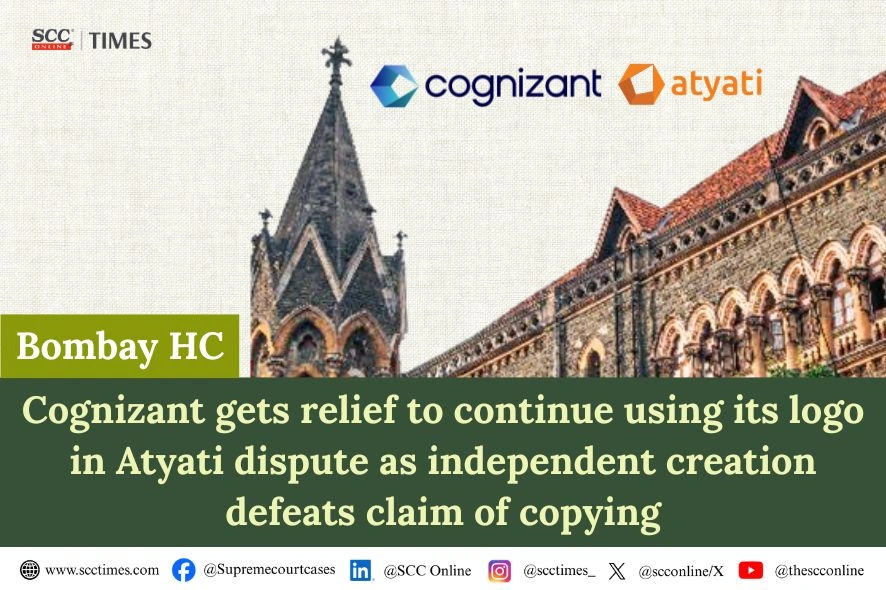
Bombay High Court: In Atyati-Cognizant dispute, while considering an interim application in a commercial intellectual property suit alleging copyright infringement and passing-off in respect of a logo device mark, a Single Judge Bench of Sharmila U. Deshmukh, J., held that the defendants had prima facie established independent creation of the impugned logo and that the plaintiff had failed to demonstrate reasonable opportunity of access, copying, goodwill in the standalone logo, or likelihood of confusion. Consequently, the Court dismissed the interim application and allowed Cognizant to continue using its logo.
Background
The plaintiff was incorporated in 2006 and the house mark “ATYATI” which was also part of its corporate name, was conceived and adopted in 2008. The plaintiff offered its services relating to information technology infrastructure, software development for banking and financial services and consulting services as well as stationery, e-books, material and allied products in relation thereto through its well-known mark –  . In 2019, as part of its rebranding exercise, the plaintiff created and adopted a unique and distinctive logo/device
  to be used along with the plaintiff’s corporate name/mark “ATYATI”. The “ATYATI” device mark was created in house by the plaintiff, and it was asserted that it qualified as original, artistic work and the ownership subsisted in the plaintiff.
The plaintiff submitted that in October 2023, it acquired knowledge about the defendants offering identical services under the mark/logo  consisting of the mark/logo
  as its prominent and leading feature. The plaintiff asserted that the overall look, layout and placement of the essential features of its logo including similar hexagonal honeycomb/hive device resembling the shape of the alphabet “C” were copied. A cease-and-desist notice was issued, but the defendants refused to comply with it. The plaintiff thereafter instituted the suit and, at the interim stage, confined its prayer to copyright infringement and passing-off, and to the impugned logo and not the word mark “COGNIZANT”.
The plaintiffs submitted that even accepting that the defendants were using the impugned mark/logo since March 2022, there was no dispute to the fact that the plaintiff was the prior adopter, user of the trade mark and “ATYATI” device. It was argued that minor variations in angle or colouring were inconsequential and the correct test to determine was whether the average viewer after having seen both the logos was clearly of the opinion that the subsequent work was a copy of the original work.
On the other hand, the defendants contended that the impugned logo was independently designed in the United States with no prior knowledge of the plaintiff’s existence. The logo was a unique representation and rendition of alphabet “C” being directly associative and reminiscent of defendant’s name/mark “COGNIZANT”. It was argued that there was no actionable similarity under the trade mark law and copyright law and no case was made for passing-off. It was stated that the plaintiff had secured the registration of an independent logo in Classes 35—42 on 20 October 2022, and the plaintiff’s mark was a composite logo  whereas it asserted its claim for infringement by primarily relying upon the component thereof i.e.
  which was neither distinctive of the plaintiff by itself nor separately registered.
The defendants further submitted that the plaintiff’s logo had not acquired distinctiveness or had become synonymous with their business in the minds of the consumer and alleged use of the logo since 2019 was relatively recent, allegedly sporadic and unsubstantiated and therefore, no case of misrepresentation or deception was made out and there was no likelihood of harm and damage.
Also Read: Delhi HC Restrains Unauthorized Use of “The Pioneer” in Trademark Dispute
Analysis
The Court framed issues concerning ownership of copyright, similarity of logos, inference of copying, proof of access, independent creation and passing-off, including reverse passing-off.
At the outset, the Court noted that the plaintiff’s adoption and use of its logo since 2019 was undisputed. The defendants sought to challenge originality by relying upon an allegedly similar logo used by a Spanish entity since 2015. The Court, however, observed that the mere existence of a similar logo elsewhere in the world could not establish copying. The Court highlighted that what undermines originality is copying and not simply chronological priority. Since there was no material demonstrating that the plaintiff had a reasonable opportunity to view the Spanish logo, the Court held that the plaintiff had prima facie established ownership of copyright in its “ATYATI” logo.
The Court relied on R.G. Anand v. Delux Films, (1978) 4 SCC 118, and reiterated that copyright protects the form, manner, arrangement and expression of an idea rather than the idea itself. The Court noted that both logos consisted of a resembling hexagonal honeycomb-type device shape with colour contrast and whereas the “ATYATI” logo was inclined upwards, the Cognizant logo was positioned horizontally. The Court opined that there was resemblance between the rival logos by adoption of the single element of hexagonal shape.
The Court noted that both parties traced the conceptual foundation of their logos to a stylised representation of the letter “C” in geometric form. According to the Court, when an abstract concept is expressed through a geometric structure, similarities in expression are bound to occur. Consequently, similarity alone could not justify an inference of copying.
The Court referred to Copinger and Skone James on Copyright, and observed that proof of infringement ordinarily requires both similarity and evidence demonstrating opportunity of access. The Court highlighted that direct evidence of copying is rarely available and that courts frequently infer copying from circumstantial evidence, provided there is material indicating a reasonable possibility of viewing the copyrighted work.
The Court then examined the extensive documentary record produced by the defendants and noted that the documents reflected an elaborate design exercise commencing in December 2020 and progressing through multiple stages before selection of the final logo. The Court opined that it was unfathomable that the defendants would have undertaken such a detailed process of surveys, refinement and branding documentation merely to copy the ATYATI logo.
On the issue of access, the Court noted that the plaintiff’s case rested largely on the defendants’ presence in India, the fact that a major portion of their employees were Indian nationals and the defendant’s representative providing the conceptual brief to the designers. However, the Court opined that keeping in mind the magnitude of the defendant’s corporate existence, it was impossible to accept that merely because the employee force comprised Indian nationals, the defendant’s personnel involved in the rebranding process in the United States had the opportunity of viewing the plaintiff’s work, given that the time distance between the adoption of the plaintiff’s logo in 2019, and the process of creation of the Cognizant logo was relatively short. The Court therefore observed that the defendants had prima facie established independent creation of the logo and opined that because of the absence of material to infer reasonable opportunity to access the plaintiff’s logo, the claim for copyright infringement at interim stage must fail.
Turning to passing-off, the Court considered the plaintiff’s argument that the case involved reverse passing-off. It was contended that defendant being the junior user with its financial abilities and market standing would swamp the market and would eclipse the plaintiff who was comparatively smaller in the relevant market, causing damage. The tort of reverse passing off resulted in damage to the senior user by loss of value of its trade mark and its product identity.
The Court highlighted that passing off is not codified and the test remains the same of goodwill, misrepresentation and damage. The Court opined that it is the nature and effect of misrepresentation which is material and not the direction of misrepresentation whether forward or reverse which would affect the action of passing-off. The statutory provision would also include a scenario where the goods originate from the plaintiff but are likely to be misrepresented as originating from the defendant, and in such an event, a case of reverse passing-off occurs.
The Court referred to Sheila Mahendra Thakkar v. Mahesh Naranji Thakkar, 2003 SCC OnLine Bom 441, wherein it was held that reverse passing off or inverse passing off is not a distinct nominate tort but a further example of actionable misrepresentation to which normal principles of passing-off would apply. Thus, the Court observed that the test of goodwill and reputation, misrepresentation and damage are applicable tests even in the case of reverse passing-off.
The Court opined that as the plaintiff claimed passing-off in respect of its standalone logo de hors the wordmark “ATYATI”, it must demonstrate that the logo by itself when viewed by the customers would be associated only with the plaintiff and no one else. The Court noted that the sales turnover which was brought on record was in respect of composite mark i.e. logo with house mark “ATYATI” and not the standalone mark.
The Court observed that it was the word “ATYATI” which was the essential feature of the plaintiff’s mark, and that there were no goodwill and reputation demonstrated by the plaintiff in respect of the standalone logo. The Court noted that even though both the parties belonged to the information technology service space, there was distinct separation of nature and scale of services which were being offered and the class of customers who availed these services. The plaintiff’s customer segments included public sector banks, regional rural banks whereas the defendant’s customers were Fortune 500 corporations including global MNCs. The Court opined that since the defendant rendered services to institutional clients who were discerning, there would not be any confusion that the plaintiff’s services were that of the defendant.
The Court opined that even applying the doctrine of reverse confusion, there was no basis to conclude that informed purchasers of specialised technology services would assume that the plaintiff’s services originated from or were connected with the defendants merely because of resemblance between the logos. Accordingly, the Court held that the plaintiff had failed to establish goodwill, misrepresentation or damage and therefore failed to satisfy the traditional tests of passing-off or reverse passing-off.
Also Read: MakeMyTrip Trademark infringement case
Decision
Dismissing the interim application, the Court held that the defendants had prima facie discharged the burden of establishing independent creation of the Cognizant logo, and that no case of copyright infringement was made out. The Court further held that the plaintiff had failed to establish the ingredients necessary to sustain a claim for passing-off or reverse passing-off. Accordingly, interim relief was refused.
[Atyati Technologies (P) Ltd. v. Cognizant Technology Solutions US Corpn., 2026 SCC OnLine Bom 5210, decided on 7-7-2026]
Advocates who appeared in this case:
For the Plaintiff: Ravi Kadam, Senior Advocate a/w Hiren Kamod i/b Abhishek Adke, Advocates.
For the Defendants: Virag Tulzapurkar, Senior Advocate a/w Rashmin Khandekar, V. Mohini, Aarti Agarwal, Karan Khiani, Rohan Lopes and Anand Mohan i/b Rashmi Singh and Karan Khiani, Venkatesh Dhond, Senior Advocate.