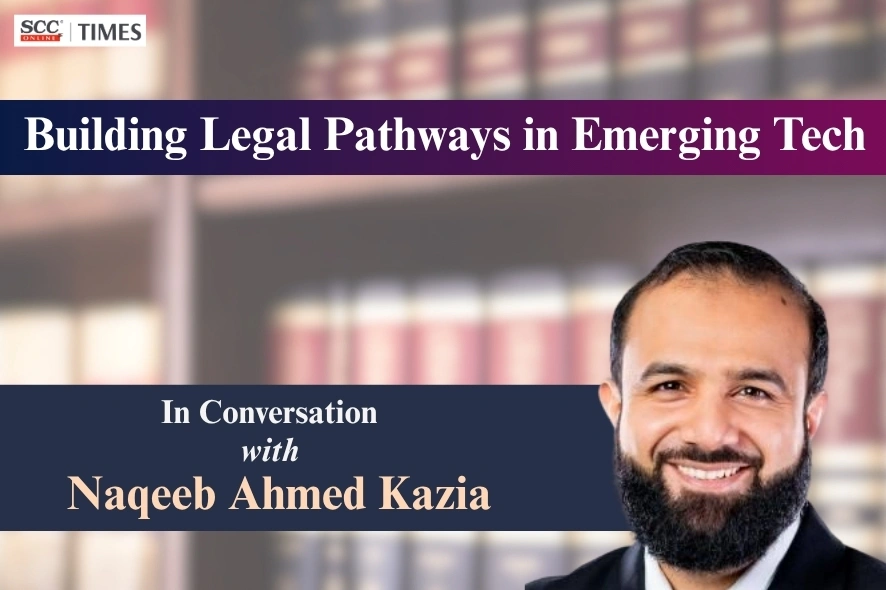
1. To begin with could you start by giving us a glimpse into your journey from a law student to entering the professional field? What was your motivation to study law?
I always knew I would be a lawyer, my father practised in disputes and real estate, and the legal world was familiar and close. But I was not particularly drawn to what he did. From as early as Class 7 or 8, I was the kind of person who read tech magazines, followed gadget launches, and genuinely loved the way technology worked and what it could do. Technology, Media, and Telecommunications law (TMT) felt like a perfect marriage of law and tech which sort of dragged me closer to this space. When I started at Vaish I did not do a lot of tech but luckily at Kochhar & Co. I worked with one of the best tech lawyers in the country, which became the start of my journey in the TMT space.
2. How has it been working in the TMT space over the course of your career?
The honest answer is that what I was doing in the early years of my practice bears very little resemblance to what I do today, and that is one of the things I find most energising about this field. TMT has a similar quality to disputes work in one respect: No two matters are alike. The facts change, the technology changes, and very often the law itself is still catching up with both.
When I started, much of the work centred on data privacy, OSP licensing, and telecommunications, which were the foundational regulatory infrastructure of the digital economy. By 2017 and 2018, the first wave of serious cryptocurrency work arrived, followed closely by a fintech boom that kept many of us fully occupied with RBI-side advisory, payment aggregator arrangements, and the regulatory architecture around prepaid payment instruments. Then came the gaming surge, beginning around 2015 and 2016, which brought its own fascinating set of legal questions. Running alongside all of this has been AI, I was advising companies on AI-related matters as far back as 2017, largely by applying first principles of contract and tort law to novel factual situations.
“In TMT, you are usually being handed a new set of facts that the existing law does not address. Your job is to construct a sound, defensible analysis from first principles. It keeps the work intellectually alive.”
3. With law firms adopting AI tools for automation, legal predictions, and contracts, what long-term role do you see AI playing in enhancing efficiency and staying ahead in complex, fast-moving sectors like digital media?
Most law firms of any significant size have already made their first moves in this direction, whether through tie-ups with AI providers or through building internal tools for research, drafting assistance, or management. The efficiency gains are real, but they are heavily dependent on the quality of what goes in. AI is ultimately only as good as the prompts it receives and the training data it is built on.
On the question of whether AI will replace lawyers, I do not think it will, and not simply because I am a lawyer. The reason is trust. There are certain decisions the kind where a client’s reputation or commercial future is at stake and someone who brings professional and ethical obligations to the relationship. We are not close to a world in which a machine can carry that weight. What AI will change is the ratio is teams may become leaner, with junior lawyers taking on more substantive work earlier because the mechanical tasks have been automated away. That is a shift in structure, not a replacement of the profession.
4. Tamil Nadu and Karnataka Governments have attempted to prohibit online gaming, but their laws were partially struck down by the respective High Courts. With courts affirming that games like rummy and poker are games of skill, do you see a pathway emerging for a uniform central regulation? Or is the State-level fragmentation more efficient?
The short answer is that State-level fragmentation was never particularly efficient. States that had enacted their own gaming laws maintained a degree of regulatory certainty within their borders, but the absence of consistent national standards meant that operators were navigating a different legal environment in virtually every jurisdiction they served. The basic legal principle that games of skill are permissible while games of pure chance are not was broadly settled, but its application varied considerably.
What has changed the conversation dramatically is the direction taken under the more recent regulatory framework for online gaming at the Central level. The shift from a relatively hands-off, self-regulatory approach to a framework that in practice prohibits real-money gaming represents a complete reversal of policy direction. The implications have been significant: Funding has contracted, foreign direct investment (FDI) inflows have slowed, and the ripple effects on adjacent industries.
5. Platforms like Stake and other offshore crypto-based casinos indirectly target Indian users. From your advisory experience, how is the legal landscape evolving around such platforms, particularly in terms of user exposure, platform liability, and regulatory response by Indian authorities?
Offshore crypto-based gaming platforms occupy one of the more complex intersections in digital law today. Under the current regulatory framework, the concept of “stakes” is defined broadly to include money or anything of monetary value. Through Section 69-A, Information Technology Act, 2000 the Government has the power to direct the blocking of access to websites and online platforms which is a tool that MeitY can deploy directly against offshore platforms whose services are accessible to Indian users. This means that the geographical location of the operator provides considerably less insulation than it once did. An offshore platform that is actively targeting Indian users is exposed to blocking action even if it has no physical presence in India.
6. The pace of innovation in TMT sectors especially in gaming and fintech has significantly impacted the way legal advice is delivered. From your own practice, how has this rapid evolution shaped your approach to advising fast-scaling startups?
Of all the clients I have worked with — startups, mid-sized companies, and large enterprises, startups particularly present the most intellectually stimulating challenges, and also the most demanding ones. The work, at its best, is a combination of legal analysis and creative problem-solving essentially understanding what the client wants to achieve, identifying where the regulatory constraints lie, and finding the most defensible path through them.
What the pace of innovation in TMT has required of me, as an adviser, is a willingness to engage with the underlying technology and business model in real depth and not just at the level of identifying which regulations apply, but understanding well enough how the product works to anticipate where the regulatory exposure will arise before it becomes a problem.
7. On a lighter note, what is one key trait you believe a young professional should develop as they begin their career in the real world?
If I had to choose just one, I would say this: Learn to be comfortable with people. The law is, at its core, a relationship profession. Your ability to build genuine connections with colleagues, with clients, with opposing counsel, with the broader professional community will shape your career in ways that your technical legal knowledge alone cannot.
Secondly, beyond that and before even entering professional life, I would strongly encourage young lawyers to invest in the practical tools of the trade, learn to type properly, learn Microsoft Word and formatting, and develop a basic literacy in the technology platforms your profession actually uses.
1. Partner, CMS INDUSLAW (Bengaluru Office).
2. Student Ambassador, School of Law, CHRIST University, Bngaluru.