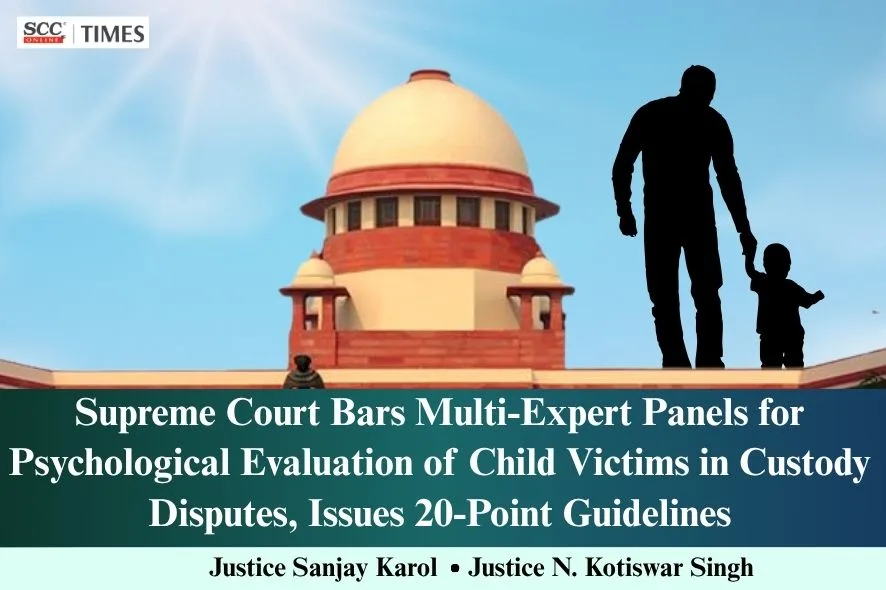
Supreme Court: In a civil appeal challenging the Bombay High Court’s orders dated 27 April 2023 and 7 December 2023 in terms of whether a minor girl child now about 10 years, who was the alleged victim in pending proceedings under the Protection of Children from Sexual Offences Act, 2012 (POCSO Act), could be subjected to psychological evaluation by a 4-member panel of experts, including professionals suggested by the father and experts situated outside Jalgaon and even outside India, constituted by the High Court at the instance of her father, who sought restoration of access and emotional reconnect with the child, the Division Bench of Sanjay Karol and N. Kotiswar Singh*, JJ., held that the High Court had failed to adequately consider the welfare, emotional security and psychological well-being of the minor child while modifying its earlier direction for appointment of an independent expert and constituting a 4-member panel of experts.
The Court held that while courts dealing with custody and visitation disputes are not barred from obtaining expert psychological assistance, such assistance must satisfy the requirements of demonstrable necessity, minimum intrusion, institutional neutrality, proportionality and the paramount consideration of the child’s welfare. The process should remain child-centric and welfare-oriented rather than assume the character of an adversarial inquiry intended to validate or discredit allegations made against either parent. Accordingly, the Court modified the impugned orders and remitted the matter to the Family Court to proceed in accordance with the directions and observations made by this Court.
The Court further framed non-exhaustive or flexible guidelines to be followed while dealing with cases involving psychological or psychiatric evaluation of minor children in proceedings arising out of custody, visitation or parental access disputes.
Factual Matrix
The parties were married on 10 February 2015 at Faridabad, Haryana according to Hindu rites and subsequently shifted to the United States. A daughter was born on 24 June 2016 in New Jersey, USA. The mother alleged that during 2018—2019, while residing in the United States, she suffered physical abuse and the child suffered sexual abuse at the hands of the father when the child was about 2 years old. Following an incident of domestic assault on 29 December 2019, proceedings were initiated before New Jersey police authorities. Apprehending danger to her safety, the mother returned to India on 30 December 2019 along with the child. Thereafter, she issued a notice seeking divorce by mutual consent and monetary settlement.
Disputes subsequently arose concerning custody and access. The father initially approached the Supreme Court through a habeas corpus petition seeking custody, which was withdrawn with liberty to pursue other remedies. Proceedings thereafter continued before the Bombay High Court where limited video access was granted to the father. During those proceedings, the mother raised allegations of sexual abuse of the child and lodged a complaint with Yerwada Police Station, Pune.
The mother also instituted proceedings under the Domestic Violence Act and later sought dissolution of marriage under the Hindu Marriage Act. On 10 February 2021, the Family Court directed continuation of custody with the mother and facilitated visa and OCI-related arrangements for the child’s stay in India.
On 12 April 2021, a Zero FIR was registered under various provisions of the Penal Code, 1860 (IPC) and the POCSO Act. Subsequently, another FIR was registered in Faridabad under identical provisions. The Supreme Court later directed that investigation in both FIRs be conducted at Yerwada Police Station under supervision of a woman ACP officer.
The father repeatedly sought visitation rights, virtual access and interim custody before the Family Court. During the pendency of proceedings, he also sought appointment of an independent psychiatric expert specialising in child psychology to evaluate the child, her living circumstances and both parents with a view to re-establishing connection with the child.
The mother opposed the application contending that the father was facing grave POCSO allegations, the child was already undergoing therapy, further evaluation would adversely affect the child’s mental health, and the POCSO framework required protection of the child from exposure to the accused.
The Family Court rejected the application on 28 April 2022. It observed that relations between the parties had not improved, serious POCSO allegations were pending, exposure of the child to the father would be hazardous, no change in circumstances had occurred, the child was already receiving therapy, and no indirect access should be permitted through psychiatric evaluation. It held that there was no need for an independent child psychiatrist at that stage.
Proceedings Before the High Court
The father challenged the Family Court’s order before the Bombay High Court. By order dated 7 January 2023, the High Court partly allowed the petition. It held that the psychologist’s report produced by the mother did not prevent appointment of an independent expert and directed the Family Court to appoint an independent child psychology expert at Jalgaon or another suitable expert. The expert was also permitted to interact with both parents if necessary.
The father challenged even this order before the Supreme Court. While declining interference, the Supreme Court granted liberty to seek clarification regarding appointment of experts. Thereafter, the father moved an application before the High Court stating that suitable experts were unavailable at Jalgaon and proposing a panel of experts selected by him. The proposed list included specialists dealing with parental alienation syndrome and false memory creation.
On 27 April 2023, the High Court modified its earlier order by substituting the expression “expert” with “panel of experts”. Subsequently, while dealing with another writ petition relating to virtual access, the High Court itself constituted a four-member panel including experts outside India, to evaluate the child.
Aggrieved, the mother challenged both orders before the Supreme Court.
Issues for Determination
-
Whether the High Court was justified in replacing the direction for appointment of an “independent expert” with a “panel of experts”?
-
Whether the impugned directions satisfied the principle that welfare, dignity and best interests of the child are paramount?
-
Whether repeated psychological evaluations could cause re-traumatisation and secondary victimisation of a child victim?
-
Whether constitution of a multi-member panel was consistent with the protective framework of the POCSO Act?
-
Whether the High Court failed to maintain institutional neutrality by constituting a panel largely from names suggested by the father?
Also Read: Work from Home cannot give parent an upper hand regarding child custody matters: Supreme Court
Analysis
At the outset, the Court clarified that although the present proceedings did not directly arise under the POCSO Act, the child was an alleged victim in pending POCSO proceedings and therefore the statutory philosophy of the POCSO Act could not be ignored. It noted that POCSO Act reflects a legislative commitment to child-sensitive, trauma-informed, child-friendly and protective procedures. Sections 24, 33(5), 36 and 39 collectively embody the principles of minimum exposure, minimum re-traumatisation and psychological safety of the child. The Court observed that the child must not be treated as a mere evidentiary object subjected to repeated forensic or psychological scrutiny.
The Court relied upon Sakshi v. Union of India, (2004) 5 SCC 518, wherein it was recognised that repeated exposure of child victims to intimidating procedures may itself aggravate trauma.
“The justice delivery system cannot treat the child as a mere evidentiary object subjected to repeated forensic or psychological scrutiny at the instance of contesting litigants. The psychological integrity of the child constitutes an independent and paramount consideration which courts are duty-bound to preserve.”
Referring to Gaurav Nagpal v. Sumedha Nagpal, (2009) 1 SCC 42; Yashita Sahu v. State of Rajasthan, (2020) 3 SCC 67 and Rajeswari Chandrasekar Ganesh v. State of T.N., (2023) 12 SCC 472, the Court reiterated that all parental rights remain subordinate to the welfare of the child. Welfare includes not merely physical needs but also emotional stability, dignity, psychological security and mental health. Any judicial process that may impair those interests must be avoided.
The Court observed that in the present case, the child had already experienced trauma due to parental discord, separation and allegations of sexual abuse by her father. Therefore, the judicially directed process had to be assessed from the perspective of whether it served the child’s best interests or risked causing “secondary victimisation” and “re-traumatisation”.
The Court drew a distinction between therapeutic engagement intended to support healing and evaluative exercises undertaken within adversarial litigation. It noted that while therapy may aid emotional rehabilitation, repeated evaluation in aid of competing parental claims could convert the child into an object of continuous forensic scrutiny and an unintended casualty of parental conflict. Therefore, the judicial procedures must conform to standards of sensitivity, minimum intrusion and psychological safety. Relying on Thrity Hoshie Dolikuka v. Hoshiam Shavaksha Dolikuka, (1982) 2 SCC 544, the Court reiterated that repeated interviews of a child may cause strain, depression and emotional harm.
The Court held that the High Court committed a fundamental error in substituting “independent expert” with “panel of experts” as it “failed to sufficiently examine the effect which repeated and multilayered evaluative processes conducted by numerous evaluators may have upon the psychological well-being of the child”. The original direction emphasised independence, neutrality and limited intervention. By creating a panel, the High Court materially altered the nature of the process and increased the child’s potential psychological exposure. The modification was not a mere semantic change.
The Court further found that the panel was largely based on names suggested by the father and that one expert was situated in the United States. The High Court did not consider whether such a dispersed and hybrid structure would itself burden the child. The Court held that the institutional neutrality required that the process remain welfare-oriented rather than adversarial.
The Court noted the father’s apprehension that the child was being influenced against him and referred to Vivek Singh v. Romani Singh, (2017) 3 SCC 231, where parental alienation syndrome was discussed. However, the Court also relied on Ramneesh Pal Singh v. Sugandhi Aggarwal, (2024) SCC online SC 847 and cautioned that courts should not prematurely label any parent as guilty of parental alienation without identifying specific alienating behaviour. Such allegations raise questions of fact and cannot become diagnostic conclusions.
“In matters involving custodial rights of the children in the context of bitterly contested disputes between the parents, the court have to adopt a very cautious approach before passing orders which may have the potential of aggravating the trauma of an already disturbed child.”
Directions for the Present Case
Having found that the child appeared to be doing well and that any further intervention must be guided solely by her welfare, the Court held that psychological assessment of both parents would be beneficial before considering any further assessment of the child. Accordingly, the Court modified the High Court’s orders and issued the following directions:
-
The Family Court should appoint a psychologist to assess the psychological condition of both parents, particularly the mother with whom the child resides.
-
The psychologist should thereafter interact with the child’s treating psychologist and ascertain the child’s present psychological condition.
-
A report should be submitted to the Family Court.
-
Only after considering that report, the Family Court should decide whether any direct psychological assessment of the child is necessary.
-
If such assessment is considered necessary, it should be undertaken by a single independent child psychologist in consultation with the treating psychologist and with minimum interaction possible.
-
The Family Court must periodically review the child’s needs and obtain reports from the treating psychologist.
-
The Court must ascertain whether “parental alienation syndrome” or “false memory creation” was occurring, preferably through reports from the treating psychologist without directly involving the child.
-
The parties must inform the Family Court regarding the status of pending POCSO proceedings, which would have a significant bearing on visitation and custody issues.
In General – Non-Exhaustive Guidelines
The Court laid down guidelines for psychological or psychiatric evaluation of children in custody, visitation and parental access disputes:
-
In every proceeding involving a child, particularly a child alleged to be a victim under the POCSO Act, the welfare, emotional security, dignity and psychological well-being of the child must remain paramount.
-
Psychological or psychiatric evaluation cannot be directed as a matter of course merely because custody, visitation or parental access issues arise between litigating parents.
-
Before ordering evaluation, the Court must record specific reasons demonstrating its necessity, the purpose sought to be achieved, its relevance and why less intrusive alternatives would not adequately serve the child’s interests.
-
Courts must follow the principle of minimum intrusion and minimum exposure while directing psychological interaction with child victims.
-
Repeated, overlapping or multi-layered psychological evaluations should ordinarily be avoided unless compelling circumstances exist and reasons are specifically recorded.
-
Where evaluation is necessary, it should ordinarily be undertaken by a single independent, court-appointed professional possessing expertise in child psychology and child trauma.
-
Constitution of a panel of experts should remain an exceptional course and be resorted to only where the peculiar facts of the case make such a course indispensable.
-
The expert appointed by the Court must remain demonstrably independent and neutral and ordinarily should have no prior engagement with either litigating party except on a purely professional basis.
-
The evaluative process must remain child-centric and welfare-oriented and should not assume the character of an adversarial, investigative or evidence-gathering exercise designed to advance the case of either party.
-
Courts must remain conscious of the possibility of re-traumatisation and regulate the number of sessions, duration of interaction, number of professionals involved and the overall manner of evaluation.
-
Any psychological evaluation must remain consistent with the child-friendly framework under Sections 24, 33(5), 36 and 39, POCSO Act and the principles of trauma-informed adjudication.
-
The child’s identity, disclosures, therapeutic records and evaluative reports must remain strictly confidential and be disclosed only to the extent necessary for adjudication.
-
Audio or video recordings, session notes and therapeutic material should ordinarily not be directly accessible to the parties unless specifically directed by the court.
-
Evaluative reports must remain confined to the purpose for which evaluation was directed and should not contain findings concerning criminal culpability.
-
Where a child is already under the care of a competent therapist or counsellor, substitution of the existing therapeutic environment should ordinarily be avoided.
-
In cases involving virtual or hybrid interaction with experts, Courts must ensure privacy, emotional safety, freedom from external influence and overall suitability of the mode adopted.
-
The Court directing evaluation must retain supervisory jurisdiction and may regulate, modify or discontinue the process if continuation appears likely to adversely affect the child’s welfare or psychological well-being.
-
The Court must ensure that psychological assessment of the child is conducted from time to time, whenever considered necessary in consultation with the concerned child psychologist, so as to satisfy itself that the child’s best interests and welfare continue to be protected.
-
While framing appropriate methodologies and passing suitable orders, Courts must ensure that the child is not subjected to avoidable intrusion, repeated exposure or unnecessary psychological burden. The controlling consideration at every stage must remain the child’s best interest, dignity, emotional security and psychological welfare.
-
Judicial processes concerning child victims must remain trauma-informed and child-centric so that procedures ostensibly adopted in aid of welfare do not themselves become instruments of psychological distress or secondary victimisation. Courts exercising parens patriae jurisdiction must remain constantly alive to the welfare of the child.
The Court clarified that the guidelines issued hereinabove were not intended to be understood as exhaustive or inflexible guidelines to be applied mechanically in every case.
Decision
The Court held that the High Court failed to adequately consider the welfare, emotional security and psychological well-being of the child while constituting a 4-member panel of experts. The Court modified the impugned orders dated 27 April 2023 and 7 December 2023, remitted the matter to the Family Court for fresh consideration in light of its directions and observations.
[Sheetal Vasant Thakur v. Chirag Arora, 2026 SCC OnLine SC 1110, decided on 11-6-2026]
*Judgment by Justice N. Kotiswar Singh
Advocates who appeared in this case:
Ms. Shobha Gupta, Sr. Adv., Mr. Dhiraj Abraham Philip, AOR, Mr. Febin Mathew Varghese, Adv., Ms. Lija Merin John, Adv., Ms. Soyarchon Khangrah, Adv., Ms. Namrata Mohapatra, Adv., Ms. Achalika Ahuja, Adv., Counsel for the Petitioners
Ms. Shahrukh Alam, Adv., Mr. Sarthak Bhatia, Adv., Mr. James Bedi, AOR, Ms. Sonali Jain, Adv., Mr. Chaitanya Madhav, Adv., Counsel for the Respondent