


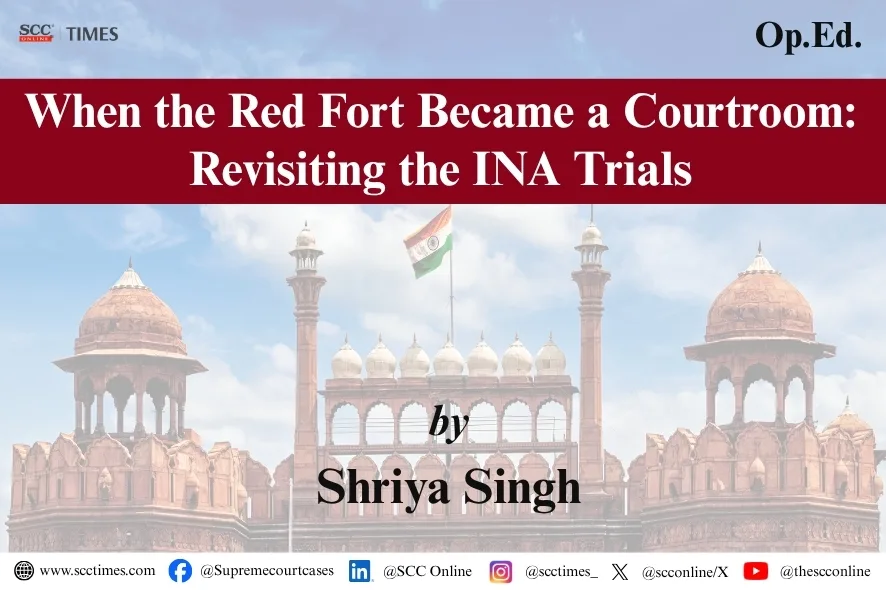
Red Fort in 1945: A courtroom where the British Empire sought to prosecute three INA officers.
Red Fort in 2026: A national monument from which the Prime Minister addresses an independent Republic.
Every Independence Day, the Red Fort is the place from which India speaks to itself. It is the stage for sovereignty, memory, and national self-definition. But in the closing months of 1945, the same fort served a very different purpose. Behind its walls, a military courtroom was assembled to try three officers of the Indian National Army (INA):
1. Shah Nawaz Khan,
2. Prem Kumar Sehgal, and
3. Gurbaksh Singh Dhillon.
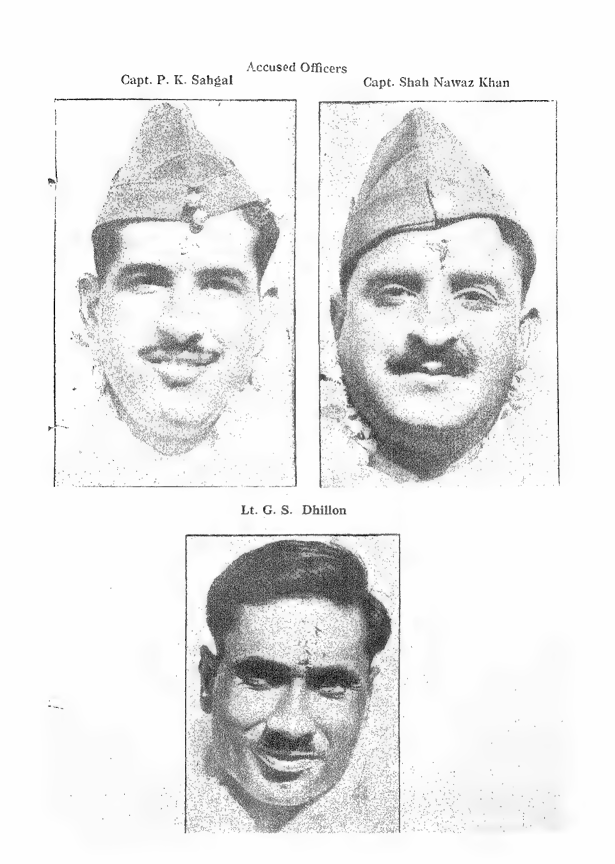
(Photo credit: Two Historic Trials in Red Fort)
They were tried1 on charges that were meant to reaffirm the authority of the British Empire. Instead, the proceedings became one of the most visible tests of whether that authority could still command obedience in India.2
That is why the INA trials remain more than a footnote to the freedom struggle.3 They were not only prosecutions of three men. They became a public confrontation between imperial legality and anticolonial legitimacy.4 The more precise question, then, is not whether the trials alone ended British rule. It is whether they accelerated a process already underway by exposing the fragility of colonial power in its own courtroom. On the historical record, the answer appears to be yes but as a catalyst, not as the sole cause.
No trial in India, either by court martial or in the civil courts, has attracted so much public attention or has dealt with issues of such fundamental national importance.5
Red Fort as courtroom
The trial opened in November 1945 at the Red Fort in Delhi, then a military headquarters of the British Indian Army.6 A public general court-martial was convened to try out the three INA officers. The symbolic choices mattered, sovereignty and later appropriated by the British as a military establishment. The Red Fort became the stage upon which the colonial administration sought to reaffirm its authority over those accused of challenging the Crown.7 History, however, invested in that same space with an altogether different meaning.
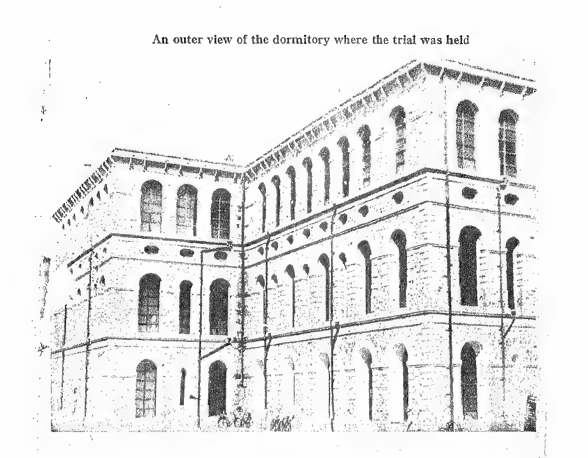
(Photo credit: Two Historic Trials in Red Fort)
The British did not quietly dispose of the matter; they placed it in public view. The accused were not ordinary prisoners but former officers of the British Indian Army who had joined the INA and were accused of “waging war against the King-Emperor”. In that sense, the case was never merely about military discipline, rather, it was about whether the colonial state could continue to define loyalty and punish its breach, exclusively on its own legal terms.8
The procedure itself was revealing. The trial was conducted before a board of officers, with a judge-advocate to rule on law and procedure. That made it a military proceeding rather than a civilian trial, and it also meant that the Tribunal was structurally ill-suited to resolve the wider constitutional and international-law questions that the defence would raise.9 In a way, the INA trial marked a significant departure in colonial legal history by transforming a military prosecution into a forum where Indian lawyers invoked international law and the emerging principle of national self-determination to challenge the legitimacy of imperial authority.
That was a profound shift. The courtroom was no longer asked merely to determine whether the accused had violated military law. It was also confronted with a deeper question, that is, whether a colonial power could claim an exclusive legal monopoly over the use of force against people asserting their right to self-determination.
Public interest in the proceedings had begun to build even before the court assembled. The INA Defence Committee was constituted pursuant to a resolution of the All-India Congress Committee to organise the legal defence of Shah Nawaz Khan, Prem Kumar Sehgal and Gurbaksh Singh Dhillon.10 The Committee established its office at Daryaganj, New Delhi, with Senior Advocate and freedom fighter Asaf Ali and lawyer Raghunandan Saran overseeing the arrangements.11 The legal defence, therefore, was organised from the outset as a matter of national importance rather than as representation for three individual accused.12
The composition of the Defence Committee itself reflected the significance attached to the proceedings. Some of the country’s most distinguished lawyers and political leaders came together to contest what was formally a court-martial but increasingly came to be viewed as a trial of colonial legitimacy.13
Inside the Red Fort: Trial that captivated a Nation
When the Court assembled, the prosecution believed the legal case was relatively straightforward.
Shah Nawaz Khan, Prem Kumar Sehgal and Gurbaksh Singh Dhillon had all served as officers in the British Indian Army before becoming prisoners of war during the Japanese advance in Southeast Asia.14 Their subsequent decision to join the INA placed them on the other side of a war that they understood as a struggle for India’s independence. Under Subhas Chandra Bose and the Provisional Government of Azad Hind, the INA was reorganised as an armed force that fought alongside Japanese forces in the Burma campaign and sought to enter India and challenge British rule.
The three officers, however, did not occupy identical positions within the INA. Shah Nawaz Khan, formerly of the 14th Punjab Regiment, rose to command the Subhas Regiment and later held a senior staff position.15 Prem Kumar Sehgal, formerly of the 10th Baluch Regiment, held important military and administrative responsibilities.16 Gurbaksh Singh Dhillon, also formerly of the 14th Punjab Regiment, participated in the INA’s recruitment, training and military operations in Burma.17 Their individual roles become relevant when the prosecution sought to attribute specific acts to each of them.
The charges, however, were not identical in every respect. While all three faced the common allegation of waging war against the King-Emperor, the prosecution also brought individual allegations arising from specific incidents during the INA’s military operations.18
Shah Nawaz Khan was charged under Section 121, Penal Code, 1860 (IPC) with waging war against the King-Emperor and was separately accused of abetment in the killing of Gunner Mohammad Hussain near Popa, Burma, in March 1945.19
Prem Kumar Sehgal was charged with waging war against the King-Emperor and was separately accused in relation to the deaths of Hari Singh, Duli Chand, Daryao Singh and Dharam Singh at Popa Hill on 6 March 1945.20
Gurbaksh Singh Dhillon faced the common charge of waging war against the King-Emperor and separate allegations concerning the deaths of Hari Singh, Duli Chand, Daryao Singh and Dharam Singh at Popa Hill.21
The prosecution alleged that the three officers had voluntarily renounced their allegiance to the Crown and had subsequently taken up arms against British forces. They were charged under the Army Act, 191122 and with waging war against the King-Emperor under the applicable provisions of the IPC, along with related charges connected with the treatment of prisoners during military operations.
From the Crown’s perspective, these were not merely political disagreements with British rule.23 The accused had once served under the British Crown and had subsequently taken up arms as members of the INA. The prosecution, therefore, sought to characterise their conduct as a violation of the allegiance owed by soldiers of the British Indian Army, while the additional allegations sought to attach criminal responsibility to particular acts committed during the INA’s campaign.
On paper, the legal position appeared uncomplicated. An officer commissioned in the British Indian Army owed an enduring duty of loyalty to the Crown. Joining an enemy force during wartime constituted one of the gravest military offences imaginable. The prosecution, therefore, maintained that personal political beliefs, however sincerely held, could not extinguish that legal obligation.24
Defence turned the trial around
Appearing for the defence, Bhulabhai Desai, assisted by Jawaharlal Nehru, Kailash Nath Katju, Asaf Ali, and others, argued that the case could not be reduced to a simple question of military discipline. The accused, he contended, were not mercenaries who had switched sides for personal gain. They believed they were fighting for the liberation of their country under the Provisional Government of Azad Hind.25
If a person possessed the right to struggle against colonial domination, could those participating in such a struggle be prosecuted merely as traitors?
This was the constitutional and moral question that came to dominate the proceedings.
Whether or not the military tribunal was prepared to accept that proposition, it had become impossible for the wider public to ignore it. The courtroom increasingly resembled a forum where two competing conceptions of loyalty confronted one another.26
1. For the prosecution, loyalty remained owed to the British Crown.
2. For the defence, the higher loyalty was owed to India.
Desai’s argument went further than a plea for sympathy or leniency. He sought to establish that the accused could not be treated simply as traitors under the law of the colonial power against which they had fought.25 The central question, in his submission, was whether a subject people had a legal right to wage war in pursuit of national liberation. He argued that the INA and the Provisional Government of Azad Hind had acquired the character of an Army and a government capable of conducting warfare and governmental affairs in their own right under international law.26 If that proposition were accepted, the accused could not be reduced to ordinary military offenders merely because they had taken up arms against the British Crown.
Desai’s submissions transformed the proceedings into something far larger than a court-martial. At the heart of the defence was the argument that the accused were not merely soldiers who had violated military discipline; they were individuals who believed they were fighting for India’s liberation under the Provisional Government of Azad Hind. 27
The issue, therefore, was whether those who took up arms for national liberation could be treated solely as traitors under colonial law. As Desai famously argued before the Tribunal, “What is now on trial before the Court is the right to wage war with immunity.”28 That single proposition captured the constitutional and political significance of the proceedings.29
Desai’s argument mattered because it reframed the INA not as a private insurgent force but as an armed expression of India’s struggle for independence. The defence maintained that the INA and the Provisional Government of Azad Hind could not be dismissed as a mere criminal conspiracy without first confronting the larger question of national self-determination. In doing so, it compelled the colonial state to defend not merely the charges it had framed, but the legitimacy of its own claim to sovereign authority. The proceedings thus evolved into a larger legal contest over who possessed the authority to determine when the use of force was lawful and when it was criminal.
The political response outside the courtroom reflected the same shift. In August 1945, Jawaharlal Nehru described the INA personnel as “misguided”, yet acknowledged that they had acted out of “patriotic motive”, cautioning that any harsh treatment would only deepen divisions between Britain and India.30 By January 1946, after the proceedings had concluded, he regarded the release of the INA officers as the only practicable outcome, observing that the people of India had become “united as never before”.31 The significance of these statements revealed that by then, the trials had ceased to be ordinary military prosecutions and had become a matter of national political consequence.32
The historical verdict
The court ultimately found all three officers guilty of the principal charge of waging war against the King-Emperor under Section 121 IPC. However, the officers were not convicted of the separate charges relating to the alleged killings.33 Although the Tribunal upheld the Crown’s case that the three officers had waged war against the King-Emperor, it did not establish their individual criminal liability for the alleged killings of Gunner Mohammad Hussain in the case of Shah Nawaz Khan, and Hari Singh, Duli Chand, Daryao Singh and Dharam Singh in the cases concerning Prem Kumar Sehgal and Gurbaksh Singh Dhillon. Yet, the convictions did not produce the result that many expected.
Instead of reinforcing imperial authority, the verdict triggered widespread demonstrations, public mobilisation, and political pressure across India. Faced with an unprecedented public response, General Sir Claude Auchinleck, the Commander-in-Chief, remitted the sentences of transportation for life.34
The convictions remained. The punishment did not.
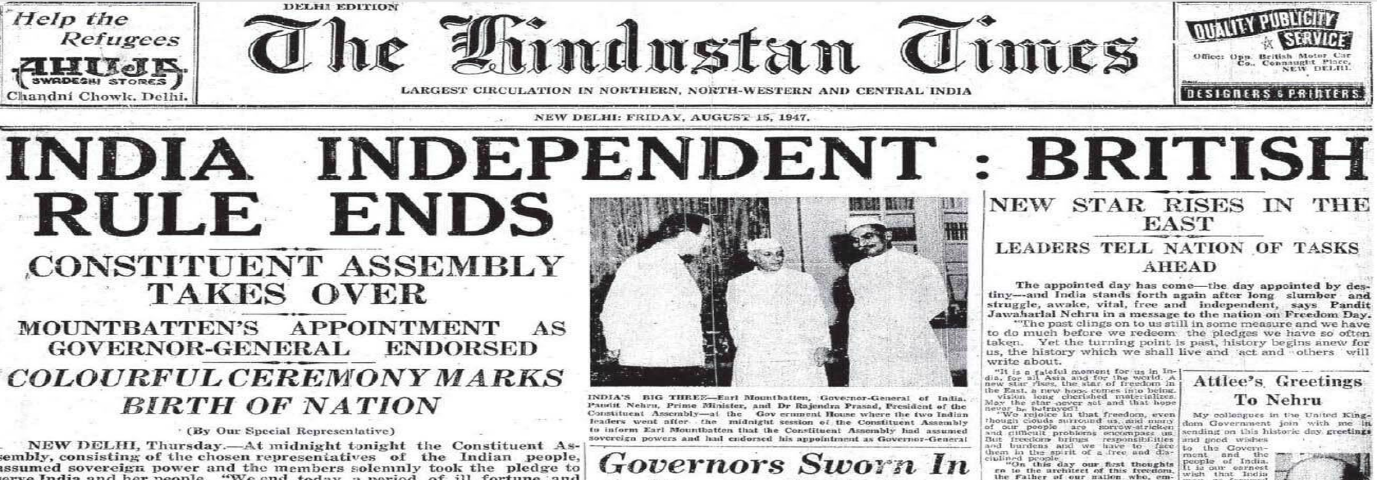
(Photo credit: The Hindustan Times August 15, 1947)
Public trial — public crisis
One of the reasons the INA trial assumed such significance was that the British chose to conduct it publicly. The decision was intended to demonstrate the fairness and legitimacy of imperial justice. Instead, it transformed the proceedings into a national political event. Once wartime censorship was lifted, the story of the INA entered the public domain, and the Red Fort trials attracted unprecedented public attention.35
The outcome exposed a striking paradox. The Crown secured convictions before the court-martial, yet failed to achieve its larger objective of reaffirming the legitimacy of colonial rule. Public demonstrations, political mobilisation, and mounting pressure across the country ultimately led to the remission of the sentences.36 In that sense, the trials illustrated the limits of colonial authority that success inside the courtroom did not translate into success outside it.
As the proceedings unfolded, the public gained an unprecedented insight into the organisation of the INA, its military campaign, and the legal arguments advanced in its defence. The evidence led before the Tribunal, together with Bhulabhai Desai’s submissions, fueled demonstrations across the country and contributed to growing unease within sections of the British Indian Army. The implications were profound. If Indian soldiers increasingly viewed the accused as patriots rather than traitors, the foundations of imperial military authority itself stood exposed to challenge.37
The Red Fort trial, therefore, cannot be understood merely as a military prosecution. It became a public contest over the legitimacy of colonial rule, transforming the courtroom into a forum where questions of law, loyalty, and national self-determination converged. The British Indian Army had long been one of the principal pillars of the British Raj. By the conclusion of the proceedings, many Indians, including members of the armed forces, were compelled to reconsider where that loyalty truly belonged. It is this transformation in public consciousness that continues to give the INA trials their enduring historical and legal significance.
From conviction to clemency
The end of the trial did not restore imperial confidence. In January 1946, the Commander-in-Chief remitted the sentences of transportation for life imposed by the court-martial, while confirming the orders of cashiering and forfeiture of pay and allowances.38 Shortly thereafter, the three INA officers were released. The significance of that decision lay not merely in the reduction of their punishment, but in the revelation that the colonial administration had come to recognise that a rigid insistence on punishment risked consequences far beyond the courtroom.39
That moment of clemency is central to the larger story. A government may secure convictions in courtrooms and yet fail to secure public legitimacy. The British succeeded in enforcing the letter of military law but struggled to translate that legal victory into political authority.40 The remission of the sentences reflected not a retreat from the law, but an acknowledgement that law alone could no longer contain the political consequences the proceedings had unleashed.
This is also where the central question finds its answer. Did the INA trials accelerate the end of British rule? The historical record suggests that they did but as a catalyst rather than a solitary cause. The trials did not bring down the British Raj by themselves. Rather, they intensified the growing perception that colonial rule had lost much of its moral authority and political coherence.41 They unfolded against the backdrop of a wider post-war crisis and, in doing so, hastened a process that was already underway.
The significance of the INA trials lies not in the claim that they created Indian nationalism, but in the fact that they gave it a courtroom. They compelled the colonial state to defend its authority in full public view at a moment when war, economic strain, and political change had already eroded imperial confidence. The trials did not mark the beginning of the end of the British Empire in India; they made that end increasingly difficult to deny.42
Wider 1946 crisis
The significance of the INA trials becomes even clearer when viewed against the wider developments of 1946, particularly the Royal Indian Navy mutiny. Both unfolded against a backdrop of growing political unrest, military disaffection, and declining imperial authority.43 The naval uprising rapidly spread beyond individual ships, drawing support from civilians and exposing widening dissatisfaction with British rule across multiple sections of Indian society.44 These events reflected a deeper crisis of colonial governance in which the British increasingly struggled to command both military loyalty and public confidence.
The INA trials and the Royal Indian Navy mutiny were not isolated episodes but interconnected manifestations of a deeper constitutional and political crisis. The trials had already demonstrated that many Indians, including members of the armed forces, increasingly viewed the INA officers as patriots rather than traitors. The naval mutiny, occurring only weeks later, underscored how fragile imperial authority had become when loyalty within the armed forces itself could no longer be assumed.
The INA trials were neither the sole cause of India’s independence nor merely a symbolic episode in the freedom struggle. Their enduring significance lies in the fact that they publicly exposed the growing disconnect between the legal authority claimed by the colonial state and the political legitimacy it increasingly struggled to command. Against the backdrop of the wider crisis of 1946, the trials accelerated a process already underway, making the continuation of British rule appear progressively more difficult to sustain.45
Why INA trials still matter in 2026
The reason the INA trials still matter is not only historical curiosity. They remain relevant because they show how a legal proceeding can become a test of legitimacy when the public no longer believes the sovereign has the moral authority to punish. That lesson is not confined to colonial India. Any legal system that relies on coercion without legitimacy risks finding that its courtroom victories do not translate into public obedience. The INA case, therefore, continues to resonate with lawyers, historians, and constitutional scholars because it illustrates the limits of law when legal authority is perceived as an instrument of power rather than an expression of justice.46
The trials also remain relevant because they demonstrate that a courtroom can reshape political discourse even when the verdict itself remains legally unchanged. The proceedings compelled the colonial state to confront an uncomfortable contradiction that the accused were charged with treason by an empire whose claim to govern India was itself being increasingly contested. In that sense, the Red Fort trials were never confined to the past conduct of three INA officers. They became a public debate about the future of sovereignty in India.
So, did the INA trials accelerate the end of British rule? The most balanced answer is yes but indirectly, and as part of a larger historical convergence. They did not by themselves end the British Raj. They did, however, erode an important layer of imperial confidence, mobilise public opinion, unsettle the armed forces, and make colonial legitimacy look increasingly exhausted.47 That is why the trial at the Red Fort still stands, even in 2026, as more than a legal episode. It remains a story about how a courtroom can become a political turning point, and how conviction can unexpectedly lead to clemency, crisis and the quiet beginning of the end of an empire.
Every year, the Prime Minister unfurls the Tricolour from the Red Fort. Few pause to remember that the same walls once witnessed a trial intended to preserve an empire. History chose a different ending. The Red Fort ceased to be a courtroom defending colonial authority and became the platform from which an independent Republic speaks to its people. That transformation perhaps explains why the INA trials continue to matter, not merely as a chapter of India’s freedom struggle, but as a reminder that the enduring authority of law ultimately rests upon the legitimacy of the sovereign in whose name it is administered.
*Editorial Assistant (Legal), EBC Publishing Pvt. Ltd. Author can be reached at: shriya.singh@ebcpublishing.in.
1. Two Historic Trials in Red Fort.
2. Chandar Sundaram, “Trial at the Red Fort 1945-1946: The Indian National Army and the End of the British Raj in India”, Education About Asia, 3-3-2023, available at <https://www.educationaboutasia.org/article/id/1798/>.
3. Chandar Sundaram, “Trial at the Red Fort 1945-1946: The Indian National Army and the End of the British Raj in India”, Education About Asia, 3-3-2023, available at <https://www.educationaboutasia.org/article/id/1798/>.
4. Mithi Mukherjee, “The ‘Right to Wage War’ against Empire: Anticolonialism and the Challenge to International Law in the Indian National Army Trial of 1945”, 31-5-2019, available at <https://www.cambridge.org/core/journals/law-and-social-inquiry/article/the-right-to-wage-war-against-empire-anticolonialism-and-the-challenge-to-international-law-in-the-indian-national-army-trial-of-1945/79CD8D580062DECC1FA694F16D72A4EF>.
5. The Nehru Archive, The Triumph of the Indian People, 17-1-1946, available at <https://nehruarchive.in/documents/the-triumph-of-the-indian-people-17-january-1946-dxedo7>.
6. Chandar Sundaram, “Trial at the Red Fort 1945-1946: The Indian National Army and the End of the British Raj in India”, Education About Asia, 3-3-2023, available at <https://www.educationaboutasia.org/article/id/1798/>.
7. Mithi Mukherjee, “The ‘Right to Wage War’ against Empire: Anticolonialism and the Challenge to International Law in the Indian National Army Trial of 1945”, 31-5-2019, available at <https://www.cambridge.org/core/journals/law-and-social-inquiry/article/the-right-to-wage-war-against-empire-anticolonialism-and-the-challenge-to-international-law-in-the-indian-national-army-trial-of-1945/79CD8D580062DECC1FA694F16D72A4EF>.
8. The Nehru Archive, The Triumph of the Indian People, 17-1-1946, available at <https://nehruarchive.in/documents/the-triumph-of-the-indian-people-17-january-1946-dxedo7>.
9. Mithi Mukherjee, “The ‘Right to Wage War’ against Empire: Anticolonialism and the Challenge to International Law in the Indian National Army Trial of 1945”, 31-5-2019, available at <https://www.cambridge.org/core/journals/law-and-social-inquiry/article/the-right-to-wage-war-against-empire-anticolonialism-and-the-challenge-to-international-law-in-the-indian-national-army-trial-of-1945/79CD8D580062DECC1FA694F16D72A4EF>.
10. Chandar Sundaram, “Trial at the Red Fort 1945-1946: The Indian National Army and the End of the British Raj in India”, Education About Asia, 3-3-2023, available at <https://www.educationaboutasia.org/article/id/1798/>.
11. The Nehru Archive, Note on the I.N.A. Defence Committee, 2-11-1945, available at <https://nehruarchive.in/documents/note-on-the-i-n-a-defence-committee-2-november-1945-onp13n>.
12. Reginald Masssey, “The Heroes of the INA Trials”, India of the Past.
13. The Nehru Archive, Note on the I.N.A. Defence Committee, 2-11-1945, available at <https://nehruarchive.in/documents/note-on-the-i-n-a-defence-committee-2-november-1945-onp13n>.
14. “Q. In the context of Colonial India, Shah Nawaz Khan, Prem Kumar Sehgal and Gurbaksh Singh Dhillon are remembered as”, LotusArise IAS.
15. 2015.526939.Two-Historic.pdf.
16. 2015.526939.Two-Historic.pdf.
17. 2015.526939.Two-Historic.pdf.
18. Chandar Sundaram, “Trial at the Red Fort 1945-1946: The Indian National Army and the End of the British Raj in India”, Education About Asia, 3-3-2023, available at <https://www.educationaboutasia.org/article/id/1798/>.
23. Chandar Sundaram, “Trial at the Red Fort 1945-1946: The Indian National Army and the End of the British Raj in India”, Education About Asia, 3-3-2023, available at <https://www.educationaboutasia.org/article/id/1798/>.
24. Mithi Mukherjee, “The ‘Right to Wage War’ against Empire: Anticolonialism and the Challenge to International Law in the Indian National Army Trial of 1945”, 31-5-2019, available at <https://www.cambridge.org/core/journals/law-and-social-inquiry/article/the-right-to-wage-war-against-empire-anticolonialism-and-the-challenge-to-international-law-in-the-indian-national-army-trial-of-1945/79CD8D580062DECC1FA694F16D72A4EF>.
25. Mithi Mukherjee, “The ‘Right to Wage War’ against Empire: Anticolonialism and the Challenge to International Law in the Indian National Army Trial of 1945”, 31-5-2019, available at <https://www.cambridge.org/core/journals/law-and-social-inquiry/article/the-right-to-wage-war-against-empire-anticolonialism-and-the-challenge-to-international-law-in-the-indian-national-army-trial-of-1945/79CD8D580062DECC1FA694F16D72A4EF>.
26. Chandar Sundaram, “Trial at the Red Fort 1945-1946: The Indian National Army and the End of the British Raj in India”, Education About Asia, 3-3-2023, available at <https://www.educationaboutasia.org/article/id/1798/>.
27. Mithi Mukherjee, “The ‘Right to Wage War’ against Empire: Anticolonialism and the Challenge to International Law in the Indian National Army Trial of 1945”, 31-5-2019, available at <https://www.cambridge.org/core/journals/law-and-social-inquiry/article/the-right-to-wage-war-against-empire-anticolonialism-and-the-challenge-to-international-law-in-the-indian-national-army-trial-of-1945/79CD8D580062DECC1FA694F16D72A4EF>.
28. The Nehru Archive, The INA, available at <https://nehruarchive.in/themes/the-ina>.
29. Chandar Sundaram, “Trial at the Red Fort 1945-1946: The Indian National Army and the End of the British Raj in India”, Education About Asia, 3-3-2023, available at <https://www.educationaboutasia.org/article/id/1798/>.
30. The Nehru Archive, The Fate of the I.N.A. Prisoners, 19-8-1945, available at <https://nehruarchive.in/documents/the-fate-of-the-i-n-a-prisoners-19-august-1945-gozdj6>.
31. The Nehru Archive, On the Release of the I.N.A. Officers, 5-1-1946.
32. The Nehru Archive, The Triumph of the Indian People, 17-1-1946, available at <https://nehruarchive.in/documents/the-triumph-of-the-indian-people-17-january-1946-dxedo7>.
33. Full text of “The Story of I.N.A.”
35. Chandar Sundaram, “Trial at the Red Fort 1945-1946: The Indian National Army and the End of the British Raj in India”, Education About Asia, 3-3-2023, available at <https://www.educationaboutasia.org/article/id/1798/>
36. The Nehru Archive, The Triumph of the Indian People, 17-1-1946, available at <https://nehruarchive.in/documents/the-triumph-of-the-indian-people-17-january-1946-dxedo7>
37. The Nehru Archive, Warning Against Harsh Treatment, 28-8-1945, available at <https://nehruarchive.in/documents/warning-against-harsh-treatment-28-august-1945-pgy7jd>.
38. The Nehru Archive, On the Release of the I.N.A. Officers, 5-1-1946.
39. https://nehruarchive.in/documents/on-the-release-of-the-i-n-a-officers-6-january-1946-ovzwzn.
40. Chandar Sundaram, “Trial at the Red Fort 1945-1946: The Indian National Army and the End of the British Raj in India”, Education About Asia, 3-3-2023, available at <https://www.asianstudies.org/publications/eaa/archives/trial-at-the-red-fort-1945-1946-the-indian-national-army-and-the-end-of-the-british-raj-in-india/>.
41. Dr Sudhanshu Mani, “The 1945-46 INA Trials: How it Accelerated India’s Independence!”, An Indecisive Indian, 26-5-2026.
42. Chandar Sundaram, “Trial at the Red Fort 1945-1946: The Indian National Army and the End of the British Raj in India”, Education About Asia, 3-3-2023, available at <https://www.asianstudies.org/publications/eaa/archives/trial-at-the-red-fort-1945-1946-the-indian-national-army-and-the-end-of-the-british-raj-in-india/>.
43. Chandar Sundaram, “Trial at the Red Fort 1945-1946: The Indian National Army and the End of the British Raj in India”, Education About Asia, 3-3-2023, available at <https://www.educationaboutasia.org/article/id/1798/>
44. Mithi Mukherjee, “The ‘Right to Wage War’ against Empire: Anticolonialism and the Challenge to International Law in the Indian National Army Trial of 1945”, 31-5-2019, available at <https://www.cambridge.org/core/journals/law-and-social-inquiry/article/the-right-to-wage-war-against-empire-anticolonialism-and-the-challenge-to-international-law-in-the-indian-national-army-trial-of-1945/79CD8D580062DECC1FA694F16D72A4EF>.
45. Mithi Mukherjee, “The ‘Right to Wage War’ against Empire: Anticolonialism and the Challenge to International Law in the Indian National Army Trial of 1945”, 31-5-2019, available at <https://www.cambridge.org/core/journals/law-and-social-inquiry/article/the-right-to-wage-war-against-empire-anticolonialism-and-the-challenge-to-international-law-in-the-indian-national-army-trial-of-1945/79CD8D580062DECC1FA694F16D72A4EF>.
46. Chandar Sundaram, “Trial at the Red Fort 1945-1946: The Indian National Army and the End of the British Raj in India”, Education About Asia, 3-3-2023, available at <https://www.educationaboutasia.org/article/id/1798/>.
47. Mithi Mukherjee, “The ‘Right to Wage War’ against Empire: Anticolonialism and the Challenge to International Law in the Indian National Army Trial of 1945”, 31-5-2019, available at <https://www.cambridge.org/core/journals/law-and-social-inquiry/article/the-right-to-wage-war-against-empire-anticolonialism-and-the-challenge-to-international-law-in-the-indian-national-army-trial-of-1945/79CD8D580062DECC1FA694F16D72A4EF>.


I had read about the INA trials but never with the legal point of view especially the arguments. Captured the whole thing so nicely..
A great read! Exceptionally well written, I was hooked throughout.