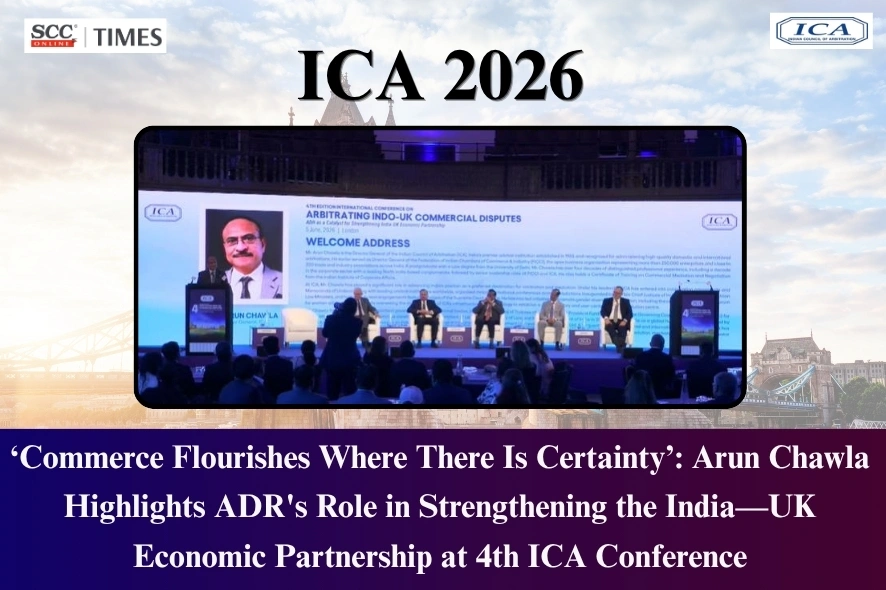
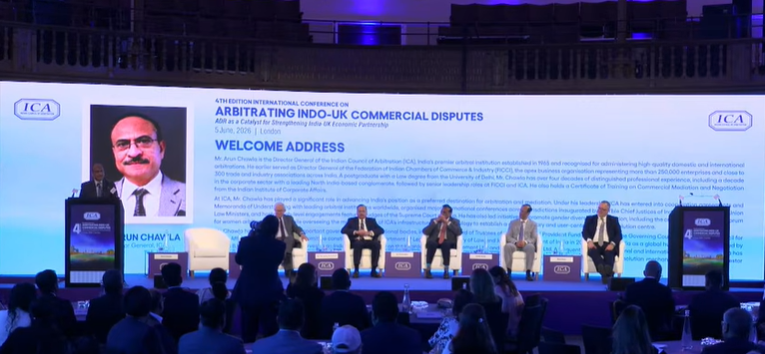
The continued growth of the India—UK economic partnership depends not only on expanding trade and investment but also on the existence of reliable institutions capable of delivering certainty when commercial disputes arise. This was the central theme of the Welcome Address delivered by Mr. Arun Chawla, Director General, Indian Council of Arbitration (ICA), at the 4th International Conference on “Arbitrating Indo-UK Commercial Disputes: ADR as a Catalyst for Strengthening the India—UK Economic Partnership”, organised by the Indian Council of Arbitration on 5 June 2026 at Church House Westminster, London.
The conference brought together members of the judiciary, policymakers, diplomats, arbitration practitioners, corporate leaders and legal professionals from India and the United Kingdom to deliberate on the future of cross-border dispute resolution and the role of alternative dispute resolution in facilitating international commerce.
Welcoming the delegates, Mr. Chawla noted that the conference reflected the growing strategic convergence between India and the United Kingdom, two nations connected by longstanding historical, commercial and legal ties, democratic institutions and an increasingly shared vision for the future of international dispute resolution. He also highlighted ICA’s role as India’s premier arbitral institution for more than six decades, noting that the institution has consistently worked towards promoting institutional arbitration, fostering international collaboration and strengthening India’s dispute resolution ecosystem. In that context, he observed that it was particularly fitting for the conference to be held during LIDW 2026, a forum that brings together the global disputes community to discuss and shape the future of international arbitration.
Distinguished Dignitaries at the Inaugural Session
At the outset, Mr. Chawla welcomed Justice Surya Kant, Chief Justice of India, who inaugurated the conference. Describing him as a jurist of exceptional distinction, Mr. Chawla acknowledged his contribution towards promoting institutional integrity, judicial efficiency and access to justice. He particularly highlighted Justice Surya Kant’s role in strengthening India’s arbitration jurisprudence and fostering judicial confidence in alternative dispute resolution mechanisms, describing those contributions as both visionary and transformative.
Mr. Chawla also welcomed Rt. Hon. Sir Geoffrey Vos, Master of the Rolls and Head of Civil Justice of England and Wales, whose leadership in advancing technology-enabled justice systems, procedural innovation and the modernisation of civil justice continues to influence legal systems across jurisdictions. He further acknowledged the presence of Mr. Kartik Pande, Deputy High Commissioner of India to the United Kingdom, whose diplomatic efforts have contributed significantly to strengthening India—UK relations across economic, strategic and institutional dimensions.
Welcoming Mr. Brett Dixon, Vice-President of the Law Society of England and Wales, Mr. Chawla noted his extensive experience as a solicitor, mediator and legal professional and expressed confidence that his perspectives on legal innovation, professional cooperation and access to justice would enrich the discussions during the conference.
The India—UK Economic Partnership and the Need for Certainty
Placing the conference theme in a broader economic context, Mr. Chawla observed that the world is currently witnessing profound economic and geopolitical transformation. Supply chains are being reconfigured, technology is reshaping commerce, geopolitical alignments are evolving and businesses across the world are navigating increasing uncertainty.
Despite these changes, he remarked that one principle has remained constant throughout the history of commerce: certainty. Quoting Lord Mansfield’s observation in Valejjo v. Wheeler (1774)1 that “in all mercantile transactions the great object should be certainty”, Mr. Chawla emphasised that certainty in rules, institutions, enforcement mechanisms and dispute resolution systems remains indispensable to commercial growth.
“Commerce flourishes where there is certainty,” he observed, adding that certainty is the foundation upon which businesses make investment decisions, enter new markets and undertake cross-border transactions.
Mr. Chawla noted that the India—UK relationship is entering a new phase of strategic and economic maturity. Referring to the ongoing discussions surrounding the India—UK Comprehensive Economic and Trade Agreement (CETA), he stated that bilateral engagement between the two countries is deepening at an unprecedented pace. Trade volumes are increasing, investment flows are strengthening, professional services are becoming more integrated and digital commerce is expanding rapidly. At the same time, collaboration across sectors such as infrastructure, technology, energy, finance, healthcare, manufacturing and innovation continues to grow, creating new opportunities for businesses in both jurisdictions.
As economic engagement becomes more sophisticated, Mr. Chawla observed, disputes inevitably become more complex. This development, however, should not be viewed negatively. Mature economies, he remarked, are not defined by the absence of disputes but by the quality, efficiency and credibility of the systems through which those disputes are resolved.
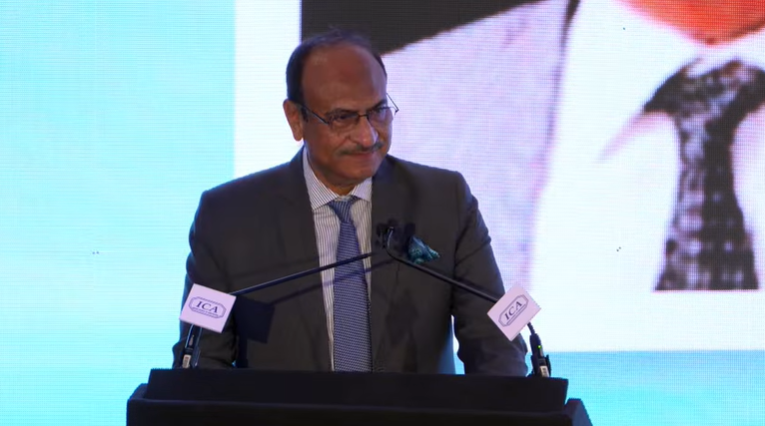
Arbitration as the “Silent Infrastructure of Globalisation”
Against this backdrop, Mr. Chawla described arbitration as occupying a central place in the architecture of modern global commerce.
According to him, international arbitration has evolved far beyond its traditional role as an alternative to litigation. Today, it functions as an enabling framework for international economic cooperation, allowing businesses to transact confidently across jurisdictions, legal systems, currencies and increasingly uncertain geopolitical environments.
Businesses are willing to engage in cross-border transactions because they have confidence that disagreements can be resolved through neutral, enforceable and commercially credible mechanisms. Arbitration therefore performs a function that is often invisible to the public but fundamental to the operation of global commerce.
In that sense, Mr. Chawla described arbitration as the “silent infrastructure of globalisation”, an institution that quietly underpins international trade, investment and commercial confidence.
India’s Arbitration Transformation
Turning to developments within India, Mr. Chawla highlighted the substantial transformation of the country’s arbitration ecosystem over the past several years. He attributed this progress to a combination of legislative reform, judicial clarity, institutional strengthening and sustained policy support.
According to him, India is steadily positioning itself as a serious and credible global arbitration jurisdiction. A key factor in this transformation has been the emergence of a distinctly pro-arbitration approach within the Indian judiciary. He noted that courts have increasingly reinforced party autonomy, minimised unnecessary judicial intervention and promoted greater efficiency and enforceability in arbitral proceedings.
Mr. Chawla stated that these developments reflect a broader national vision in which India’s growing economic stature is matched by equally strong legal and dispute resolution institutions. Referring to the Chief Justice of India’s vision for the future of arbitration, he observed that India continues to pursue the goal of becoming a global hub for international arbitration and that recent institutional and judicial developments are important steps towards achieving that objective.
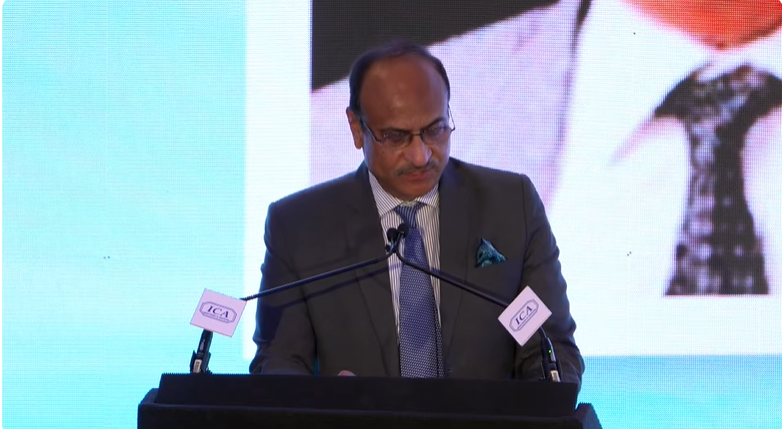
Key Questions for the Future of Cross-Border ADR
Mr. Chawla noted that the conference had been designed to facilitate discussions on some of the most significant issues currently shaping international commercial dispute resolution.
Among the questions identified for consideration were how cross-border ADR systems can be made more efficient; how institutional cooperation between jurisdictions can be strengthened; how procedural expectations can be harmonised; how arbitration can become faster, more enforceable, technology-enabled and commercially responsive; and how dispute resolution frameworks can continue to evolve alongside changing commercial realities.
He expressed confidence that the discussions throughout the conference would make a meaningful contribution to the broader global conversation on the future of international arbitration and cross-border dispute resolution.
A Shared Commitment to Strengthening Dispute Resolution
Before concluding, Mr. Chawla acknowledged the presence and support of several institutions and stakeholders participating in the conference, including representatives from the UK Ministry of Justice, the Law Society of England and Wales, the Commercial Bar Association, RICS, Blackstone Chambers, 39 Essex Chambers, Trilegal, JSA, PwC, SCC Times, among others.
Concluding his remarks, Mr. Chawla reiterated that trusted dispute resolution systems are indispensable to sustainable economic partnerships. Efficient, credible and enforceable ADR mechanisms, he said, help convert commercial confidence into commercial reality by providing businesses with the certainty necessary to invest, innovate and expand across borders.
His address set the intellectual foundation for the conference by positioning arbitration not merely as a method of resolving disputes but as an essential component of modern economic infrastructure. In doing so, he underscored the proposition that the future of the India—UK economic partnership will depend not only on expanding commercial opportunities but also on the strength, credibility and effectiveness of the institutions that support them.
1. Vallejo v. Wheeler (1774) 1 Cowp. 143, 98 E.R. 1012