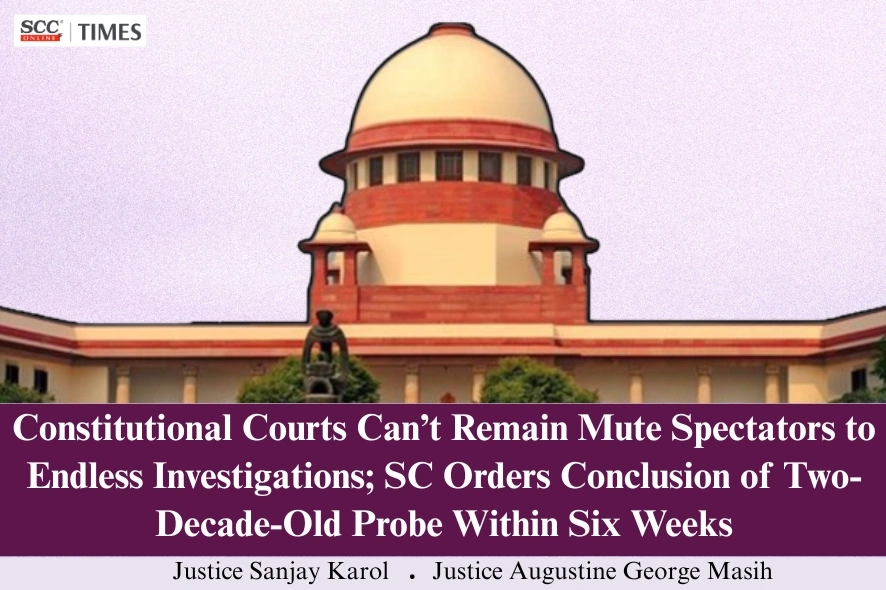
Supreme Court: In an appeal presenting a disturbing instance of prolonged investigative delay where a criminal complaint lodged in 2007 remained unresolved even after nearly 2 decades and challenging High Court’s order refusing to issue directions for filing of a charge-sheet despite repeated orders of the Magistrate and despite the complainant’s persistent efforts to secure completion of investigation, the Division Bench of Sanjay Karol* and Augustine George Masih, JJ., reaffirmed that “the right to speedy trial is intrinsically linked to Article 21 of the Constitution” and held that the High Court erred in not taking the note of the inordinate delay in filing of the chargesheet and intervening in the matter.
“It is incumbent upon constitutional courts to not remain mute spectators, when such prolonged investigations are brought to its notice.”
Recognising that nearly 2 decades had passed without completion of investigation and that no satisfactory explanation existed for such delay, the Court intervened and directed completion of investigation within 6 weeks together with filing of an appropriate report and affidavit by the State.
Brief Facts
The father of the appellants, who was the original complainant, instituted a criminal complaint before the Judicial Magistrate First Class (JMFC), Bhiloda, against Respondents 1 to 4 alleging offences under Sections 120-B, 406, 420, 463, 468, 471 and 114, Penal Code, 1860 (IPC). According to him, the property concerned had been self-acquired by him on 11 December 1975. While he was away on Haj pilgrimage between 5 February 2002 and 21 March 2002, the accused allegedly forged his signatures and prepared a fabricated partition deed and a bogus sale deed in respect of the property. On the basis of these forged documents, entries were subsequently mutated in the revenue records in favour of the accused persons.
During investigation, the police submitted a C-Summary report before the JMFC on 10 October 2014. The Magistrate rejected the report and directed further investigation to be completed within 60 days. Thereafter, when the complainant approached the High Court, the High Court by order dated 20 July 2017 directed preparation of the investigation report within 6 weeks and recorded that certain materials collected during investigation had gone missing from police custody.
Pursuant to the High Court’s directions, a Forensic Science Laboratory report was prepared on 29 August 2017 and forwarded to the JMFC on 27 November 2017. The report indicated that the disputed signatures and documents had been forged and that the complainant had not executed them. Acting on this report, the JMFC directed the police to take further action and continue investigation.
Despite these developments, no final report or charge-sheet was filed. Consequently, on 21 January 2018, the complainant again approached the JMFC seeking appropriate directions. The Magistrate directed the investigating officer to clarify within 10 days whether the investigation was still pending or had been concluded. Subsequently, on 14 September 2022, the Additional Judicial Magistrate, Bhiloda once again directed the investigating officer to complete investigation and file a charge-sheet in accordance with law. Since even these directions yielded no result, the complainant filed a special criminal application before the High Court seeking directions to the investigating officer to file the charge-sheet.
However, the High Court declined to grant the relief sought, holding that no case had been made out for exercise of jurisdiction under Article 226 of the Constitution. The Court observed that since the JMFC had already issued directions regarding investigation, the complainant ought to pursue appropriate proceedings before the Magistrate instead of seeking intervention from the High Court.
Issue for Consideration
Whether the High Court erred in refusing to exercise its extraordinary jurisdiction despite an investigation remaining incomplete for nearly 2 decades?
Analysis
At the outset, the Court observed that the High Court ought to have taken note of the inordinate delay in filing the charge-sheet and should have intervened.
The Court reaffirmed that “the right to speedy trial is intrinsically linked to Article 21 of the Constitution”. The Court relied on Robert Lalchungnunga Chongthu v. State of Bihar, 2025 SCC OnLine SC 2511, wherein it was held that criminal procedure has evolved from a regime with little oversight to one that increasingly recognises the necessity of concluding investigations within a reasonable time. Although the Criminal Procedure Code, 1973 (CrPC) does not prescribe rigid timelines, investigations cannot continue indefinitely. The Court had observed that where there is a substantial gap between registration of a case and filing of the charge-sheet, courts must seek an explanation from the investigating agency.
In Robert Lalchungnunga Chongthu, the Court had held that “if investigation into a particular offence has continued for a period that appears to be unduly long, that too without adequate justification, such as in this case, the accused or the complainant both, shall be at liberty to approach the High Court under Section 528 BNSS/482 CrPC, seeking an update on the investigation or, if the doors of the High Court have been knocked by the accused, quashing.”
Also Read: “Investigation cannot continue endlessly”: Supreme Court issues directions
Applying these principles, the Court noted that nearly 20 years had elapsed since initiation of the complaint. Despite repeated efforts by the complainant and repeated judicial directions, the investigation had failed to reach any meaningful conclusion. The Court observed that the complainant had effectively been running “from pillar to post” seeking filing of a charge-sheet, but without success.
The Court emphasised that Constitutional Courts cannot remain mute spectators when prolonged and unexplained investigations are brought to their notice. In circumstances where investigative agencies fail to act for years together, High Court ought to have exercised its extraordinary jurisdiction and intervene in the matter.
Examining the explanation offered by the State, the Court stated that even assuming that records had been lost and witnesses had become difficult to trace, nearly a decade had elapsed after the High Court ordered reinvestigation. If the investigation genuinely could not proceed further, the police ought at least to have filed an appropriate closure report before the JMFC. No satisfactory explanation existed as to why the complaint and investigation were kept pending indefinitely.
The Court expressed serious concern over the disappearance of records during the course of an active criminal investigation. According to Court, “such incidents strike at the very core of the criminal justice system, rendering bona fide complaints inactionable”.
Directions
In order to ensure that the matter finally reached a conclusion, the Court issued the following directions:
-
The State of Gujarat and Police Station Bhiloda to conclude the investigation within 6 weeks from the date of the order.
-
An appropriate report to be filed before the JMFC containing all available investigative material and, where material was unavailable, indicating the absence thereof.
-
The State of Gujarat to file an affidavit specifying:
(a) the precise action taken against the officer responsible for the loss of records, the present stage of such action and whether it had been carried to its logical conclusion;
(b) the reasons why, despite directions of the JMFC, the Magistrate was not informed about the inability to reconstruct records or trace witnesses; and
(c) compliance with the direction to conclude investigation.
-
The matter was listed on 14 July 2026 as part-heard.
[Sahil Abdulsattar Mansuri v. Safimahamad Fafirbhai Mansuri, 2026 SCC OnLine SC 1073, decided on 4-6-2026]
*Judgment by Justice Sanjay Karol
Advocates who appeared in this case:
Anshuman Srivastava, AOR with Aastha Mehta, Prerana Mohapatra, Prina Sharma, Advs., Counsel for the Appellants
Mehmood Umar Faruqui, AOR. with Swati Ghildiyal, AOR and Neha Singh, Adv., Counsel for the Respondents
Buy Penal Code, 1860 HERE
Buy Constitution of India HERE

Buy Code of Criminal Procedure, 1973 HERE