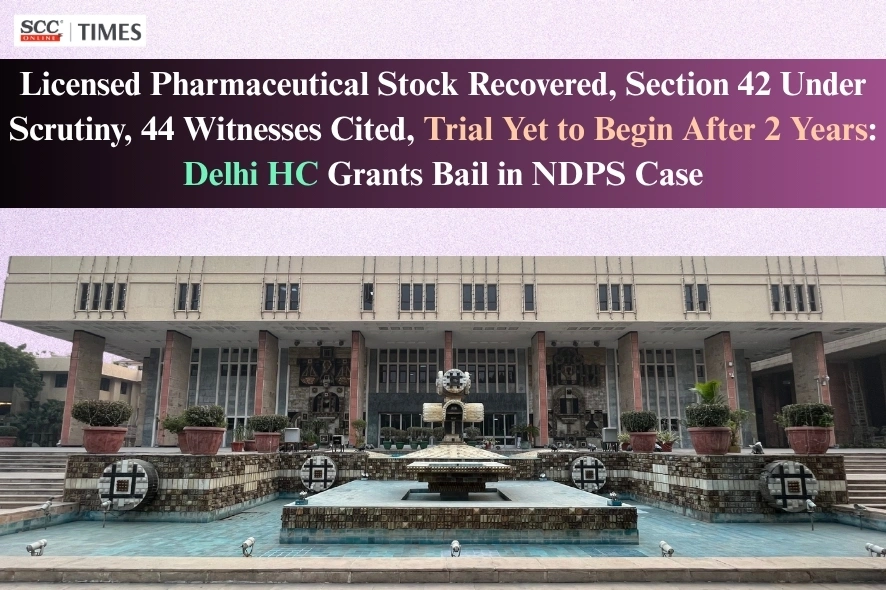
Delhi High Court: In a petition filed under Section 483, Nagarik Suraksha Sanhita, 2023 (BNSS) seeking regular bail in FIR for offences under Sections 22 and 29, Narcotics Drugs and Psychotropic Substances Act, 1985 (NDPS Act), the Single Judge Bench of Anup Jairam Bhambhani*, J., granted bail, holding that where the accused demonstrated an arguable challenge to compliance with mandatory safeguards under Section 42, NDPS Act, the recovered stock forms part of licensed pharmaceutical inventory, trial is yet to commence despite prolonged incarceration of more than 2 years and 1 month, and co-accused stand enlarged on bail, the rigours of Section 37, NDPS Act do not preclude grant of regular bail.
Background
The prosecution case originated from secret information received on 6 October 2023 regarding 1 accused, who was allegedly involved in the transportation and distribution of narcotic and psychotropic substances. During the course of investigation, it was disclosed that he procured contraband from the co-accused. Based on co-accused’s interrogation and disclosure statements, the investigating agency alleged that the present petitioner was the ultimate supplier in the chain and arrested him on 8 April 2024.
According to the prosecution, the petitioner was the proprietor of Sunrise Pharmaceuticals and was also operating 3 other pharmaceutical entities, namely, NA Pharma, Medisales Pharmaceuticals and AC Pharmaceuticals, through nominal proprietors. It was alleged that these firms were used as fronts for procuring, storing and distributing psychotropic substances. During investigation, the police claimed to have recovered commercial quantities of tramadol and codeine phosphate from the godown of Sunrise Pharma at the petitioner’s instance. The prosecution further alleged that invoices and records recovered from the premises, coupled with call detail records, financial transactions and statements of the ostensible proprietors of the firms, demonstrated that the petitioner exercised effective control over all 4 entities and used them to channel contraband into the illegal market.
The petitioner, however, asserted that all the firms involved possessed valid pharmaceutical licences and that the medicines recovered from the godown were supported by lawful purchase invoices and bills. He contended that the co-accused, to whom medicines were allegedly sold, were themselves licensed pharmaceutical dealers operating Kashish Pharma and Bajrang Pharma respectively. According to the petitioner, the prosecution’s own case showed that the medicines were purchased and sold through licensed entities and that the only allegation against him was that medicines purchased in the names of certain firms were stored at the premises of Sunrise Pharma. He maintained that such conduct, even if assumed to be true, constituted at best a regulatory violation under the Drugs and Cosmetics Act, 1940 and not an offence attracting the stringent provisions of the NDPS Act.
The petitioner also challenged the legality of the search and seizure proceedings by alleging non-compliance with Section 42, NDPS Act. It was contended that information allegedly leading to the recovery from the godown was recorded by Sub-Inspector (SI) Vishal Malik but was not forwarded by him to his superior officer as required under Section 42(2). Instead, the information was subsequently reduced into writing and communicated to superior authorities by another officer. On this basis, the petitioner argued that a mandatory statutory safeguard had been violated, rendering the search and seizure operation legally questionable.
Having remained in judicial custody since 8 April 2024, with charges yet to be framed and 44 prosecution witnesses cited in the charge-sheet, the petitioner approached the Delhi High Court seeking regular bail on the grounds of arguable procedural irregularities, lawful possession of licensed pharmaceutical stock, parity with co-accused who had already been granted bail, absence of any prior conviction and prolonged incarceration as an undertrial prisoner.
The State opposed the grant of bail, submitting that the investigation has unearthed substantial material pointing to the petitioner’s integral role in a drug trafficking network and that releasing him at this stage would not be in the interests of justice.
Analysis
At the outset, the Court identified 4 principal aspects requiring examination, i.e., alleged non-compliance with Section 42, NDPS Act; nature of the alleged contravention and the licensing framework; prolonged incarceration and delay in trial; and parity with co-accused already enlarged on bail.
The Court noted that the information leading to recovery from the Sunrise Pharma godown was first received and recorded by SI Vishal Malik, whereas the communication to the superior officer was admittedly made by another inspector through a general diary entry. Prima facie, the Court found substance in the petitioner’s submission that Section 42 is designed “to ensure contemporaneous recording and transmission of information by the officer who receives it, so as to preclude the possibility of reinterpretation, embellishment or interpolation at a later stage”.
The Court stated that while deciding a bail application, courts do not finally determine the merits of the case. Nevertheless, if there is an arguable violation of a mandatory procedure governing search and seizure, that factor can be considered while assessing the prosecution case under Section 37, NDPS Act.
The Court further noted that all the entities concerned held pharmaceutical licences and that the recovered medicines were accompanied by bills and invoices. The prosecution itself did not dispute the existence of valid licences. The central allegation was that medicines purchased in the names of certain firms were stored at the Sunrise Pharma godown rather than at their designated licensed premises.
The Court observed that this was not a case where wholly illicit pharmaceutical drugs had been recovered from a person lacking lawful authority to possess them. The issue appeared to be whether the conduct amounted to licensed possession coupled with improper storage and breach of licence conditions, or whether it unmistakably established drug trafficking. The Court asserted that the licensing aspect, particularly that invoices for purchase of the drugs were recovered from the same godown, dilutes the allegation of straightforward illicit possession.
The Court noted that the petitioner had remained in custody since 8 April 2024, had undergone more than 2 years and 1 month of incarceration as an undertrial, case was still at the stage of arguments on charge, and 44 prosecution witnesses had been cited. Consequently, it appears that there was no immediate likelihood of the trial concluding in the near future.
Relying on Mohd. Muslim v. State (NCT of Delhi), (2023) 18 SCC 166, wherein the Supreme Court had given primacy to the right to speedy trial and frowned upon prolonged undertrial incarceration, the Court asserted that while stringent bail provisions may be necessary, prolonged undertrial incarceration cannot be permitted to assume a punitive character.
The Court observed that the co-accused, who formed part of the same alleged chain of transactions, had already been granted regular bail. Although the State sought to distinguish the petitioner as the principal supplier, the Court held that parity remained a relevant consideration.
Regarding antecedents, the Court accepted that previous involvements were relevant but noted that there was no previous conviction. It was held that prior implication in criminal cases, without conviction and without demonstrated misuse of liberty, could not override all other factors favouring bail.
Decision
Considering the arguable challenge regarding compliance with Section 42, NDPS Act; the admitted fact that the recovered pharmaceutical drugs formed part of licensed stock; the more than 2 years and 1 month of incarceration undergone; the evident delay in commencement and conclusion of trial; the absence of any prior conviction; and parity with co-accused already released on bail, the Court held that the petitioner had succeeded in making out a case for grant of regular bail notwithstanding the rigours of Section 37, NDPS Act.
The Court granted regular bail subject to certain bail conditions. It clarified that observations in the order were confined to the bail stage and would not influence the merits of the trial. The bail application and all pending applications were accordingly disposed of.
Also Read: Top NDPS Judgments of 2025: Bail, Detention, Evidence & Procedural Safeguards
[Yusuf Aajam v. State (NCT of Delhi), 2026 SCC OnLine Del 4329, decided on 30-5-2026]
*Judgment authored by Justice Anup Jairam Bhambhani
Advocates who appeared in this case:
Mr. Akshay Bhandari, Ms. Megha Saroa, Mr. Kushal Kumar, Mr. Janak Raj Ambavat and Mr. Anmol, Advs., Counsel for the Petitioner
Ms. Shubhi Gupta, APP, Counsel for the Respondent/State