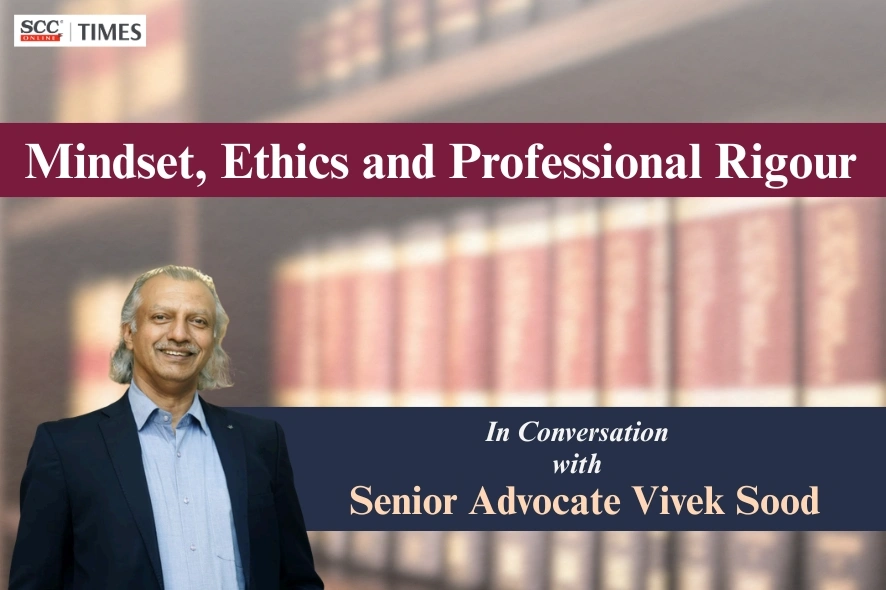
1. Kindly introduce yourself to our readers. What sparked your interest in law as a field which ultimately resulted in you pursuing criminal litigation?
Law is in my blood and DNA. I never thought of any other profession other than law. In my childhood, I saw my father as a leading tax lawyer in Punjab. My grandfather was a lawyer based in Lahore prior to the partition and then became a leading civil lawyer of Punjab post partition. My initial interest in law came from them. Later, this interest became a passion. My interest in criminal jurisprudence, while I was studying law, brought me into criminal litigation. Also, this interest is fuelled by the fact that criminal litigation is a way to serve the society, especially the accused, the majority of whom come from poverty. The growth of white-collar crime law practice has made criminal law a lucrative area of the legal profession. These factors motivated me to pursue criminal law.
2. In your book Chaff and Grain, you discuss the malfunctions of the criminal justice system. For a student transitioning from the idealism of law school, what is the most critical mindset shift required to handle the reality where procedural delays and investigative irregularities often overshadow the letter of the law?
Students must only focus on sharpening their legal skills, to become a fine lawyer. Rest is extraneous. Procedural delays and investigative irregularities are part of the legal system and should not come in the way of building skills of advocacy.
3. You have famously stated that whatever little you know of the law, you have learnt it in court. Early in your career, how did you balance the need for rigorous academic study with the street-smart intuition required to navigate the high- pressure environment of the Delhi High Court and trial courts?
Like homework and classwork are equally important, in the legal profession, research and preparation are as important as appearances in courts where you are pitted against formidable opponents and have to win the perception of Judges in favour of your case. All along till this day, I give equal importance to both these areas in my law practice. Pressures are part and parcel of litigation. In fact, I love the challenges of litigation more than anything else. Hence, I never feel the pressure of the litigation environment as it is a way of life for me.
4. For cross-examinations, what is your primary strategy in dealing with a hostile witness, in addition to pointing out obvious contradictions?
Cross-examination is an art as well as a science. First and foremost, I analyse the personality profile of witnesses. Then I visualise what I want from the witness in cross-examination. Accordingly, I prepare the questions. In cricket, they say, a batsman must know where his off stump is. In a criminal trial, a defence lawyer must know his defence before embarking upon cross-examination of a witness. Added to the above, I always carry with myself the spontaneity that is required in cross-examination. Many answers give birth to new questions which happens on the spot during cross-examination. You have to be well prepared with the questions and be in the moment at the same time, to create new questions based upon answers given witnesses. Hostile witnesses are of several kinds and all contradictions are not similar. Hence, generalisation in dealing with hostile witnesses and contradictions is not possible.
5. You have handled cases that have made headlines for years. How do you maintain professional detachment and ethical rigor when handling cases that are under intense media glare?
Professional objectivity is something you build up with experience. For me, every case is important. I do not classify cases depending upon media headlines. I put in the same effort in every case irrespective of media headlines.
6. You have previously advised young lawyers on the importance of avoiding personal conflicts with Judges. In a high-stakes criminal trial where tensions run high, how can a lawyer remain assertive in their arguments while maintaining the decorum of the court?
In my younger days, I would all the time get into personal brawls with Judges but with experience, I realised its futile to enter into personal fights with Judges. After all, we lawyers and Judges are there to perform our respective duties. A lawyer argues and the Judge decides. Hence, with experience, I started to only focus on building arguments, leaving decision-making to the Judges. My work ends in addressing the finest arguments whereupon the duty of a Judge begins.
7. What are some actionable steps you would recommend that a 3rd or 4th-year student of law undertake to start building their professional identity while still in law school, especially if they lack legacy advantages?
Build capacity for hard work, develop advocacy skills such as speaking abilities, and develop a big appetite for reading and research. These are sure shot ways to compete with legacy lawyers. Also, develop the skill to build human relations. You may be a fine lawyer but if your public relations (PR) is poor, you may not succeed. PR is so relevant for the first 20 years at least, till you build a reputation and goodwill in the legal profession and do not need PR.
8. With the transition to the new criminal laws, what specific areas of the new laws do you believe will most significantly alter the way trials are conducted in India?
Nothing will change drastically in the way trials will be conducted with the new criminal laws. The new criminal laws are substantially the same as the old laws, with some changes. But the changes will not alter the trial process substantially. We are not shifting to a jury system or something. The trial process remains the same with some changes here and there. However, white-collar crime will become bigger in terms of quantum of legal work. Also, technologies such as artificial intelligence (AI) will facilitate legal work wholistically. AI will make litigants more aware of what is happening in their trials, making lawyers more accountable. Also, scientific and electronic evidence will play a bigger role in criminal trials.
9. For many aspiring lawyers, the ethical burden of defending individuals accused of grave offences can be daunting. How do you then define the role of a defence counsel: is it to find truth or to ensure the integrity of the process?
There is no ethical dilemma at all, in defending persons accused of the gravest offences. It is a professional duty. If a lawyer feels uncomfortable taking up such cases, he has a choice of refusal to defend. Having said this, ethics come into play in terms of using only the legal and legitimate tools of defending the accused. Advice to the accused to buy or threaten witnesses, or use other extraneous means to win a case is what is unethical professional conduct. Other than this, there should be no ethical burden or dilemma.
10. Looking back at your professional journey, is there any advice you would give to young lawyers to handle the inevitable failures and hardships of the early years in litigation?
This profession is a long marathon race, hence, perseverance and stamina play a critical role to make a successful career in law. Also, there is no substitute for hard work. Another advise to young lawyers is to work on your shortcomings. And there is no bar against improvisation. For instance, if you are not good with your language skills, work on it. If you do not have an appetite for reading, build it. If your PR is not good enough, make it happen. Age is neither an excuse nor a bar to improvisation. Do not lose hope in this long journey. Early years are difficult but use them to build your skills as a fine lawyer. Lamenting on your difficulties will not help. And remember: If you follow the above Mantras, “Apna time ayega!”.
1. Vivek Sood, Senior Advocate, Supreme Court of India.
2. SCC-EBC Student Ambassador, Dr. Ram Manohar Lohiya National Law University.