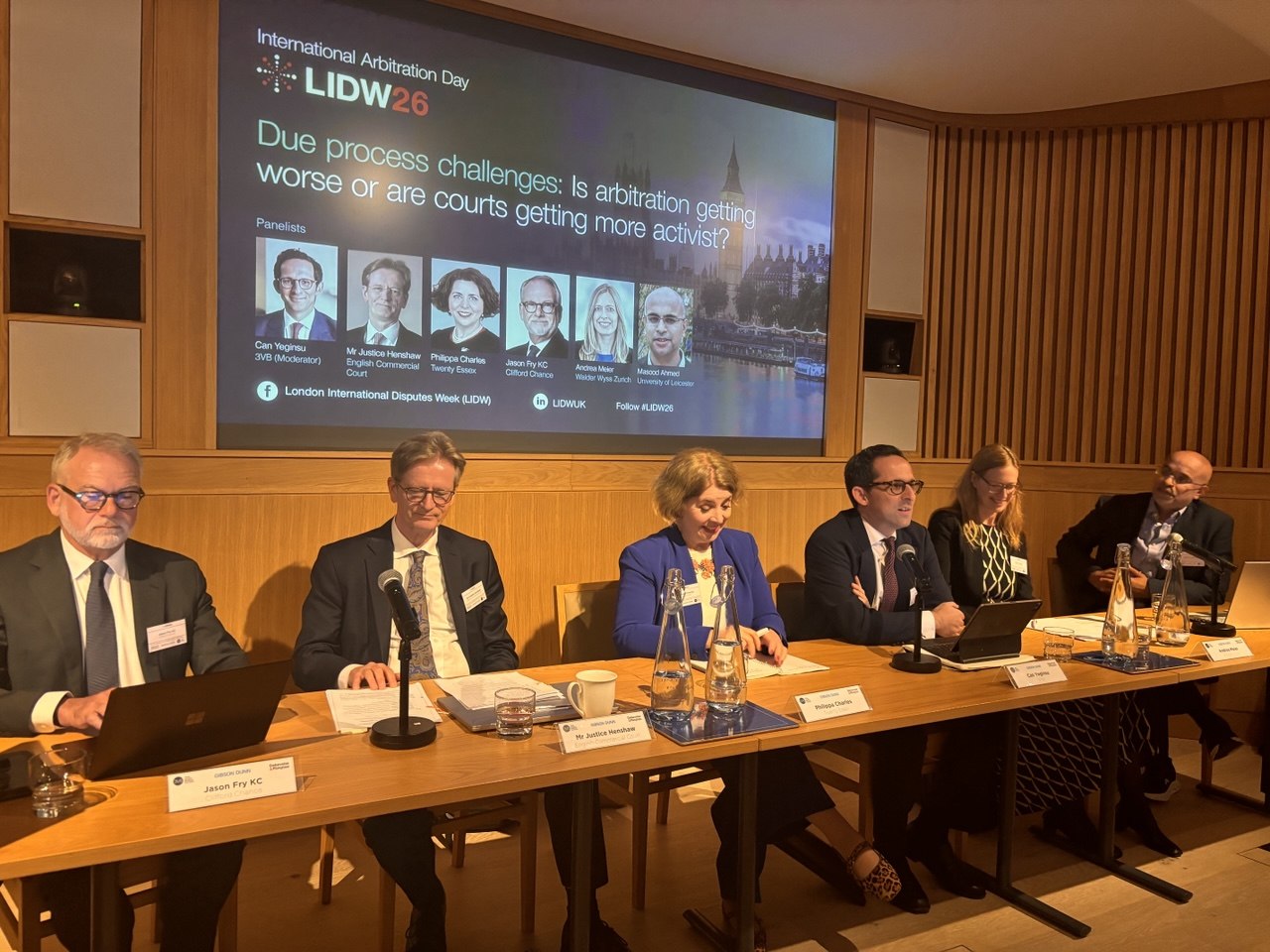
The panel on “Due Process Challenges: Is Arbitration Getting Worse or Are Courts Getting More Activist?”, held during International Arbitration Day at London International Disputes Week (LIDW), 2026, brought together distinguished voices from England, France, Switzerland and academia to examine one of the most persistent questions in international arbitration: whether increasing challenges to arbitral awards indicate a shift in judicial attitudes or a growing reluctance among tribunals to take decisive procedural decisions. Moderated by Mr. Can Yeginsu, Barrister, 3VB, the discussion focused on due process, public policy review, procedural fairness, and the impact of emerging technologies on arbitral proceedings.
Due Process Concerns and Tribunal Decision-Making
Opening the discussion, Ms. Phillipa Charles, Twenty Essex, reflected on the practical challenges faced by arbitral tribunals in managing proceedings efficiently while protecting awards from subsequent challenges. She observed that tribunals often struggle to predict which procedural decisions may later be relied upon by an unsuccessful party seeking to challenge an award.
She remarked:
“There is a real tension between the desire to provide the parties with an efficient, effective process, and the concern that by acting efficiently, expeditiously, boldly, bravely, we’re somehow laying the ground for a subsequent challenge.”
Discussing methods for minimising due process attacks, she emphasised the importance of early dialogue with parties, bespoke procedural orders, structured case management and maintaining an appropriate tone when addressing procedural objections. She also highlighted the growing importance of discussing the use of artificial intelligence at the first case management conference and cautioned tribunals against dismissing procedural concerns too abruptly, even when they appear unmeritorious.
Judicial Perspective: Section 68 Challenges Remain Rare
Providing the judicial perspective, Justice Andrew Henshaw, English Commercial Court, reflected on challenges brought under Section 68 of the English Arbitration Act, 1996 (English Arbitration Act). Drawing on Commercial Court statistics, he noted that while the number of applications has varied over the years, successful challenges remain exceptionally rare when compared to the thousands of arbitral awards rendered annually.
Also read: Professional Ethics in the Era of Self-Promotion on Social Media: Toby Landau KC Delivers Keynote Address on International Arbitration Day at LIDW 2026He observed that English courts continue to adopt a restrictive approach to intervention, with most successful applications involving situations where parties were not given an adequate opportunity to address an issue that later became decisive to the award.
He explained:
“The commonest type of Section 68 claim has been to say that the tribunal has done something significant without giving the parties a chance to comment and or to adduce evidence about it.”
Referring to recent cases involving interest awards, limitation defences and causation issues, Justice Henshaw emphasised that tribunals should ensure parties have an opportunity to address all material issues before an award is rendered. He concluded that English courts remain reluctant to interfere with arbitral awards except in exceptional circumstances, reaffirming the judiciary’s strong support for arbitral finality and party autonomy.
Switzerland, Public Policy and the Semenya Litigation
Providing the Swiss perspective, Ms. Andrea Meier, Partner, Walder Wyss, Zurich, noted that while challenges before the Swiss Federal Supreme Court have increased significantly over the past two decades, the success rate remains exceptionally low. She explained that public policy remains the principal ground through which parties can seek limited judicial review of arbitral awards.
She explained:
“Public policy means that really the most fundamental principles of law that should underpin every legal order are breached.”
Ms. Meier discussed the landmark Semenya litigation, where athlete Caster Semenya challenged regulations requiring her to lower naturally elevated testosterone levels. The litigation raised significant questions regarding the extent to which courts may review arbitral awards where fundamental rights are implicated. She observed that the decision of the European Court of Human Rights has reignited debate regarding the relationship between arbitration, human rights and judicial oversight.
She further emphasised that tribunals can best protect their awards by ensuring that serious allegations, including corruption or human rights concerns, are properly addressed and reflected in the factual findings of the award.
France and the Expanding Use of Public Policy Challenges
Addressing developments in France, Mr. Jason Fry KC, Clifford Chance, observed that although due process challenges continue to enjoy a low success rate, parties increasingly rely on public policy arguments to contest awards, particularly where allegations of corruption or illegality are involved.
Drawing on recent trends before the Paris Court of Appeal, he explained that French courts may conduct an independent review where enforcement of an award is alleged to give effect to corruption, money laundering or other serious violations of international public policy.
He emphasised:
“The French courts are still pretty intolerant to due process challenges.”
At the same time, he highlighted a growing number of challenges framed through public policy, often seeking to revisit issues that could not succeed as conventional due process objections. The discussion also explored the distinction between the French approach and the English standard requiring clear and convincing evidence of corruption.
Comparative Perspectives: Convergence in Outcomes, Divergence in Reasoning
Offering a comparative analysis, Mr. Masood Ahmed, University of Leicester, observed that major arbitration jurisdictions increasingly arrive at similar practical outcomes while relying on different legal theories and judicial philosophies.
He stated:
“The trend is mostly convergence in results but divergence in legal reasoning and judicial approaches.”
Comparing England, France and Switzerland, Mr. Ahmed noted that all three jurisdictions remain strongly supportive of arbitration and generally reluctant to interfere with awards. However, English courts continue to emphasise their supervisory role as part of the broader justice system, whereas Switzerland focuses on efficiency and predictability, and France adopts a more delocalised approach centred on arbitral autonomy and finality.
The panel also discussed the P&ID case, with participants largely viewing it as an exceptional example of serious impropriety rather than evidence of a broader trend towards judicial intervention.
Managing Witnesses, Experts and Procedural Fairness
The discussion then turned to witness examination and expert evidence. Addressing Swiss practice, Ms. Meier explained that while tribunals may in limited circumstances require witness questioning to take place in writing, parties should ordinarily be afforded an opportunity for oral examination where requested.
On expert evidence, Mr. Fry advocated for a more proactive approach by tribunals. He expressed concern that experts increasingly function as advocates rather than independent specialists and suggested dedicated case management procedures aimed at narrowing genuine technical disagreements.
He observed that tribunals should be:
“More proactive in case management of expert evidence.”
Mr. Fry also supported tribunal education sessions conducted by experts to assist arbitrators in understanding highly technical disputes before evaluating competing expert opinions.
AI, Hallucinations and Future Challenges to Arbitral Awards
The final segment focused on artificial intelligence and its implications for arbitral proceedings. Mr. Ahmed highlighted the growing use of AI in document review, disclosure, legal research, transcription and arbitrator selection. While acknowledging the efficiency gains, he warned that the technology also presents significant risks.
Referring to recent judicial decisions involving AI-generated legal citations, he emphasised:
“An arbitrator should not delegate his or her decision-making responsibility to an AI tool.”
Discussing recent cases from Canada and the United States, Mr. Ahmed noted that courts are beginning to confront situations where arbitrators have relied on hallucinated authorities generated by AI systems. While courts remain open to responsible use of technology, he stressed that arbitrators must independently verify all outputs and retain ultimate responsibility for their reasoning and conclusions.
Concluding Reflections
The discussion revealed broad agreement that successful due process challenges remain exceptional across leading arbitration jurisdictions. However, the increasing use of public policy arguments, human rights-based challenges, corruption allegations and emerging AI-related concerns demonstrates that courts and tribunals continue to recalibrate the balance between arbitral autonomy and procedural fairness. The panel concluded that robust case management, clear reasoning and principled judicial restraint remain central to maintaining confidence in international arbitration.
This report is part of SCC Times’ special coverage of London International Disputes Week (LIDW) 2026. As an official Media Partner of LIDW26, SCC Times is covering key discussions, insights and developments from across the conference, bringing readers perspectives on emerging trends shaping the future of international dispute resolution.
SCC Times extends its appreciation to Zehra Naqvi, EBC–SCC Online Foreign Student Ambassador and Lawyer, for her on ground presence, valuable assistance and contribution to the reporting of this event.