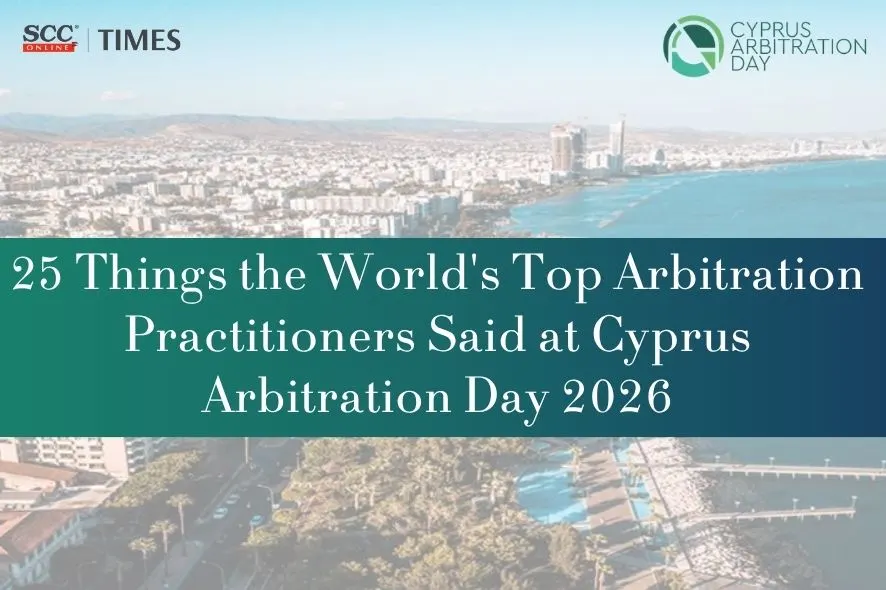
The much-awaited 4th Edition of the Cyprus Arbitration Days, titled Cyprus Arbitration Day 2026, held on 15 May 2026 brought together leading practitioners, arbitrators, academics, and policymakers from across jurisdictions to discuss the international arbitration landscape, fostering dialogue on evolving legal, procedural, and institutional aspects of dispute resolution.
The esteemed dignitaries engaged in insightful conversations ranging from AI in arbitration to Bilateral Investment Treaties, from EU Acquis to development of arbitration jurisprudence, from judicial overreach to res judicata, and so much more. The deliberations that took place over the course of 1.5 days were not only enriching but also thought provoking. Here are some key takeaways from the conference:
1. India was once only a capital importer until it started signing investment operation agreements. Now Indian companies are operating in the global market and suing foreign countries. — Mr. Roman Khodykin, Partner, Bryan Cave, UAE
2. India is very well positioned with good lawyers, good arbitrators, infrastructure, the structure is slowly coming in place, driven by a very strong-willed judiciary. — Ms. Purnima Kambalay, Senior Partner, Fox Mandal, Hyderabad
3. AI can improve efficiency. But it cannot replace human judgment or procedural responsibility. Transparency is key. — Prof. Dr. Alexander Petsche, Partner, Baker McKenzie, Vienna
Read about the eve of CAD 2026 in detail here: Cyprus Arbitration Day 2026 Kicks Off with Discussions on India-Cyprus relations, Investment Treaties and AI in arbitration
4. The question is not whether AI belongs in legal practice. It already does. The question is whether legal institutions are prepared for its long-term cognitive consequences. — Mr. Amir Singh Pasrich, LPD Secretary-Treasurer and IBA Treasurer, International Bar Association
5. The question is no longer whether AI will influence arbitration, but rather how arbitration can responsibly integrate technological innovation while preserving the fundamental principles of professional fairness, human judgment, and ethical integrity. — Mr. Agis Georgiades, Partner, CGA and CAD Co-Chair
Read more about the opening discussion on AI, ethics, and the future of arbitration here: Human Judgment vs AI Efficiency: The Question That Opened Cyprus Arbitration Day 2026
6. That trust cannot be taken for granted. It must constantly be justified and reinforced through the quality of arbitral decision-making, the integrity of the process, and the willingness of practitioners and institutions to adapt intelligently to new realities. — Mr. Stavros Pavlou, CAD Co-Chair
Read more about Stavros Pavlou’s reflections on trust, institutional credibility, and the evolving arbitration landscape here: “Arbitration Is a People-Driven Profession Built on Trust”: Stavros Pavlou’s Welcome Address at Cyprus Arbitration Day 2026
7. The modern arbitral institution is not outside the arena. It is in the arena. And it may even be the arena. — Mr. Kevin Nash, Director General, London Court of International Arbitration (LCIA)
Read more about institutional credibility, evolving expectations, and the future role of arbitral institutions here: “Move from Case Count to Credibility”: LCIA Director General Kevin Nash on the Future of Arbitration Institutions at Cyprus Arbitration Day 2026
8. CEDRAC is now becoming more active, more visible, and more operational. — Mr. Christodoulos Christodoulou, Senior Associate, Chrysostomides Advocates, Nicosia
Read more about CEDRAC’s growing role in regional dispute resolution and arbitration initiatives here: Cyprus Eurasia Dispute Resolution and Arbitration Center: What CEDRAC Does and Why It Matters — Cyprus Arbitration Day 2026
9. We try to delineate how Achmea and the precedent that the European courts have developed, and that courts in other jurisdictions have picked up on, are threatened to spill over into commercial arbitration as well. —Mr. Franz Schwarz, President, VIAC, London
10. Practical implications for investors and practitioners has created a chilling effect when negotiating arbitration clauses with the state in new concession agreements. —Mr. Dimitrios Andriopoulos, Senior Associate, Calavros Law Firm Filios Kloukinas, Athens
11. The success of the reform will depend on whether it is possible to reconcile the skeptical and non-skeptical supportive views. —Ms. Eleni Dionysiou, Senior Associate, Patrikios Legal, Limassol
Read more about Achmea spillover concerns, enforcement challenges, and the future of investor-state arbitration in Europe here: When EU Law and International Arbitration Collide: Achmea Spillover, Sovereignty Concerns and Enforcement Resistance at Cyprus Arbitration Day 2026
12. There is a meaningful difference between refining legal analysis with an existing framework and building an entirely new legal framework from scratch, particularly where the governing law is foreign, where the risk of error and perceived overreach is considerably higher. —Ms. Eleni Lentziou, Senior Associate, CGA, Nicosia
13. There is a thin line between legal indications and warnings by the tribunal and legal advice to the parties or councils, or imitations for arguments or further objections. This could lead to a potential for, at least, perceived bias and challenges, for example setting aside actions. —Dr. Alexander Milionis, Attorney, Niedermüller, Lichtenstein
Read more about the insightful discussion on Iura Novit Curia here: Walking the tightrope between procedural fairness and judicial initiative: Cyprus Arbitration Day 2026 Unpacks Iura Novit Curia
14. If we were to move away from the traditional conflict of laws approach, the use of a transnational approach to govern issues such as that of res judicata is not perfect because considerations of public policy as well as other considerations that may arise at the enforcement stage will still be extremely relevant. —Mr. Kyriakos Pittas, Partner, Soteris Pittas, Limassol
15. Arbitral precedent is not mechanical repetition. It is about disciplined engagement with prior arbitral reasoning. The tribunal remains independent, but it does not decide in a vacuum. If prior tribunals have addressed the same or similar issue, that reasoning forms part of the arbitral context in which the later tribunal operates. —Mr. Christodoulos Christodoulou, Senior Associate, Chrysostomides Advocates, Nicosia
Read more about res judicata and precedent in international arbitration here: Preventing Arbitral Law from Developing Invisibly: Experts on Precedent, Res Judicata and Award Publication at Cyprus Arbitration Day 2026
16. In the heartland of commercial arbitration, the resolution of corporate disputes, we see a new wave of courts discussing the arbitrability of certain corporate disputes. This is in the context of shareholder disputes and making sure you involve all shareholders. There have obviously been methods in arbitration to deal with these issues, but now the question is elevated much more fundamentally to a question of arbitrability. — Mr. Franz Schwarz, President, VIAC
Read his keynote address in detail here: Arbitration Under Pressure: VIAC President Franz Schwarz on Public Policy, Arbitrability and Judicial Overreach at Cyprus Arbitration Day 2026
17. The future of arbitration will not be built by legislation alone. It will be built by institutions, by practice and by trust. —Mr. Ioannis Economou, Member of Board of Executives, CAMC
Read more about the newly launched Cyprus Arbitration and Mediation Centre here: Local Enough to Know the Market, Institutional Enough to Be Trusted, Outward-Looking Enough to Matter: Inside CAMC at Cyprus Arbitration Day 2026
18. Hallucinations, fabricated quotations, and erroneous references to standards or contract clauses pose serious reputational risks that will crystallize the moment opposing counsel challenges the source of a claim under cross-examination. —Mr. Daniel Correa, Managing Director, DAC Consulting, London
19. No technology can fully eliminate hallucination or bias, so firms must adopt a layered defense strategy that includes diversifying AI model providers, maintaining rigorous human oversight, and grounding outputs in authoritative legal content. Critical thinking remains the indispensable safeguard, and that responsibility rests squarely with the practitioner. —Mr. Sébastien Bardou, General Manager, LexisNexis, Versailles
Read more about use of AI by legal practitioners here: Are Practitioners Ready to Use AI Responsibly? Cyprus Arbitration Day 2026 Asks the Question the Profession Is Avoiding
20. Organisations should establish a four-tier risk matrix categorizing AI use cases as low, amber, high or prohibited, combined with a five-stage operational framework i.e. identify the tools in use, document search methodologies, implement checks and reviews, maintain transparent disclosure practices and invest in continuous training. It is process and governance, not the technology itself, that will safeguard practitioners as AI capabilities continue to evolve —Mr. Christopher Clements, Partner, Deloitte, UAE
21. AI does not dilute professional responsibility but rather intensifies it. Lawyers must never outsource legal judgment to algorithmic tools, and disputes are often won not by identifying patterns but by recognizing the anomaly, the human context, or the single document that reshapes an entire case. —Mr. Alexander Marcopoulos, Partner, Hughes Hubbard & Reed, Paris
Read more about AI-assisted arbitration practice here: AI Governance, Professional Obligations, and the Question of Critical Thinking at Cyprus Arbitration Day 2026
22. Tribunals seem to be seated more in what are now perceived as neutral seats geographically, which is shifting in today’s world. —Mr. Artem Doudko, Partner, Osborne Clarke, London
23. International arbitration is actually the preferred choice rather than litigation [in renewable sector disputes] because you are often dealing with complex, multi-jurisdictional parties. —Ms. Lynn Yin, Partner, Asserson, London
24. Sanctions and fundamental rights are uncomfortable bedfellows and that the tension between them gives rise to difficult legal questions for arbitrators and national courts, which require them to find principled ways of ensuring that sanctions are complied with in a way which minimises their effect on fundamental rights of the parties and fundamental principles of justice and fairness. —Mr. Alexandros Gavrielides, Partner, Scordis Papapetrou, Nicosia
25. Historically, force majeure clauses were often treated as boiler plate provisions, i.e., parties would include standard wording in their contracts without considering how these provisions would operate in practice during a major geopolitical crisis. However, recent crises have demonstrated the need for sophisticated risk-specific clauses. —Ms. Niki Liassides, Partner, Harris Kyriakides, Limassol
Read detailed discussion on key topics in arbitration in the last panel session of CAD 2026 here: Force Majeure, Geopolitics, Sanctions, Renewable Energy: Cyprus Arbitration Day 2026 concludes | SCC Times