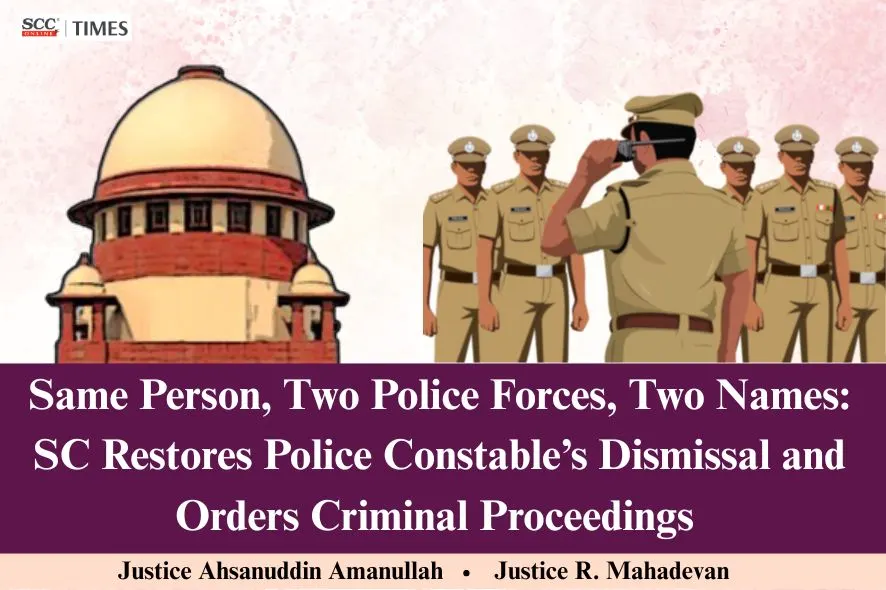
Supreme Court: In an appeal arising from the Jharkhand High Court’s judgment dated 25 August 2022, whereby Single Judge’s judgment was reversed and orders of the disciplinary authority, appellate authority, and revisional authority which had all concurrently upheld Respondent 1’s dismissal from service as a Constable in the Jharkhand Police was quashed, the Division Bench of Ahsanuddin Amanullah and R. Mahadevan*, JJ., set aside the impugned judgment of the Division Bench of the Jharkhand High Court and restored the judgment of the Single Judge, along with the order of dismissal passed by the disciplinary authority and affirmed by the appellate and revisional authorities.
The Court held that “Public employment, particularly in the police service, cannot be converted into an instrument of fraud. If individuals entrusted with enforcing the law themselves secure entry into service through deception and fabricated credentials, it would seriously erode the Rule of Law.”
Factual Matrix
In the instant matter, Respondent 1 was appointed as Constable in the Jharkhand Police on 18 May 2005 and was posted in Garhwa District. While serving as Reserve Guard at Dhurki Police Station, he was granted compensatory leave from the afternoon of 20 December 2007 till 23 December 2007. However, he failed to rejoin duty thereafter and remained unauthorisedly absent.
During this period of absence, allegations surfaced that the respondent had secured appointment in the Bihar Police as a Constable under another assumed name, pursuant to Patna District Order No. 10524 of 2007 dated 26 December 2007. It was alleged that he used forged certificates and fabricated credentials for obtaining such appointment. Thereafter, he allegedly absconded from Bihar Police Service on 6 January 2008 without intimation.
Subsequently, the Senior Superintendent of Police, Patna issued notice to him. An enquiry was thereafter conducted by the Officer-in-charge, Onkari Police Station pursuant to Memo No. 2512/Go dated 21 June 2008 issued by the Superintendent of Police, Jehanabad. The enquiry reportedly disclosed that “Ranjan Kumar” and “Santosh Kumar” was one and the same person in both cases.
Based on these allegations, a memorandum of charge dated 2 September 2008 was issued to the respondent. He submitted his written defence on 29 September 2008. Following departmental proceedings, the Superintendent of Police, Garhwa dismissed him from service by order dated 20 August 2010.
The statutory appeal preferred before the Deputy Inspector General of Police was dismissed on 21 May 2011. The memorial petition before the Director General-cum-Inspector General of Police was also rejected on 6 February 2012.
Thereafter, the respondent filed writ petition before the High Court. The Single Judge dismissed the writ petition on 30 October 2015. However, the Division Bench allowed the letters patent appeal and set aside the disciplinary action, leading to the present appeal before the Supreme Court.
Disciplinary Authorities’ Findings
The disciplinary authority recorded that the respondent had failed to produce any convincing defence against the allegations. It found that while serving in Garhwa Police, the respondent clandestinely obtained appointment in Bihar Police under a changed name and parentage by committing forgery and cheating. The authority held that the misconduct constituted serious violation of the Civil Service Code and even disclosed criminality. Accordingly, the respondent was dismissed from service under Rule 824, Police Manual.
The appellate authority independently examined the record and concurred with the disciplinary authority, observing that the respondent had committed fraud upon the department and secured appointment in Bihar Police by changing his identity. It upheld the punishment of dismissal as proportionate to the misconduct.
The revisional authority similarly held that the departmental proceedings had been conducted according to prescribed procedure and that the allegations were extremely serious. It noted that forged certificates had been detected during investigation and that the respondent failed to establish innocence through any cogent material.
Issue for Consideration
Whether the disciplinary action culminating in dismissal of Respondent 1 suffered from any legal infirmity warranting interference in judicial review under Article 226 of the Constitution?
Proceedings Before the Supreme Court
The Court initially stayed the operation of the impugned Division Bench judgment on 20 March 2023. Thereafter, the Director General of Police, Bihar was impleaded as Respondent 2 to facilitate effective adjudication. Subsequently, by order dated 10 February 2026, one Santosh Kumar, son of Kamta Sharma, resident of the same village, was impleaded as Respondent 3.
The Court directed the Bihar Police authorities to conduct an enquiry into whether “Ranjan Kumar” and “Santosh Kumar” were in fact the same individual. A special team was constituted to verify the identity of Respondent 3 and to conduct scientific examination.
Pursuant to the directions, the Director General of Police, Bihar submitted an enquiry report dated 11 April 2026. The report concluded, on the basis of forensic comparison of fingerprints, biometric records and photographs, that “Ranjan Kumar” and “Santosh Kumar” were one and the same person. Genealogical records and electoral rolls also suggested that the variance in the father’s name formed part of a manipulated identity trail.
Analysis
The Court observed that the findings of the disciplinary authority, appellate authority and revisional authority were concurrent findings of fact based upon relevant material and could not be characterised as based on “no evidence”.
The Court emphasised that the gravamen of the charges were not a mere procedural lapse or unauthorised absence simpliciter but involved a “deliberate and premeditated fraud upon two State police forces” by securing public employment under 2 identities using fabricated documents.
The Court attached considerable importance to the forensic enquiry report submitted pursuant to its own directions, which established through fingerprint comparison, biometric data and photographic evidence that the respondent and “Santosh Kumar” were the same person. According to the Court, this scientific evidence substantially demolished the defence of mistaken identity or absence of proof.
The Court reiterated that “a member of the police force is expected to maintain the highest degree of integrity, honesty and discipline. Fraud at the threshold of entry into service strikes at the very root of public employment”.
Rejecting the respondent’s objections regarding non-examination of witnesses and formal proof of documents, the Court held that departmental enquiries are not criminal trials and strict rules of evidence do not apply. What is required is fair opportunity and some relevant material having probative value. The Court found that the respondent had been supplied with all relevant materials, given opportunity to defend himself and heard at every stage of the proceedings.
The Court referred to Union of India v. Subrata Nath, (2024) 20 SCC 402 and the other precedents referred in the Subrata Nath (supra) governing judicial review in disciplinary matters and reiterated that High Courts exercising jurisdiction under Articles 226 and 227 cannot act as appellate authorities by reappreciating evidence or reassessing adequacy of evidence in departmental proceedings.
Applying the principles discussed in Subrata Nath (supra), the Court held that the Single Judge had correctly appreciated the limited scope of judicial review, whereas the Division Bench had clearly transgressed settled parameters by disturbing concurrent findings of fact.
The Court further held that Rule 828, Jharkhand Police Manual and Appendix 49 had been substantially complied with, since the respondent was served with charges, furnished materials, allowed to participate in enquiry and given opportunity to represent against the enquiry report. Therefore, requirements of procedural fairness and substantial compliance with the prescribed procedure stand satisfied.
The Court observed that continuance of a person guilty of impersonation, forgery, dual employment and fraud in police service would seriously damage public confidence and institutional discipline. Therefore, the punishment of dismissal was proportionate and justified administrative measure arising out of a fair and lawful enquiry.
The Court further held that the matter did not remain confined to departmental misconduct alone. The allegations, reinforced by forensic findings, prima facie disclosed cognizable offences including cheating, forgery, impersonation and use of forged documents under the Penal Code, 1860 (IPC) or corresponding provisions of the Nyaya Sanhita, 2023 (BNS).
Decision and Direction
Accordingly, the Court directed the Director General of Police, Bihar and the Director General of Police, Jharkhand to ensure that the matter is examined by competent jurisdictional police authorities and that appropriate criminal proceedings be initiated in accordance with law. It clarified that its observations were confined to adjudication of the service matter, and any criminal proceedings would be decided independently on their own merits.
Consequently, the Court allowed the appeal and set aside the judgment of the Division Bench of the High Court and restored the judgment of the Single Judge, along with the dismissal order passed by the disciplinary authority and affirmed by the appellate and revisional authorities.
Further, exercising powers under Article 142 of the Constitution, the Court quashed Patna District Order No. 10524 of 2007 dated 26 December 2007 and set aside the appointment of “Santosh Kumar” in the Bihar Police.
[State of Jharkhand v. Ranjan Kumar, 2026 SCC OnLine SC 824, decided on 8-5-2026]
*Judgment by Justice R. Mahadevan