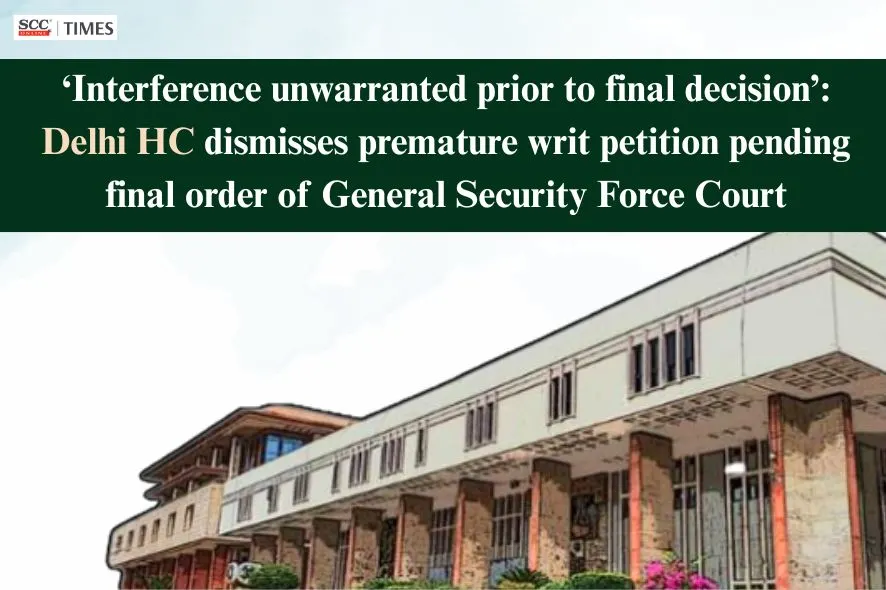
Delhi High Court: In a petition seeking quashing of the reconstitution of the Internal Complaints Committee (ICC) in May 2025, the ICC’s findings and opinion dated 26 May 2025, the order dated 30 July 2025 convening the Record of Evidence (RoE), the chargesheet dated 12 January 2026 and the order dated 12 January 2026 convening the General Security Force Court (GSFC), along with its findings and sentence, the Division Bench of *V. Kameswar Rao and Manmeet Pritam Singh Arora, JJ, held that the petition was premature, as the petitioner had already invoked the statutory remedy of a pre-confirmation petition under the relevant provisions of the Border Security Force Act, 1968 (BSF Act), which was pending consideration.
Declining to interfere at an intermediate stage of the proceedings, the Court dismissed the petition, observing that no judicial intervention was warranted prior to the final decision by the competent authority.
Background
The matter arose from an incident during duty hours in January 2025. The petitioner, upon returning from patrol, had found a woman constable assigned to the LCTS room allegedly asleep. According to the petitioner, he attempted to wake her by tapping on the table and tugging her jacket, reprimanded her for dereliction of duty, and later consoled her before directing her to resume duty. He asserted that the constable, being new and reserved in nature, became overwhelmed during the interaction.
Two days later, the petitioner had learned that a complaint had been lodged against him. He subsequently met the complainant in the presence of another constable, during which the complainant recorded their conversation. The petitioner had maintained that he merely attempted to apologise for any perceived misunderstanding.
The complaint was referred to the ICC, but the initial proceedings were annulled due to improper constitution of the Committee, as the Presiding Officer was male. A reconstituted ICC conducted a fresh inquiry and, by its report dated 26 May 2025, found the petitioner blameworthy of misconduct and recommended disciplinary action. The report was approved by the competent authority, following which the petitioner was directed to face disciplinary proceedings and be transferred.
Subsequently, an RoE was convened on and based on the RoE, a GSFC was convened on and a charge-sheet was issued the same day. The GSFC proceedings were conducted, resulting in findings and sentence against the petitioner. Aggrieved, the petitioner filed a pre-confirmation appeal under Section 117(1), BSF Act and thereafter approached the Court.
The petitioner contended that the ICC was improperly constituted, lacked quorum, and that its proceedings violated principles of natural justice. He also argued that the Committee members lacked requisite legal expertise.
The respondents, relying on the ICC findings, alleged that the petitioner had engaged in inappropriate physical contact, attempted to establish a personal relationship with the complainant, and misused his official position by pressuring her to maintain contact and linking official favours to personal compliance. The ICC had further noted that the petitioner had attempted to influence the complainant to withdraw her complaint and concluded that his conduct was unbecoming of a subordinate officer, warranting disciplinary action.
Analysis and Decision
The Court noted that the core issue for determination was whether the impugned actions, namely, the ICC findings dated 26 May 2025, the chargesheet and order convening the GSFC dated 12 January 2026, and the subsequent GSFC findings, were liable to be set aside at this stage.
The Court noted that the petitioner had already availed the statutory remedy of filing a pre-confirmation petition under Section 117(1), BSF Act, which was pending consideration before the competent authority. Importantly, the grounds raised in the writ petition had also been urged in the said pre-confirmation petition. The Court observed that it was incumbent upon the competent authority to consider all such grounds and pass a reasoned order. It further noted that the petitioner would have an additional remedy of post-confirmation under Rule 117(2), BSF Rules, if required.
Reiterating the settled legal position, the Court held that judicial interference at an intermediate stage of disciplinary proceedings, prior to the passing of a final order, is ordinarily unwarranted. In the present case, since the GSFC findings were yet to be confirmed, the matter had not attained finality.
While acknowledging the legal propositions relied upon by the petitioner, the Court held that their applicability must be assessed in the factual context of each case. On the facts at hand, the Court found no justification to intervene at this premature stage.
Accordingly, the writ petition was dismissed as being premature and devoid of merit, along with any pending applications.
[Ajit Kumar Singh v. Union of India, 2026 SCC OnLine Del 1306, decided on 30-3-2026]
*Order by: Justice V. Kameswar Rao
Advocates who appeared in this case:
For the Petitioner: Arjun Pawar, Prahil Sharma, Advocates.
For the Respondent: Swati R.K., CGSC, Dumni Soren, GP, Mohnish Balu, Amit Kumar Singh, Advocates.