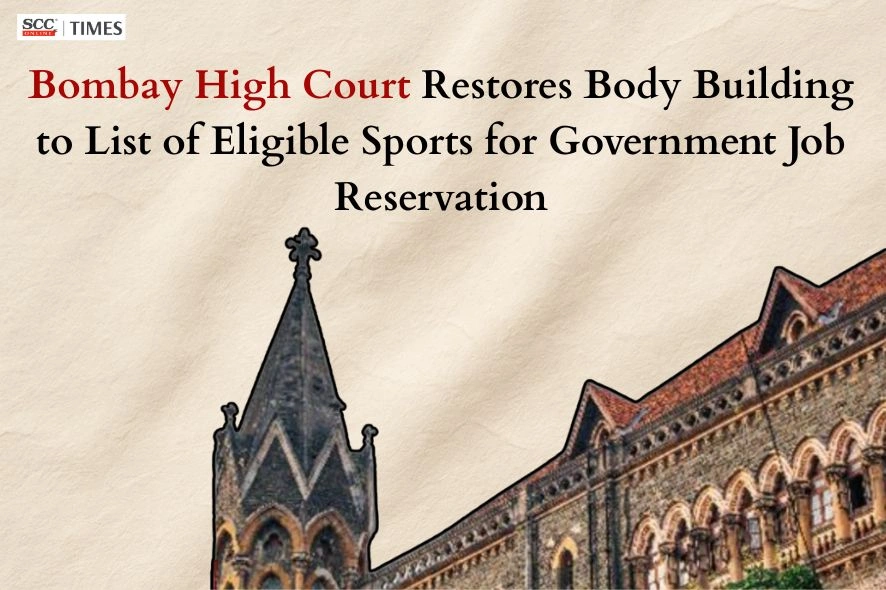
Bombay High Court: In a writ petition filed at Nagpur Bench, the Division Bench of Nandesh S. Deshpande* and M.S.Jawalkar, JJ., held that the Maharashtra government’s decision to exclude ‘Body Building’ from the list of eligible sports for the purpose of granting 5% reservation in appointment of Group (A) & (B) posts in government/semi-government institutions, under 2016 Government Resolution, even though the sport was eligible under the 2005 and 2013 Resolutions, was violative of Article 14 of the Constitution of India as it was done arbitrarily and not based on intelligible differentia. The Court held that the basis of legitimate expectation, the action violated the right of the petitioner to claim reservation and the action had no nexus to the aim and object of the policy.
Background and Contentions
A Government Resolution in 2005 reserved 5% of the posts in Class ‘A’ to ‘D’ of the Government and Semi Government institutions under sports quota where game of ‘Body Building’ was eligible for reservation. By 2016, the rule changed the eligibility criteria to include the player of State of Maharashtra who secured First/Second/Third rank or Gold/Silver/Bronze medal while representing their university in All India Inter Universities Sports Meet, to be organized by Inter Universities Sports Board as referred to in the respective Government Resolution.
Various games/sports eligible for appointment of Group (A) & (B) posts were mentioned in the Government Resolution. A note mentioned that only those games which are held in Olympics, Asiad and Commonwealth games along with Chess, Kabaddi and Kho-Kho would be included in the said eligibility to avail the reservation. Against this exact note the present writ petition was filed, contending that the action of the State in limiting the games only to those which are held in the said competitions was absolutely bad-in-law and showed colourable exercise of power. The 2005 Resolution had ‘Body Building’ as an eligible sport whereas in 2016 Resolution, apart from Olympics, Asiad and Commonwealth games, a special class of games was included where Chess, Kabaddi, Kho-Kho and eventually Mallakhamb found place. It was argued that not including ‘Body-Building’ here was not based on intelligible differentia and had no nexus with the policy and the object to be achieved. Moreover, the action was violative of Article 14.
On the other hand, the respondents submitted that the action, being a policy matter, was out of the scope of judicial review, unless ex facie arbitrary, and that there was no legally enforceable right based upon the principles of promissory estoppel and legitimate expectation in respect of the policy framed in 2005.
Issue raised
Whether a legally enforceable right can be claimed based upon the principles of promissory estoppel and legitimate expectation in respect of the policy framed under the Government Resolution dated 30/4/2005, which has been superseded by the Government Resolution dated 1/7/2016?
Analysis and Decision
After referring to multiple judgements, the Court held that the doctrine of legitimate expectation cannot be claimed as a right in itself but can be used only when the denial of a legitimate expectation leads to the violation of Article 14 of the Constitution.
The Court referred to the Preamble of the 2005 Resolution to ascertain the aim and object of the policy which was similar in subsequent resolutions too and observed that even the games which did not fulfill the criteria were included by the Government subsequently. The Court held that inclusion of few Indian games and non-inclusion of the game of ‘Body Building’ affected the fundamental rights of the petitioner. The Court agreed with the petitioner that,
“The basis of classification and limiting the games to Olympics, Asiad and Commonwealth Games is not based on any intelligible differentia and does not have any nexus with the object of the said policy, which is to encourage students to participate in sports activities.”
The Court found that as the Central Government acknowledged ‘Body Building’ as a legitimate and recognized sport by conferring Arjuna Award in the field, the exclusion by State Authorities, for the purpose of reservations was inconsistent, arbitrary, and devoid of reasonable justification. Referring to the principle of law of class legislation, where by conferring particular privileges upon a class of persons, arbitrarily selected from a large number of persons all of whom stand in the same relation to the privilege granted, and those on whom the privileges conferred and the persons not so favored, are discriminated, the Court finally held that the petitioner had a legitimate expectation that he would secure job if he is qualified as per the said policy and has dedicated his precious years of life in it. Thus, the action of the State in excluding the game but at the same time adding some games without any rationale or logic behind it, has led to arbitrariness resulting in violation of Article 14 of the Constitution of India. Therefore, the Court held that,
“Body Building” is a species of Gymnastics and is eligible for 5% reservation in Government and semi-Government Class ‘A’ to ‘D’ posts.
[Deepak Asaram Pawar v State of Maharashtra, 2026 SCC OnLine Bom 2351, decided on 13-3-2026]
*Judgement authored by: Justice Nandesh S. Deshpande
Advocates who appeared in this case:
For Petitioners: Petitioner in person
For Respondents: N.R.Patil, Assistant Government Pleader, V.V.Dahat, J.B.Kasat
Buy Constitution of India HERE