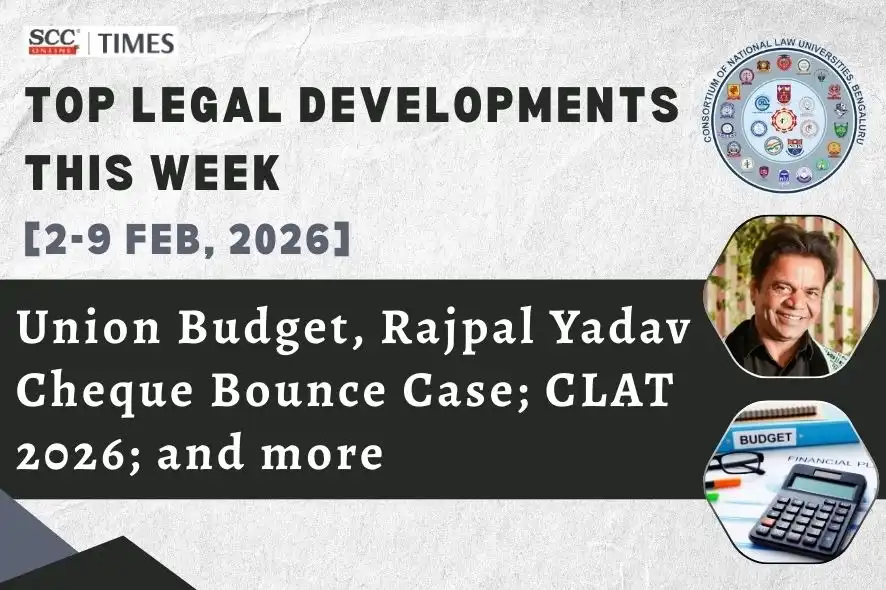
Catch up on the top legal developments this week (2—9 Feb 2026), including major Supreme Court and High Court rulings, CLAT 2026 updates, Union Budget highlights, key legislative reforms, and more.
STORY OF THE WEEK
Union Budget 2026-27 Highlights | Key Announcements, Tax Reforms & Strategic Sector Push
On 1-2-2026, the Finance Minister, Nirmala Sitharaman presented the Union Budget 2026- 2027 in Parliament. It is the first Budget prepared in Kartavya Bhawan and inspired by “3 Kartavya”:
-
1st Kartavya- to accelerate and sustain economic growth, by enhancing productivity and competitiveness, and building resilience to volatile global dynamics;
-
2nd Kartavya- to fulfil aspirations of people and build their capacity, making them strong partners in India’s path to prosperity;
-
3rd Kartavya- is aligned with vision of Sabka Sath, Sabka Vikas to ensure that every family, community, region and sector has access to resources, amenities and opportunities for meaningful participation.
Read Union Budget 2026-27 Highlights
Also Read:
Union Budget 2026-2027: Read Expert Insights on Macroeconomy, Taxation, Trade Policy and more
Union Budget 2026-27: Expert Views on Tax, Law, Infrastructure & Industry Reforms
ADMINSTRATIVE LAW
ORISSA HIGH COURT | Two-child norm disqualification, upheld; Protective proviso inapplicable to Panchayat membership termination
While deciding an intra-court appeal challenging termination of membership of a Grama Panchayat on the ground of disqualification under Section 25(1)(v) of the Odisha Grama Panchayats Act, 1964 (‘Act of 1964’), a Division Bench of Dixit Krishna Shripad* and Chittaranjan Dash, JJ., upheld the order of the Single Judge. The Court ruled that the statutory protection under the proviso to the two-child norm was inapplicable, squarely attracting the disqualification clause. Finding no ground to interfere, the Court dismissed the appeal. [Maheswar Jena v. Madhusudan Dalai, W.A No.1962 of 2025, decided on 15-01-2026]
Read more HERE
ADVOCATES
ALLAHABAD HIGH COURT | Advocate pulled up for calling rape victim a woman of “easy virtue”; says it violates dignity & privacy under Article 21
In a significant ruling condemning rape victim character assassination in court proceedings, the Single Judge Bench of Anil Kumar-X, J., held that labelling a survivor as a woman of “easy virtue” amounts to a direct attack on her dignity and privacy under Article 21 of the Constitution. The Court came down heavily on the defence counsel for relying on scandalous and extraneous material to malign the prosecutrix’s moral character, stressing that such attempts are expressly barred under Section 53A and the proviso to Section 146 of the Evidence Act and are wholly inconsistent with standards of ethical advocacy. [Bechan Prasad v. State of U.P., Criminal Appeal No. 9287 of 2022, decided on 29-01-2026]
Read more HERE
ALTERNATIVE DISPUTE RESOLUTION
SUPREME COURT | Not Orwell’s ‘Big Brother’: Which Court Can Extend Arbitral Mandate Under Section 29-A, Clarified
Resolving a long-standing judicial divergence on whether the jurisdiction to extend the mandate of an arbitral tribunal depends upon the forum that appointed the arbitrator under Section 11 of the Arbitration and Conciliation Act, 1996 (A&C Act), or whether it is governed exclusively by the statutory definition of “Court” under Section 2(1)(e), A Division Bench of Pamidighantam Sri Narasimha and R. Mahadevan, JJ., held that applications under Section 29-A of the A&C Act lie exclusively before the “Court” as defined under Section 2(1)(e), and not necessarily before the High Court that appointed the arbitrator under Section 11. [Jagdeep Chowgule v. Sheela Chowgule, 2026 SCC OnLine SC 124, Decided on 29-01-2026]
Read more HERE
SUPREME COURT | Mediation directed in long-standing property dispute between siblings; Justice Sudhanshu Dhulia appointed to oversee settlement
In a Special Leave Petition (SPL) arising out of a long-standing property dispute between a brother and his sisters concerning a prime property in Hyderabad, a Division Bench of J.B. Pardiwala and Vijay Bishnoi, JJ., appointed Justice Sudhanshu Dhulia, former Judge of the Supreme Court, to act as Mediator between the parties and oversee the settlement. [R. Ravindranath v. Greater Hyderabad Municipal Corpn., 2026 SCC OnLine SC 150, Decided on 02-02-2026]
Readmore HERE
SUPREME COURT | Forged Arbitration Agreement Not Arbitrable: Scope of Sections 8 & 11, clarified
In a significant ruling on forged arbitration agreements, the Supreme Court held that a dispute cannot be referred to arbitration when the very document containing the arbitration clause is alleged to be fabricated. The Court held that where the arbitration clause is embedded in a document alleged to be forged, the controversy “strikes at the very root of arbitral jurisdiction” and falls squarely within the category of non-arbitrable disputes. [Barnali Mukherjee v. Rajia Begum, 2026 SCC OnLine SC 135, Decided on 02-02-2026]
Read more HERE
PUNJAB AND HARYANA HIGH COURT | Arbitration and Conciliation Act, 1996 | Time-Barred Claim ≠Time-Barred Section 11 Petition: Second Arbitrator appointed
In a petition filed under Section 11(6) of the Arbitration and Conciliation Act, 1996 (‘Arbitration Act’) for appointment of an independent Arbitrator, a Single Judge Bench of Jasgurpreet Singh Puri, J., held that there is a distinction between a claim to be made and petition under Section 11 to be filed, thus, the present petition was filed within the period of limitation of 3 years and appointed the second arbitrator since the respondent-company had failed to respond to the notice served by the petitioner-company. [Shinryo Suvidha Engineers India Pvt. Ltd. v. Cosmas Research Lab Ltd., 2026 SCC OnLine P&H 773, decided on 22-1-2026]
Read more HERE
CRIMINAL LAW
Abetment to Suicide
KERALA HIGH COURT | Saying ‘go away and die’ in heat of passion not abetment of suicide under S. 306 IPC
While deciding the issue whether the alleged utterance ‘go away and die’ during a wordy altercation could amount to abetment of suicide within the meaning of Section 306 of the Penal Code, 1860 (‘IPC’), a Single Judge Bench of C. Pratheep Kumar, J., held that saying ‘go away and die’, in a heat of passion while quarrelling, without the requisite intention to instigate, is not abetment of suicide. Consequently, the Court set aside the order of framing charge and discharged the accused of the offences under Sections 306 and 204 IPC. [Safwan Adhur v. State of Kerala, 2026 SCC OnLine Ker 1175, decided on 28-1-2026]
Read more HERE
Bail
MADHYA PRADESH HIGH COURT | Bail granted to Anwar Kadri in forced conversion case; Weekly Police Reporting Ordered
In a bail application filed by Anwar Kadri in a forced conversion case, the Single Judge Bench of Subodh Abhyankar considered the evidence, his involvement, and bail granted to his co-accused, and granted bail to the former Congress Councillor while directing him to mark weekly attendance at the concerned police station in view of his criminal antecedents. [Anwar Kadri v. State of Madhya Pradesh, Misc. Criminal Case No. 58287 of 2025, decided on 04-02-2026]
Read more HERE
DELHI HIGH COURT | Bail denied to habitual offender accused of metro power cable theft and endangering public safety
In an application for bail filed under Section 483 of the Nagarik Suraksha Sanhita, 2023 (BNSS) in connection with offence of theft of high-voltage copper cables from Delhi Metro infrastructure under the Nyaya Sanhita, 2023 (BNS) and the Metro Railways (Operation and Maintenance) Act, 2002, a Single-Judge bench of Saurabh Banerjee, J., refused to grant bail on the ground of habitual criminal conduct, seriousness of the offence affecting public infrastructure, and likelihood of repetition and interference with the trial process. [Shivam v. State (NCT of Delhi), 2026 SCC OnLine Del 343, Decided on 31-01-2026]
Read more HERE
Defamation
ALLAHABAD HIGH COURT | ‘Court not required to conduct mini trial’, Refuses relief to News 18 Journalists in IPS Amitabh Yash’s 2017 defamation case
In an application under Section 482 of the Criminal Procedure Code, 1973 (‘CrPC’), the applicants, Journalists of the News 18 Channel, sought quashing of summoning order passed by Additional Chief Judicial Magistrate (‘Add. CJM’), a Single Judge Bench of Brij Raj Singh, J., held that at the given stage, mini trial was not required. [Jyoti Kamal v. State of U.P., 2026 SCC OnLine All 100, decided on 29-1-2026].
Read more HERE
Economic Offences
DELHI HIGH COURT | Debit freezing/attaching bank accounts without Magistrate’s order under Section 107 BNSS is illegal
In a writ petition while deciding the legality of bank account freezing under BNSS (Bharatiya Nagarik Suraksha Sanhita, 2023) of a business entity’s bank accounts on the basis of transactions with a third party accused of cyber fraud, in the absence of any allegation or material indicating the account holder’s complicity, a Single-Judge Bench of Purushaindra Kumar Kaurav, J., allowed the writ petition and held that the freezing of the petitioners’ bank accounts, without Magistrate’s order under Section 107 BNSS, was unjustified and illegal.[Malabar Gold and Diamond Ltd. v. Union of India, 2026 SCC OnLine Del 297, Decided on 16-01-2026]
Read more HERE
MADHYA PRADESH HIGH COURT | Mere operation from separate shops located within same commercial complex does not make them benami entities; Rs. 136 Crore Poppy Seeds Import Case quashed
In a petition filed by a man seeking quashing of an FIR registered against him in a Rs. 136 Crore Poppy Seeds Import Case, the Single Judge Bench of Milind Ramesh Phadke, J., quashed the FIR against the accused herein, holding that the impugned FIR does not disclose the commission of any cognizable offence under Sections 120-B, 417 or 420 of the Penal Code, 1860 (“IPC”) and the continuation of the proceedings would amount to abuse of the process of law.[Asif Hanif Thara v. State of M.P., 2026 SCC OnLine MP 424, decided on 28-01-2026].
Read more HERE
DELHI HIGH COURT | Bollywood actor Rajpal Yadav directed to surrender in cheque bounce case; Repeated settlement defaults cited
While hearing a batch of pleas filed Rajpal Yadav and his wife (‘petitioners’) challenging the order dated 29-5-2024 (‘impugned order’), whereby they had been sentenced to undergo six months simple imprisonment under Section 138 of the Negotiable Instruments Act, 1881, the Single Judge Bench of Swarna Kanta Sharma, J, deprecated the petitioners’ conduct of giving repeated assurances and failing to deposit the requisite amount. Accordingly, the Court lifted the suspension of sentence and directed Petitioner 1, Rajpal Yadav to surrender before the Jail Superintendent concerned. [Rajpal Naurang Yadav v. Murli Projects Pvt. Ltd., CRL. M.C. No. 4870 of 2024, decided on 2-2-2026]
Read more HERE
Kidnapping, Abduction and Murder
ALLAHABAD HIGH COURT | PIL registered noting State inaction on 1.08 lakh missing persons cases filed since 2024
In a writ petition filed by a father seeking action on his missing person complaint about his son, the Division Bench of Babita Rani and Abdul Moin, JJ., rebuked the State authorities for inaction on 1.08 lakh missing persons cases registered since 2024 and directed the registration of the present petition as a public interest litigation (“PIL”). [Vikrama Prasad v. State of U.P., Criminal Misc. Writ Petition No. 11291 of 2025, decided on 29-01-2026]
Read more HERE
Practice and Procedure
SUPREME COURT | Mandatory to issue notice under S. 35(3) BNSS to accused regarding offences punishable with 7 yrs imprisonment
While considering this petition revolving around issues related to issuance of notices under Section 35(3) of the Bharatiya Nagarik Suraksha Sanhita, 2023 (BNSS) qua an offence punishable with imprisonment up to 7 years; the Division Bench of M.M. Sundresh and N. Kotiswar Singh, JJ., held that for effecting an arrest, regarding an offence punishable with imprisonment up to 7 years, the mandate of Section 35(1)(b)(i) of the BNSS along with any one of the conditions mentioned in Section 35(1)(b)(ii) of the BNSS must be in existence. The Court emphasised that a notice under Section 35(3) BNSS to an accused or any individual concerned, qua offences punishable with imprisonment up to 7 years, is the rule. [Satender Kumar Antil v. CBI, MA NO.2034 OF 2022, decided on 15-1-2026]
Read more HERE
DELHI HIGH COURT | Guidelines laid down for enforcement of judicial orders after 13-year delay in securing convict’s custody
While hearing an appeal against the order of conviction dated 24-1-2009 (‘impugned order’), whereby the Trial Court had sentenced the appellant-convict to undergo life imprisonment for offences punishable under Sections 302, 397 and 34 read with Section 120-B of the Penal Code, 1860 (‘IPC’), the Division Bench of Navin Chawla, J and Ravinder Dudeja, J, expressed concern over the inordinate delay of 13 years in securing custody of the convict and laid down guidelines for ensuring enforcement of judicial orders. [Sonu @ Sonu Singh @ Gopal v. State NCT Delhi, CRL. A. No. 463 of 2009, decided on 27-1-2026]
Read more HERE
Quashment of Proceedings/ FIR
ALLAHABAD HIGH COURT | UP Gangsters Act case against Former MLA Irfan Solanki refused to be quashed
In an application filed by Former MLA Irfan Solanki seeking quashing of an FIR registered against him under the Uttar Pradesh Gangsters and Anti-Social Activities (Prevention) Act, 1986 (“the Gangsters Act”), the Single Judge Bench of Samit Gopal, J., rejected the application, holding that the facts of the case, stage of the trial, and the prima facie material available against Irfan Solanki did not make it a fit case for interference.[Irfan Solanki v. State of U.P., 2026 SCC OnLine All 137, decided on 30-01-2026].
Read more HERE
ALLAHABAD HIGH COURT | ‘Continuation of these futile litigations adding to judiciary’s burden’; Cases against two men involved in 1991 UP Vidhan Sabha Ruckus Case, quashed
In a set of two applications seeking quashing of proceedings filed by accused persons who had been implicated in the 1991 UP Vidhan Sabha Ruckus Case, the Single Judge Bench of Pankaj Bhatia, J., allowed the applications due to the absence of any material to prosecute the accused persons under the charged Sections, the inordinate delay in the trial, and the futility of the litigation. [Madhukar Sharma v. State of U.P., 2026 SCC OnLine All 115, decided on 28-01-2026]
Read more HERE
EDUCATION LAW
DELHI HIGH COURT | Direct Benefit Transfer of school uniforms subsidy in place of in-kind supply is valid
A policy decision, i.e., DBT policy in lieu of uniforms in kind, taken on grounds of administrative feasibility and efficiency, does not violate the Right of Children to Free and Compulsory Education Act, 2009 (RTE Act) or the Delhi Right of Children to Free and Compulsory Education Rules, 2011 (Delhi Education Rules) and is not liable to judicial interference unless shown to be arbitrary or unconstitutional. [Justice For All v. State (NCT of Delhi), 2026 SCC OnLine Del 281, Decided on 23-01-2026]
Read more HERE
ALLAHABAD HIGH COURT | Revision of Merit List in CLAT 2026, directed; Expert View Recognising Two Answers for One Question, upheld
In a big relief to CLAT aspirants, the Allahabad High Court settled the CLAT 2026 two answers for one question issue by directing revision of the merit list after finding that one question had two valid correct answers as per expert evaluation. Accordingly, the Court directed the Consortium of National Law Universities (“CLAT Consortium”) to revise the merit list and republish/renotify the same within one month. [Avneesh Gupta (Minor) v. Consortium of National Law Universities, Citation No. of 2025, decided on 03-02-2026]
Read more HERE
ALLAHABAD HIGH COURT | “Strikes at the very root of education system”: Action directed against teachers appointed through fake or forged documents
In a writ petition filed by an Assistant Teacher whose appointment had been cancelled after 15 years of service due to allegations of forged documents, the Single Judge Bench of Manju Rani Chauhan, J., rejected the petition, holding that no interference was required and the relief as prayed for could not be granted. Noting that there was a disturbing pattern of teachers being appointed through fake or forged documents, the Court issued a mandamus directing the Principal Secretary, Basic Education, to undertake a comprehensive and time-bound scrutiny of the appointments of Assistant Teachers across the State.[Garima Singh v. State of U.P., 2026 SCC OnLine All 159, decided on 22-01-2026]
Read more HERE
MADHYA PRADESH HIGH COURT | Discriminatory to candidates who complied with instructions’; Aspirants plea to accept late documents on medical grounds, dismissed
In a petition under Article 226 of the Constitution , praying to direct the Madhya Pradesh Public Service Commission to accept documents after the expiry of prescribed time on medical ground, the court rejected a plea for late document submission and reinforced that recruitment authorities cannot relax deadlines unless the rules expressly allow it. The Single Judge Bench of Jai Kumar Pillai, J., held that granting such relief would not only be unacceptable in eyes of law, as there is no clause for such relaxation in the official advertisement, but also discriminatory to candidates who complied with Commission’s instructions despite their personal challenges. In view of the settled law in this context, the Court found no reason to interfere with the recruitment process which had attained finality and thereby dismissed the petition. [Aaradhna Buj v. State of Madhya Pradesh, 2026 SCC OnLine MP 394, decided on 21-01-2026]
Read more HERE
ELECTION LAW
ALLAHABAD HIGH COURT | Blanket ban on caste rallies cannot be judicially imposed; remedy lies in proper enforcement of existing law
In a Public Interest Litigation filed by the petitioner seeking directions to ban caste-based rallies, the Division Bench of Rajan Roy and Abdhesh Kumar Chaudhary, JJ., held that the existing constitutional and statutory framework already provides mechanisms to regulate such conduct during elections and otherwise. The Court declined to issue the sweeping mandamus sought and disposed of the petition, observing that further reforms fall within the legislative domain. [Moti Lal Yadav v. Election Commission of India, 2026 SCC OnLine All 156, order dated 19-01-2026]
Read more HERE
ENVIRONMENT LAW
SUPREME COURT | NGT has power to determine proportionate environmental compensation based on project turnover
In appeals arising out of two separate orders passed by the National Green Tribunal (NGT), regarding alleged violations of environmental laws by two real estate developers, appellants and imposing of compensation on them, a Division Bench of Dipankar Datta* and Vijay Bishnoi, JJ., held that there was no ground to interfere with the computation of environmental compensation imposed by the NGT in either appeal. The Court held that —
-
The NGT is not divested of authority to determine environmental compensation merely because no rigid statutory formula exists.
-
The NGT has statutory authority to employ project turnover as a relevant yardstick for the determination of environmental compensation.
-
Project cost or turnover may be used as a relevant factor, provided the compensation is rational, proportionate and reasoned.
-
The compensation imposed on both Rhythm County (Rs. 5 crores) and Key Stone Properties (Rs. 4,47,42,188/-) was neither arbitrary nor disproportionate. [Rhythm County v. Satish Sanjay Hegde, 2026 SCC OnLine SC 126, Decided on 30-01-2026]
Read more HERE
FAMILY AND PERSONAL LAW
Adoption
BOMBAY HIGH COURT | Adopted child entitled to caste status of adoptive parents when biological parents unknown
In a writ petition challenging the cancellation of a caste certificate issued in favour of an adopted child, a Division Bench of M.S. Karnik and S.M. Modak*, JJ., held that once a valid order of adoption is passed under the Juvenile Justice (Care and Protection of Children) Act, 2000, and the biological parents of the child are unknown, the caste of the adopted child must be treated as the caste of the adoptive parents. The Court observed that the authorities failed to consider the legal effect of adoption and acted contrary to the statutory scheme. Accordingly, the orders cancelling the caste certificate were set aside and issuance of caste validity was directed. [Geeta Dattatray Achari v. State of Maharashtra, 2026 SCC OnLine Bom 606, decided on 29-01-2026]
Read more HERE
Custody
SUPREME COURT | Child’s welfare paramount in custody disputes; but parents’ financial capacity, living standard, and education also matter
In a custody dispute involving custody of two minor sons, the Division Bench of Pankaj Mithal* and SVN Bhatti, JJ., emphasized that while the welfare of the children is undoubtedly the paramount consideration in custody matters, other child custody factors also carry weight in shaping the final order. These include the parents’ financial capacity, the standard of living, the children’s comfort, and their education. Accordingly, the High Court may not have been entirely correct in holding that such factors are of little relevance and that custody must depend solely on child’s welfare. [Mohtashem Billah Malik v. Sana Aftab, 2026 SCC OnLine SC 146, decided on 4-2-2026]
Read more HERE
DELHI HIGH COURT | Custody transferred to father on ground of sustained “parental alienation” by mother
In an appeal arises out of a protracted custody dispute between estranged spouses concerning their two minor children, further involving allegations and counter-allegations of matrimonial cruelty, parental alienation and abuse of legal process, a Division Bench of Anil Kshetarpal and Harish Vaidyanathan Shankar,* JJ., dismissed the matrimonial appeal and upheld the judgment of the Family Court directing that the custody of both minor children be handed over to the father, along with structured visitation and communication rights for the mother. [A v. B, 2026 SCC OnLine Del 276, decided on 23-01-2026]
Read more HERE
Divorce
MADHYA PRADESH HIGH COURT | “Invasion of privacy and humiliation”: Relief denied to husband who sought virginity test of his wife
In a petition filed by the husband seeking virginity test of his wife to prove cruelty as she allegedly refused to have a physical relationship with him, the Bench of Vivek Jain, J., rejected the present petition, holding that the medical examination or virginity test would be nothing but invasion of privacy of the wife, which otherwise also was not a direct ground to seek divorce, and not essential to adjudicate on the issues arising in the present case. [Bhupendra Kushwaha v. Priyanshi Kushwaha, 2026 SCC OnLine MP 379, decided on 21-01-2026]
Read more HERE
MADHYA PRADESH HIGH COURT | DNA test of a child permissible in divorce proceeding on ground of adultery
In a petition filed by the petitioner-wife, challenging the Jabalpur Family Court’s order directing a Deoxyribonucleic Acid (‘DNA’) test of a minor girl child in divorce proceedings to determine if the child is born out of wedlock, the Single Bench of Vivek Jain, J., held that where a divorce petition is founded on allegations of adultery and is supported by specific pleadings of non-access, ordering a DNA test to ascertain the if the grounds hold, does not violate the statutory presumption of legitimacy under the Evidence Act. The Court upheld the Family Court’s direction and dismissed the petition. [X v. Y, 2026 SCC OnLine MP 428, decided on 20-01-2026]
Read more HERE
HEALTH AND MEDICAL LAW
SUPREME COURT | Stem cell therapy for Autism cannot be offered as routine/commercial clinical treatment
In a Public Interest Litigation (PIL) raising serious concerns regarding the rampant promotion, prescription and administration of stem cell “therapy” for Autism Spectrum Disorder (ASD) by clinics across the country, the Division Bench of J.B. Pardiwala* and R. Mahadevan,* JJ., held that Stem cell therapy for treatment of Autism cannot be demanded by a patient as a matter of right. The Court further held that —
-
Stem cells administered for ASD, though falling within the definition of “drugs”, cannot be offered as a clinical service merely on that basis.
-
Administration of an intervention, lacking credible scientific evidence or not recommended by authoritative bodies, violates the standard of care owed by medical practitioners.
-
Stem cell therapy for Autism cannot be offered as a routine or commercial clinical treatment.
-
Patient consent does not legitimise an unproven treatment in the absence of adequate information.
-
Therapeutic use of stem cells in ASD is permissible only within approved and monitored clinical trials.
The Court directed the Secretary, Ministry of Health and Family Welfare, in consultation with AIIMS and the National Medical Commission, to evolve a mechanism so that patients already undergoing therapy could be re-routed to approved clinical trial institutions, while discontinuation should not be abrupt. [Yash Charitable Trust v. Union of India, 2026 SCC OnLine SC 131, Decided on 30-01-2026]
Read more HERE
JHARKHAND HIGH COURT | FIR ordered in Alleged HIV-Infected Blood Transfusion to Minor Thalassemia Patients; Police Duty to Register FIR reaffirmed
While deciding a writ petition under Article 226 of the Constitution, a Single Judge Bench of Gautam Kumar Choudhary, J., held that the authorities are duty-bound to register an FIR whenever allegations disclose a cognizable offence. Reiterating that the statutory obligation of the police cannot be diluted, the Court, in view of the grave allegations of HIV-infected blood being transfused to minor thalassemia patients, directed the registration of an FIR.-bound to register an FIR whenever allegations disclose a cognizable offence. Reiterating that the statutory obligation of the police cannot be diluted, the Court, in view of the grave allegations of HIV-infected blood being transfused to minor thalassemia patients, directed the registration of an FIR. [Deepika Hembram v. State of Jharkhand, W. P. (Cr) No. 50 of 2026, decided on 04-02-2026]
Read more HERE
INTELLECTUAL PROPERTY
Personality Rights
DELHI HIGH COURT | Personality rights of Telugu actor Akira Nandan protected; Release of AI film using his identity, halted
While hearing an application for an ad interim injunction filed by Telugu actor, Akira Nandan, seeking to restrain Defendant 1 from further disseminating the AI movie created by Defendant 1 wherein the plaintiff’s person has been used without authorization, the Single Judge Bench of Tushar Rao Gedela, J, held that the usage of AI tools to morph, modify or distort aspects of the plaintiff’s persona to create deepfake images and videos was violative of the plaintiff’s right to privacy as well as his personality and publicity rights. Accordingly, the Court granted an ex parte injunction in favor of the plaintiff. [Akira Desai v. Sambhawaami Studios LLP, 2026 SCC OnLine Del 283 decided on 23-1-2026]
Read more HERE
Copyright
DELHI HIGH COURT | Illegal streaming of ICC cricket events, restrained; Ex parte interim relief granted to JioStar India
In a commercial suit filed by JioStar India Pvt. Ltd. (‘JioStar India’) seeking protection of exclusive broadcast and digital media rights over ICC cricket events, Jyoti Singh, J., granted an ex parte ad interim injunction restraining rogue mobile applications and associated websites from unlawfully streaming and communicating the matches. The Court held that JioStar India had established a prima facie case of infringement of Broadcast Reproduction Rights under Section 37 of the Copyright Act, 1957, and that immediate relief was necessary to prevent irreparable loss. [JioStar India (P) Ltd. v. GHD Sports, CS(COMM) 89 of 2026, order dated 30-01-2026]
Read more HERE
PRACTICE AND PROCEDURE
DELHI HIGH COURT | Registry cannot refuse to accept execution petitions below Rs. 2 crores; Access to Court cannot be curtailed by administrative order
In a writ petition challenging an administrative order issued by the Registry declining to accept execution petitions where the amount of the decree was Rs. 2 crores or less, the Division Bench of C. Hari Shankar* and Om Prakash Shukla, JJ., partly allowed the petition, holding that such a threshold bar was impermissible in law. The Court ruled that while objections as to jurisdiction may be raised, the Registry could not refuse to register proceedings; the question of maintainability must be decided by the Court. Accordingly, the impugned administrative order was set aside to that extent. [Asian Patent Attorneys Association (Indian Group) v. Delhi High Court, 2026 SCC OnLine Del 360, decided on 30-01-2026]
Read more HERE
SERVICE LAW
SUPREME COURT | Dearness Allowance is a Right, Not a Bounty; State cannot cite financial crunch to deny it
In a significant ruling on the rights of government employees, the Supreme Court has held that Dearness Allowance (DA) is a statutory and enforceable right, and not a discretionary benefit that a State can withhold citing financial constraints. The Bench of Sanjay Karol* and Prashant Kumar Mishra, JJ., made it clear that once Dearness Allowance becomes payable under the governing rules, the State is legally bound to release it, observing that denial of such dues directly impacts employees’ right to life and livelihood under Article 21 of the Constitution. [State of W.B. v. Confederation of State Govt. Employees, 2026 SCC OnLine SC 155, decided on 05-02-2026]
Read more HERE
SUPREME COURT | Targeted Vendetta & Institutional Bias vitiate Selection Process; Relief granted to Ex-Army Officer; Rs 5 Lakh Cost Imposed
In a writ petition unveiling “a sordid tale of targeted departmental vendetta, full of mala fide actions and protracted persecution”, compelling a senior civil servant and former Armed Forces officer to repeatedly knock at the doors of constitutional courts. While noting that the petitioner, despite having an unblemished service record and been ranked first by a duly constituted Search-cum-Selection Committee for appointment as Member (Accountant), Income Tax Appellate Tribunal, was persistently denied appointment through a series of obstructive administrative actions and bias in Search-cum-Selection Committee, a Division Bench of Vikram Nath and Sandeep Mehta, JJ., held that the petitioner had been subjected to grave injustice, rank high-handedness, and deliberate obstruction bordering on vendetta by the respondents. Setting aside the minutes of the impugned selection meeting, the Court directed the convening of a fresh Search-cum-Selection Committee, expressly excluding the concerned officer, and imposed ₹5,00,000/- costs on the respondents for their continued procrastination and mala fide conduct. [Captain Pramod Kumar Bajaj v. Union of India, 2026 SCC OnLine SC 127, Decided on 30-01-2026]
Read more HERE
DELHI HIGH COURT | Medical Board’s bald plea of “lifestyle disorder” insufficient to deny disability pension
In an appeal challenging Armed Forces Tribunal’s order which held that the respondent was entitled to disability pension even when the Release Medical Board opined that the disability was neither attributable to nor aggravated by military service but is the result of lifestyle disorder, a Division Bench of V. Kameswar Rao* and Manmeet Pritam Singh Arora, JJ., affirmed the Tribunal’s order of granting disability pension to the respondent and held that a bald statement by the Medical Board that a disability is lifestyle related or not attributable to service, without recording individualised reasons, is insufficient to deny disability pension. [Union of India v. Tejpal Singh, 2026 SCC OnLine Del 374, Decided on 19-01-2026]
Read more HERE
SPORTS AND ENTERTAINMENT
DELHI HIGH COURT | Recognising Indian Pickleball Association as National Sports Federation is policy decision; Reassessment of comparative merits of rival bodies, refused
In a writ petition filed by the All India Pickleball Association (‘AIPA’) challenging the decision of the Ministry of Youth Affairs and Sports to recognise the Indian Pickleball Association (‘IPA’) as the National Sports Federation (‘NSF’) for pickleball, a Single Judge Bench of Sachin Dutta, J., held that recognition of an NSF is a policy decision within the domain of the executive and that judicial review cannot extend to reassessing the comparative merits of rival associations unless the decision is shown to be arbitrary or mala fide. [All India Pickleball Association v. Union of India, W.P.(C) 5736/2025, Decided on 02-02-2026]
Read more HERE
OTHER UPDATES
NEWS
LEGISLATIONS
-
DPIIT Proposes Amendments to the Designs Act, 2000: Key Reforms
-
Baggage Rules 2026: Key Provisions, Allowances & Duty-Free Limits Explained
-
Customs Baggage (Declaration and Processing) Regulations 2026: Key Rules Explained
ALSO READ