Top Legal Developments [3-9 August]: Handbook on Judgments and Gender, Section 498-A IPC for live-in relationship, and 20+ More
A quick roundup to cover all the important legal developments and cases this week.

Bringing you the Best Analytical Legal News


A quick roundup to cover all the important legal developments and cases this week.

While noting that the reported amounts defrauded had decreased substantially, the Court regarded this trend as certainly encouraging but expressly cautioned that “continued monitoring remains indispensable”.
The President has appointed 30 persons as Judges and Additional Judges of the Madras, Calcutta, Karnataka and Madhya Pradesh High Courts, including five Judges of the Madras High Court and 25 Additional Judges across the four High Courts. The appointments were notified through separate Gazette notifications dated 7 August 2026.
The Court held that employees serving in disciplined and uniformed forces such as the CISF are expected to maintain consistently high standards of efficiency and discipline.
Supreme Court reiterated that a declaration of law by the Supreme Court has retrospective effect unless expressly stated otherwise. The prospective protection contemplated in T.M.A. Pai Foundation case was held to apply only to statutory provisions inconsistent with the judgment and did not preserve executive schemes such as the subvention scheme.
Supreme Court set aside the conviction of a man who spent 22 years in prison, holding that the prosecution case rested on an unreliable solitary eyewitness account. The Court also emphasised that Constitutional Courts must adopt a proactive approach in condoning delays in criminal appeals filed by convicts.
Supreme Court has ruled that appeals under Section 54, Land Acquisition Act challenging statutory benefits such as solatium, additional amount and statutory interest attract ad valorem court fee, holding that these benefits form an inseparable part of compensation.
The Court granted 1 final opportunity to the defaulting States, that had failed to deposit the earlier costs of ₹50,000 were granted to deposit enhanced costs of ₹1,00,000 by 5 August 2026, failing which contempt proceedings would follow.
The Supreme Court has passed an interim order prohibiting the editing, uploading, reposting and monetisation of recordings of judicial proceedings on social
An Administrative-cum-Finance Officer of MAKAIAS challenged his compulsory retirement, alleging that the disciplinary proceedings were vitiated by bias on the part of the Director who acted as the disciplinary authority.
The Court held that a comprehensive maintenance contractor owes a heightened duty of care and where it is aware of a defect and fails to implement the necessary remedial measures or ensure safe operation, it is guilty of deficiency in service.
The Court examined the scope of Section 299 CrPC in a case involving an absconding accused, evidence recorded during a co-accused’s trial, and its subsequent use after the accused’s arrest.
From a fake AI-generated precedent that voided an insolvency order to a stray bull attack that reshaped animal-welfare law, July 2026 was one of the Supreme Court’s most consequential months. Explore 30+ rulings spanning constitutional law, criminal justice, technology, and human rights, plus the appointments, transfers, and numbers behind the month’s docket.
Supreme Court clarified that “criminal antecedents” in its NEET 2026 protest order refers only to “grave and heinous offences” and held that NCT of Delhi and other States are at liberty to decide closure or withdrawal of FIRs in accordance with law.
The Court clarified that the safeguards against arrest laid down in Arnesh Kumar v. State of Bihar, (2014) 8 SCC 273 shall be strictly followed. No live-in partner or relative should be arrested without the mandated preliminary safeguards.
Supreme Court released the “Handbook on Judgments and Gender (Sensitivity and Compassion in Writing Judgments)” highlighting the need for empathetic, inclusive and stereotype-free judicial language. The Handbook provides guidance on avoiding gendered expressions, adopting survivor-centric terminology and promoting trauma-informed adjudication to ensure dignity and fairness in the justice process.
The Court noted that the respondent was dragged unnecessarily to the High Court by a review prompted by the office of the Chief Minister. The State ought to have accepted the High Court’s interference with a “patently illegal and blatantly tainted” sanction order.
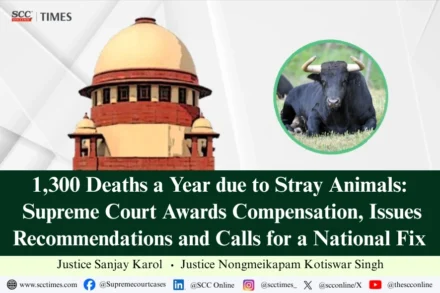
Supreme Court awarded ₹15 lakhs compensation to the widow of a man who died after a stray bull attack, holding that relegating the claimants to a civil suit after nearly 2 decades would leave them “remediless”.
The Supreme Court said that there cannot be a presumption in law that, after marriage, a daughter severs her ties with her parental family and resides with husband in her matrimonial home and that any classification differentiating a daughter from a son is, per se, unconstitutional
The July Criminal Law Roundup highlights important decisions of the Supreme Court and High Courts on prisoners’ rights, bail, juvenile justice, POCSO, custodial deaths, investigation, sentencing, quashment proceedings, and notable legislative developments in criminal law.