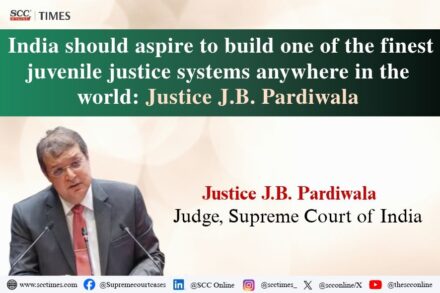
Justice Pardiwala: India Must Build One of the World’s Finest Juvenile Justice Systems | 10 Years of the JJ Act, 2015
India should aspire not only to build a better child protection system than the one it inherited, but to build one of

Bringing you the Best Analytical Legal News


India should aspire not only to build a better child protection system than the one it inherited, but to build one of
The two-day National Annual Stakeholders Consultation on Ten Years of the Juvenile Justice (Care and Protection of Children) Act, 2015, concluded at the Supreme Court of India, with calls for measurable accountability, prevention, de-institutionalisation, and stronger child protection systems.
The Supreme Court of India will host a two-day national consultation on ten years of the Juvenile Justice Act, 2015, on 10 – 11 October 2026 to review implementation challenges and identify priorities for strengthening child protection and juvenile justice.
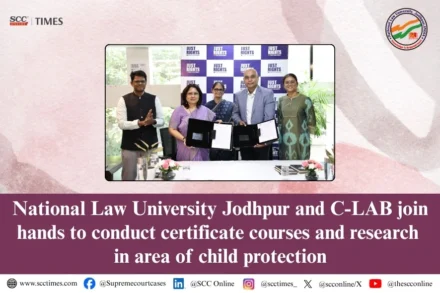
Recognising the increasing interdependence of law, technology, and society in the 21st century, and the need for a stronger knowledge base, robust interdisciplinary education and research, and enhanced capacity in the fields of child safety and human rights, NLUJ and C-LAB have agreed to establish a collaborative institutional framework to promote research, knowledge development, and capacity building in these areas.
The Rajasthan High Court expressed concern over the systemic deficiencies in the implementation of the Juvenile Justice Act, particularly in relation to preliminary assessments of children accused of heinous offences and the rehabilitation of Care Leavers, and issued wide-ranging directions to State authorities for institutional reforms.
The case depicts the tragic plight of a minor girl, aged 17 years, who was repeatedly subjected to sexual exploitation by her own father.

NHRC has taken suo motu cognizance of media reports alleging abuse of toddlers at a Bengaluru IT company creche and has sought a detailed report from the Karnataka Chief Secretary and DGP within two weeks
The Court directed the SDM to liaise with police authorities to trace the whereabouts of the employers and directed the Delhi police to “pro-actively investigate and take all necessary measures” for tracing them and facilitating recovery proceedings.

“Parental rights of a biological father cannot be undermined at the altar of dispute between the couple. A child should not suffer the dispute, either emotionally or educationally/ socially.”

“Ultimately, it is the individual choice and right to access such obnoxious material or to avoid it and as far as children are concerned, the vulnerability is high, so the parents’ responsibility is higher.”

Written by Tiya Sharma, Vaibhavi Ambasta & Hiya Saxena, students at NLIU Bhopal

Focused on the effective implementation of the Juvenile Justice Act, 2015 and the POCSO Act, 2012, the consultation brought together key stakeholders to advance the safety and rights of the girl child in Uttar Pradesh.

The NHRC addressing an intimation letter to the Chief Secretary, Government of Telangana, further sought an Action Taken Report in the matter.
“In tribal communities, practice of child marriages remains deeply ingrained, driven by tradition, poverty, and a lack of legal oversight. Ending child marriage requires legal and social intervention”

The summons was issued after taking note of non-receipt of requisite report despite sending reminders. NHRC however clarified that if the required documents are received on or before 14-01-2025, then the personal appearance shall stand dispensed with.
Kerala High Court instructed the Hospital to preserve all relevant blood samples and tissues to facilitate further medical tests, ensuring that the necessary forensic evidence is available for the ongoing legal proceedings.
“The next era of child rights must move forward with a better and more equipped and pragmatic approach where the children are better heard and treated with more respect. We need to be more receptive to the needs of the children. We have to start listening to them”
The Court held that Wrongful Death of a Minor Act provides a cause of action for the death of any “minor child,” without exception or limitation, which means it also includes frozen embryos.
The impugned order held that the fathers of the parties were real brothers and so, the marriage between the parties fell within the meaning of sub-clause (f) of Section 3 of Hindu Marriage Act, which defines the terms of degrees of prohibited relationships.
The Court strictly observed that in India, Gurus/teachers are considered akin to God and the Government Teacher’s perverse acts have created fear in the minds of the parents of minor girls students.