Mapping the Progression of LGBTQ+ Rights in India- Important Laws and Judicial Pronouncements
Tracing the development of LGBTQ+ rights in India with the help of statutory provisions and notable judgments by Supreme Court and High Courts.
“A heart transplant is a serious ailment, and its surgery is critically important, and cannot be postponed, thus, is a special circumstance. Such surgeries are expedited in the interest of human life without an embargo of an expenditure which is secondary to human life.”
“In a democracy, of the people, by the people, and for the people, peaceful protest is a constitutional right. Simply because an individual took to the streets to protest in order to safeguard their rights when their interests were affected does not imply that they have committed offences.”
“Such an undisciplined approach is symptomatic of the culture of apathy that has developed on the subject of the rights and well-being of convicts. In denying them their legal right to be considered under a policy duly devised by the State for a specific purpose, the authorities have essentially categorised them as second-class citizens.”
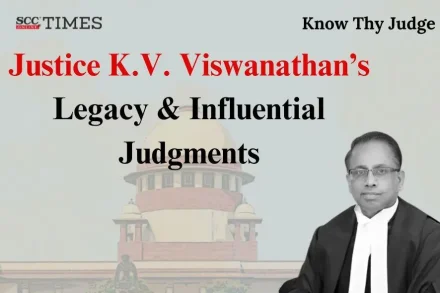
Discover the life, judgments, and contributions of Justice K.V. Viswanathan, who, on 19-05-2023, became one of the few lawyers, who were elevated directly from the Bar to the Judgeship of the Supreme Court of India, thereby enhancing the representation of the Bar in the Supreme Court.
by Vanita Bhargava* and Vishal Shrivastava**
“No child shall be liable to pay fees and charges that prevents him/her for pursuing elementary education. The Government and Local Authorities should ensure that every child completes his/her elementary education.”
The Court stated that it cannot be overlooked that he has been in jail for more than twenty years and may be for a crime that he has committed but that does not denude him of his basic right to life.
“The Judiciary must recognize its pivotal role in restoring confidence among minorities, acting as a guardian of the rights that were pledged to them, thus reinforcing the very essence of India’s democratic ethos and its dedication to unity in diversity.”
In the present case, the primary stakeholders are the husband and wife, along with their children or relatives. Given this, the principles established in the Paradip Port Trust case would be more appropriate, and there is no scope for adopting a different view.
“There is no fundamental right of a person to have a live-in relationship with a woman legally married to another man and, more particularly, when the woman appears to be his own sister.”
“Though, the power of judicial review keeps a check and balance on the functioning of the public authorities and is exercised for better and more efficient and informed exercise of their powers, such power has to be exercised very cautiously keeping in mind that such exercise of power of judicial review may not lead to judicial overreach, undermining the powers of the statutory authorities”
“The Constitution of India is blind to the differences between able-bodied and differently abled citizens in matters of providing equal opportunity to all citizens in all spheres of life, including employment, and envisages equality and non-discrimination.”
“The framework of the Customs Act clearly reflects the legislative intent to establish a distinct and unique procedure for the exercise of arrest powers by a customs officer”
“The possibility that some accused persons have not appeared due to their socio-economic vulnerabilities must be taken into account, and their absence should not be construed as a waiver of their right to seek justice.”
“The sweep of the right to life conferred by Article 21 of Constitution of India is wide and far reaching. An important facet of that right is right to livelihood, because no person can live without the means of living, i.e., the means of the livelihood.”
The petitioner’s right to organize and participate in a religious event is protected under Article 25 of the Constitution of India and merely based on certain objections raised by the member of one community, it cannot be denied.
“The display of photographs of defaulting borrowers violates their dignity, reputation, and fundamental right to life, as guaranteed under Article 21 of the Constitution of India”
“The right of the accused to defend himself in a criminal trial is guaranteed by Article 21 of the Constitution of India. He is entitled to a fair trial. But if effective legal aid is not made available to an accused who is unable to engage an advocate, it will amount to infringement of his fundamental rights guaranteed by Article 21”
Supreme Court emphasized that while peaceful protests are a fundamental right in a democracy, there must be a sense of responsibility when engaging in such protests.