

Dubai Arbitration Week 2026, held in Dubai from 9 to 13 November 2026, brought together members of the international arbitration community to discuss emerging developments in cross-border dispute resolution. Among the sessions held during the week was “Paid in What? Arbitrating the De-Dollarised Corridor Between Delhi, Dubai and Moscow”, organised by Balfaqeeh Advocates & Legal Consultants and co-organised by Lexster Law LLP on 12 November 2026.
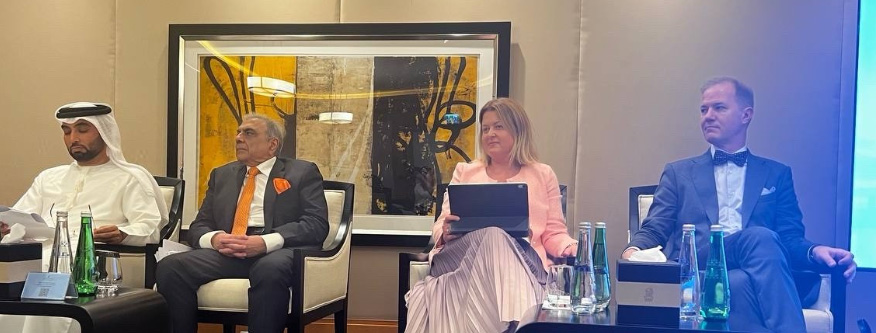
[In picture from left to right: Speakers Dr. Khaled Alhadhrami, Mr. Mahesh Jethmalani, Ms. Julia Zagonek and Mr. Ilia V. Rachkov]
The session explored the legal and commercial implications of the growing use of alternative currencies and payment mechanisms in cross-border trade involving India, the United Arab Emirates (UAE) and Russia. Against the backdrop of international sanctions, banking restrictions and increasing difficulties in accessing conventional dollar-based payment channels, the discussion centred on three key questions: who bears the risk when an agreed payment route becomes unavailable; whether a buyer is discharged from its payment obligation when the seller receives funds but cannot access or use them; and how arbitral awards can be enforced when a debtor’s assets are held in alternative forms or across multiple jurisdictions.
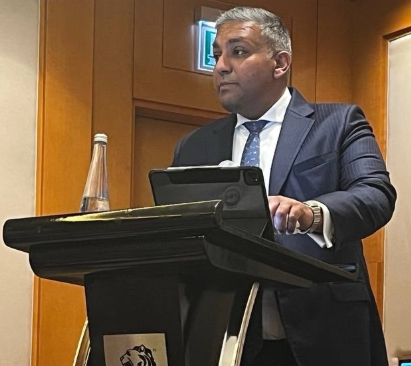
[In picture: Mr. Shantanu Agarwal]
The discussion was moderated by Mr. Shantanu Agarwal, Founding and Managing Partner, Lexster Law LLP. The panel comprised Dr. Khaled Alhadhrami, Professor of Law, University of Dubai and Co-founder, UCL; Mr. Ilia V. Rachkov, Partner and Head of International Arbitration, NSP Law Firm; Mr. Mahesh Jethmalani, Senior Advocate, Supreme Court of India; and Ms. Julia Zagonek, Co-founder, Alyff.
Drawing on their experience across different jurisdictions and through practical contractual hypotheticals, the panellists examined the evolving role of payment clauses in international trade, the allocation of currency and banking risks, the application of force majeure, the framing of arbitral relief to facilitate enforcement, and the challenges of recovering funds held in digital tokens and rupee-denominated accounts.
The changing payment landscape: beyond the US dollar
Opening the discussion, Mr. Shantanu Agarwal observed that payment provisions had traditionally received little attention during contract negotiations. As he remarked, “The payment clause was frankly the least interesting clause in the contract.” However, the disruption of conventional payment channels had changed that position, making currency and payment-route provisions central to cross-border commercial disputes. He explained that before 2022, a typical transaction between an Indian buyer and a Russian seller would be priced and paid in US dollars through a correspondent bank in New York. The parties rarely questioned the route through which the money travelled. That arrangement had since become considerably more difficult for certain transactions involving Russian counterparties.
Sanctions, the exclusion of several Russian banks from the SWIFT (Society for Worldwide Interbank Financial Telecommunication) network and the caution exercised by international banks had encouraged traders to explore alternative payment arrangements. Mr. Agarwal identified three routes emerging in the corridor: payments in Indian rupees through Special Rupee Vostro Accounts maintained by Russian banks with Indian banks; payments in UAE dirhams, often routed through traders and banks in Dubai; and, at a relatively nascent stage, digital tokens backed by fiat currency and held on licensed platforms. He described the practical problem arising from these arrangements: goods could be delivered and money transferred, yet the parties could still end up before an arbitral tribunal because the seller had received funds that it could not use or repatriate. He observed:
“Commerce is like water, you block one channel it finds another”,
while cautioning that every alternative payment channel could create a new set of legal and commercial difficulties.
The discussion began with the position of Russian sellers receiving payments from Indian buyers. Mr. Ilia V. Rachkov explained that, based on his experience, USDT (United States Dollar Tether) could be a viable payment mechanism in certain transactions. Russian sellers, however, remained reluctant to accept Indian rupees because the currency was not freely convertible and previous transactions had resulted in difficulties in using accumulated rupee balances. He added that dollar payments were not necessarily impossible, but parties needed to check with both the remitting and recipient banks whether the proposed route remained operational. A payment mechanism that appeared available under the contract might still encounter practical difficulties at the banking stage.
Mr. Mahesh Jethmalani then addressed India’s rupee settlement framework. He referred to the Reserve Bank of India’s circular dated 11 July 2022, which introduced an additional arrangement for invoicing, payment and settlement of international trade transactions in Indian rupees. Under the framework, authorised dealer banks may open Special Rupee Vostro Accounts of correspondent banks in partner countries, subject to the applicable regulatory requirements. Mr. Jethmalani distinguished between transactions settled through Special Rupee Vostro Accounts and arrangements involving payment in the national currencies of the contracting parties. He observed that the latter depended on the commercial agreement between the parties and referred to the growing use of local currencies in India–UAE trade. He also discussed the broader commercial relationship between India and the UAE, including the use of rupees for purchasing UAE goods and the investment of rupee surpluses in Indian sovereign debt, infrastructure and capital markets.
How currency and payment-route disputes reach arbitral tribunals
Ms. Julia Zagonek explained that payment and currency disputes were increasingly appearing in international arbitration, although there was no separate institutional database identifying all cases involving such disputes. She therefore relied on sanctions-related disputes as an indicator of the trend. She observed that sanctions could affect commercial contracts in different ways: a correspondent bank might close an account, a bank might refuse to process a transfer, or a payer might offer payment in a currency different from the one stipulated in the contract. She referred to an increase in sanctions-related disputes and discussed the movement of Russian parties towards arbitral institutions in Asia, including SIAC. She also referred to the participation of parties from the UAE, India and Russia in ICC proceedings, illustrating the changing geographical distribution of commercial disputes.
According to Ms. Julia, the disputes generally involved recurring questions. A party might challenge the payment route it had previously accepted, offer a different currency from the one specified in the contract, or encounter a bank that refused to process the transfer. The ultimate issue was whether payment through the alternative channel constituted valid contractual performance. She also referred to the difficulties created by Russian proceedings seeking to restrain arbitration elsewhere, including anti-suit measures. These developments illustrated how payment disputes could extend beyond the underlying commercial obligation and affect the choice of forum and the conduct of arbitral proceedings.
The discussion then turned to the role of the UAE, particularly Dubai, as a commercial and financial hub for transactions involving the three jurisdictions.
Dr. Khaled Alhadhrami attributed the UAE’s position to its business environment, commercial infrastructure and the ease with which traders could establish and conduct business. He observed that the transaction itself did not necessarily have to involve goods physically entering or leaving the UAE. Parties could purchase goods from Russia, transfer them to India and arrange the commercial and payment aspects of the transaction through Dubai. He also emphasised the importance of the UAE’s currency and its ability to provide a relatively neutral commercial environment for parties from different jurisdictions.
When the agreed payment route fails: who bears the risk?
The second part of the session examined a hypothetical involving an Indian buyer and a UAE seller. Under the contract, the buyer was required to pay in a specified currency into the seller’s account with a named bank in Dubai. The seller had assigned its rights to the payment to a Russian entity. Following a compliance review, the seller’s bank refused to accept the transfer. The buyer then offered to pay in US dollars instead, but the seller refused. The buyer had attempted to pay in the agreed currency through the agreed bank, yet the payment could not be completed. The question was whether the buyer remained in breach and which party should bear the resulting loss.
Dr. Alhadhrami emphasised that the parties’ agreement governed both the currency and the method of payment. If a bank refused a transfer because of compliance requirements, the buyer’s underlying obligation to pay did not automatically disappear. The parties should return to negotiations and agree on an alternative method of payment. He stressed that contracts should anticipate the possibility of banking restrictions and specify how the parties would respond if the agreed route became unavailable. The parties should address the alternative payment mechanism at the drafting stage rather than wait for a dispute to arise.
Mr. Jethmalani took the position that where the buyer had tendered payment in accordance with the contractual terms, it would not be in breach merely because the seller’s bank refused to process the payment. However, he acknowledged that the payment obligation could remain outstanding if the seller had not actually received the money. He observed that contractual relations were increasingly being disrupted by sanctions and that parties should consider providing for an alternative currency if the agreed currency became unavailable. A properly drafted clause could identify the circumstances in which an alternative currency would be accepted and the manner in which the conversion would be calculated.
Ms. Julia approached the hypothetical from the perspective of how an arbitral tribunal would assess the parties’ arguments. She identified the contract and the place where payment was required to be made as the starting point. If the contract required payment into the seller’s own bank account in Dubai and the buyer had tendered the correct amount in the agreed currency through that route, the tribunal would examine whether the bank’s refusal was a risk attributable to the seller. She referred to the principle that a party should not ordinarily rely on a failure caused by its own act or by a risk that it had assumed. She also referred to the UNIDROIT (the International Institute for the Unification of Private Law) Principles of International Commercial Contracts, particularly the obligations of cooperation and good faith. Parties should cooperate where reasonably possible to facilitate performance, but that obligation did not necessarily require one party to abandon the commercial terms to which it had agreed.
Ms. Julia cautioned that there was a distinction between facilitating contractual performance and changing the contract itself. A tribunal would examine whether the proposed alternative merely enabled the agreed obligation to be performed or whether it required the other party to accept something materially different. She referred to RTI Ltd. v. MUR Shipping BV1, in which the UK Supreme Court considered whether a party relying on a force majeure clause was required, as part of its reasonable endeavours, to accept payment in euros instead of the contractually agreed US dollars. The UK Supreme Court held that the reasonable endeavours proviso did not require the affected party to accept non-contractual performance in the absence of clear contractual wording.
The decision was relevant to the panel’s discussion because it highlighted the importance of the agreed currency and the limits of arguments that an alternative payment arrangement should be accepted simply because it would avoid practical difficulties. The speakers also considered the effect of an assignment of the seller’s payment rights to a Russian entity.
Ms. Julia observed that the assignment and the reasons for the bank’s refusal would be relevant to the tribunal’s assessment of which party bore the risk. If the bank had refused the transfer because of the seller’s own assignment, that circumstance could strengthen the argument that the risk lay with the seller.
The seller’s obligations under Russian law and the limits of force majeure
Mr. Rachkov explained that a Russian seller’s position had to be considered not only under private contractual law but also under Russian foreign-exchange regulations. He stated that Russian exporters were required to ensure that export proceeds were credited to their bank accounts within the applicable contractual period. Failure to comply could expose the seller to penalties imposed by Russian authorities. He referred to the significant penalties that could arise where export proceeds were not repatriated, explaining that the regulatory consequences could make it difficult for a Russian seller simply to accept an arrangement under which payment remained inaccessible. He further explained that, under Russian civil law, the buyer’s principal obligations were to accept the goods and pay for them. Payment required the money to reach the seller’s bank account. He added that Russian legal entities faced restrictions on maintaining bank accounts outside Russia and that opening such accounts could involve procedures with the relevant authorities. Mr. Rachkov also highlighted the role of good faith in Russian contract law. Unlike systems in which the obligation is primarily considered in the context of contractual performance, he explained that Russian law also recognised good faith obligations during negotiations.
The discussion then turned to whether sanctions-related banking restrictions could constitute force majeure.
Mr. Jethmalani suggested that parties could expressly identify the occurrence of sanctions or the unavailability of a payment channel as a deemed force majeure event in their contracts. If the parties had specifically agreed on the consequences of such an event, the tribunal would have to consider that contractual stipulation.
Ms. Julia cautioned that force majeure could be a weaker argument where the payment obstacle was not insurmountable. The existence of an alternative payment route or the possibility of negotiating a different arrangement could affect whether the relevant event genuinely prevented performance.
Mr. Rachkov added that Russian courts applied a strict standard when assessing force majeure in commercial contracts. He explained that the relevant circumstances had to be extraordinary and insurmountable under the conditions in question. Events such as the COVID-19 pandemic, financial crises or war would not automatically qualify merely because they made performance more difficult. He further clarified that force majeure did not necessarily extinguish the underlying contractual obligation. Depending on the circumstances, it could provide relief for the period during which the impediment persisted. He therefore emphasised the importance of carefully drafted force majeure clauses, while cautioning that even an expressly drafted clause would not guarantee that a court or tribunal would accept the defence.
The speakers agreed that parties entering into cross-border contracts involving jurisdictions where payment restrictions already existed should address these risks in advance. At the same time, Ms. Julia cautioned against drafting clauses so extensively that they created unnecessary complexity or opportunities for parties to exploit alternative payment mechanisms.
Can an arbitral award be framed to facilitate enforcement?
The third module addressed the recovery of money after an award had been issued. The hypothetical involved a Russian company obtaining a DIAC (Dubai International Arbitration Centre) award against a UAE company whose only identified assets were dirham-backed digital tokens held on a licensed platform in Dubai and a rupee balance maintained through a Vostro account with a bank in India. The question was whether the tribunal could frame its award in a manner that would make recovery easier, particularly where the debtor did not hold conventional bank balances or immovable property.
Ms. Julia explained that an arbitral tribunal could not independently devise an enforcement mechanism without the parties placing the relevant issues before it. The tribunal’s decision would be based on the claims, reliefs and arguments presented by the parties. She emphasised that a claimant seeking payment in a particular currency should expressly plead the relief it required. If the contractual currency was unavailable, the claimant could seek an alternative currency, specifying the applicable exchange rate and the relevant date for conversion. She observed:
“If nobody asks for that, the tribunal won’t invent it.”
She further explained that a tribunal could have powers to award relief in a currency different from the one initially claimed, depending on the applicable law and the circumstances. However, parties should not assume that the tribunal would formulate an alternative payment mechanism on its own. The relevant arguments should therefore be raised before the award was issued. Once the award had been made, the opportunity to alter its substantive relief would be limited. Ms. Julia noted that correction procedures were not intended to provide an opportunity to change the currency or the substance of the relief originally sought. She also referred to cases in which tribunals had considered awarding amounts in alternative currencies, while distinguishing between an error of law and an excess of jurisdiction. Her broader point was that the enforceability of an award depended substantially on the relief requested and the material placed before the tribunal.
Attachment of digital tokens and enforcement in the UAE
The panel next considered whether digital tokens held on a licensed platform in Dubai could be attached in execution of an arbitral award.
Dr. Alhadhrami explained that enforcement depended on whether the award was domestic or foreign. Where an award was issued in the UAE, the award holder would need to follow the applicable execution procedure before the competent court. Where the award was foreign, the award holder would first need to obtain recognition and enforcement before proceeding with execution. On the question of digital tokens, he explained that a court could consider measures directed at the platform holding the assets. However, the applicant would need to establish the relevant jurisdiction, identify the platform and provide evidence that the tokens belonged to the judgment debtor. The court would then consider the appropriate direction to the licensed platform. He cautioned that foreign award holders sometimes approached the execution stage without first completing the necessary recognition or procedural steps. An award holder could not simply approach the execution section and expect the court to take action without satisfying the applicable requirements.
The discussion then turned to the position in India and the difficulties of enforcing UAE-seated arbitral awards against assets located there.
Mr. Jethmalani raised the issue of reciprocity and the need for an effective mechanism for recognition and enforcement of awards between India and the UAE. He referred to discussions concerning bilateral arrangements2 and the steps required to facilitate enforcement in both jurisdictions. He also distinguished between the execution of foreign court judgments and arbitral awards, referring to the need for appropriate legal arrangements and implementation. The discussion highlighted the importance of identifying the correct legal route rather than assuming that a foreign arbitral award could be executed in the same manner as a domestic court decree.
Mr. Rachkov then addressed the hypothetical involving a rupee balance maintained in a Vostro account in India. He suggested that an award holder could seek recognition and enforcement of the arbitral award in India under the New York Convention, 1958, and seek execution against the funds by establishing, with supporting evidence, that they were beneficially owned by the debtor rather than constituting the bank’s own property. He acknowledged, however, that establishing such ownership could be challenging, particularly where the relevant information was protected by banking confidentiality obligations. The award holder might face difficulties obtaining sufficient evidence to demonstrate that the funds in the account were attributable to the judgment debtor. Mr. Rachkov further observed that banks faced competing risks when dealing with payments involving sanctioned entities. Processing a transfer could expose them to sanctions-related consequences, while refusing to comply with an enforcement order could expose them to other legal consequences. These difficulties could also be used by debtors as leverage during settlement negotiations.
The discussion reinforced that enforcement planning should begin before an award was issued. Parties needed to identify the debtor’s assets, determine where those assets were held and consider the legal route through which recovery could be pursued.
Payment in rupees: when does the buyer discharge its obligation?
In the final hypothetical, the panel considered an Indian refiner purchasing Russian crude through a Dubai trader. The price was fixed in US dollars, but the buyer paid the rupee equivalent into a Vostro account maintained by the seller’s bank in India. The bank accepted the payment. Several months later, the seller claimed that it had not been paid because it could neither use the rupees nor repatriate them. The seller sought the contractual price as well as compensation for the exchange loss. The panel was asked whether the payment had discharged the buyer’s obligation and whether the seller could claim the difference arising from the inability to use the funds.
Mr. Rachkov explained that the answer would depend substantially on the wording of the contract. A sophisticated seller might include provisions dealing with gross-up, price adjustment or other mechanisms to address currency-related losses. If negotiations failed, the seller could consider commencing further arbitration, although the commercial viability of separate proceedings would depend on the amount involved. He also suggested that, in certain circumstances, a seller might explore whether the conduct of the State had created a situation giving rise to an investment treaty claim. He described this as a possible strategy requiring careful consideration of the applicable treaty and the relevant circumstances. Addressing the ownership of money, Mr. Rachkov explained that Russian law recognised the elements of use, possession and disposal. A seller might have a credit recorded in its favour, but if it could not use or dispose of the money, the practical value of that balance could be significantly impaired.
Mr. Jethmalani considered the effect of the parties having expressly varied the original payment arrangement. If the parties had agreed that payment would be made through a rupee Vostro account and the buyer had made that payment, the variation would operate in the buyer’s favour.
Dr. Alhadhrami emphasised that neither the payment route nor the currency could ordinarily be changed unilaterally. A change from rupees to dirhams, or a decision to route the transaction through a Dubai trader, would require the agreement of the relevant parties. The contractual arrangement had to be examined to determine who was entitled to approve the change.
Ms. Julia then set out the approach she would adopt when deciding whether the buyer had discharged its payment obligation. She explained that payment is made once the creditor receives the money unconditionally when the contract says it should receive money. The seller’s subsequent use of the money would ordinarily be a separate matter. However, she drew an important distinction between a bank accepting rupees and the seller agreeing to accept rupees as contractual payment. The bank’s acceptance of funds did not, by itself, establish that the seller had agreed to a change in the currency of payment. The tribunal would therefore examine who had selected or nominated the payment route. If the seller had nominated the Vostro account and the rupee payment had been agreed or accepted under the contract, it would be difficult for the seller to argue subsequently that payment had not been made. In such circumstances, she considered that the payment obligation would have been discharged and no exchange loss would be payable. If, on the other hand, the seller had not agreed to accept rupees and the contract continued to require payment in dollars, the dollar debt could remain outstanding. The tribunal would then have to consider the appropriate credit for the rupee amount already transferred.
The discussion brought the panel back to the central question with which it had begun: whether payment had been made depended not merely on the movement of money between accounts, but on the contractual currency, the agreed payment mechanism and the party that had selected that route.
Conclusion
The session highlighted how the growing use of alternative currencies and payment mechanisms is reshaping cross-border commercial disputes involving India, the UAE and Russia. The speakers demonstrated that sanctions, banking restrictions and disruptions to conventional payment channels can create significant legal and commercial uncertainty, even where goods have been delivered and the buyer has attempted to fulfil its payment obligations. The discussion emphasised the need for carefully drafted contractual provisions addressing alternative currencies, payment routes, banking restrictions, assignments of payment rights, exchange-rate adjustments and the consequences of a payment mechanism becoming unavailable. The speakers also examined the limits of force majeure in circumstances where payment becomes difficult, emphasising that the existence of banking restrictions does not automatically excuse non-performance. The allocation of contractual risk, the availability of alternative payment arrangements and the applicable legal standards remain central to determining the parties’ obligations. On enforcement, the discussion underscored the importance of identifying the debtor’s assets and considering the appropriate recovery mechanisms before an arbitral award is issued. Whether assets are held in digital tokens, Vostro accounts or conventional bank accounts, successful recovery may depend on establishing ownership, satisfying the applicable recognition requirements and following the correct execution procedures.
The broader takeaway was that payment provisions can no longer be treated as routine clauses in cross-border commercial contracts. As international trade increasingly relies on alternative currencies and payment channels, the choice of currency, the agreed method of payment and the allocation of risk arising from inaccessible funds may ultimately determine whether a payment obligation has been discharged. For businesses and arbitration practitioners, anticipating these issues at the contractual stage and considering enforcement at the outset of a transaction are becoming increasingly important.
SCC Times is the Official Information & Documentation Partner for Dubai Arbitration Week 2026. Stay tuned for comprehensive coverage, key insights and highlights from the event!
1. [2024] UKSC 18
2. India–UAE Agreement on Juridical and Judicial Cooperation in Civil and Commercial Matters, 1999