Disclaimer: This has been reported after the availability of the order of the Court and not on media reports so as to give an accurate report to our readers.
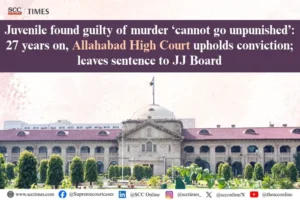
Allahabad High Court: In a criminal appeal against the judgment and order of the Additional Sessions Judge, convicting the appellant under Section 302, Penal Code, 1860 (IPC) and sentencing him to life imprisonment with a fine of ₹10,000, the Division Bench of Abdul Moin and Pramod Kumar Srivastava, JJ., upheld the conviction but set aside the sentence and remitted the matter to the jurisdictional Juvenile Justice Board (JJ Board) for passing appropriate orders in accordance with law, as the appellant was below 18 years of age on the date of the offence.
Background
The prosecution case was that on 2 February 1999, the deceased, a college student, left home to attend college but did not return. His mother subsequently informed his family that she had seen him going with the appellant and co-accused. On the following day, his dead body was found near a canal. The post-mortem examination revealed 44 ante-mortem cut wounds, and the cause of death was opined to be coma, shock and excessive haemorrhage resulting from the injuries.
During the investigation, a Gandasa and bloodstained clothes were recovered at the appellant’s pointing out. The forensic science laboratory report confirmed the presence of human blood on the recovered articles. The trial court convicted the appellant under Section 302 IPC and sentenced him to life imprisonment with a fine of ₹10,000, while acquitting the co-accused by extending the benefit of doubt.
During the pendency of the appeal, the appellant claimed juvenility, submitting that his date of birth was 15 November 1981 as per his High School certificate and the Class 8 school leaving/transfer certificate, and relying on Section 7A of the Juvenile Justice Act, 2000, under which a claim of juvenility can be raised before any court at any stage, even after final disposal of the case. The State verified the educational records and did not dispute his date of birth. The appellant did not challenge his conviction but sought setting aside of the sentence and remittal of the matter to the Juvenile Justice Board.
Analysis and decision
The Court examined Section 94, Juvenile Justice (Care and Protection of Children) Act, 2015 (JJ Act), which provides for presumption and determination of age, and observed that the provision gives primacy to the matriculation or equivalent certificate or the date-of-birth certificate from the school first attended. As the appellant’s educational records had been verified by the State authorities, the Court found that he was 17 years, 2 months and 17 days old on the date of the incident and was, therefore, a juvenile.
On the question of whether the appellant’s conviction was justified, the Court examined the circumstantial evidence, particularly the testimony of the mother of the deceased, who had seen her son leaving with the accused persons and stated that he did not return by 8.00 p.m., and PW 3, who had also seen the deceased in their company along the canal embankment. Finding their testimonies reliable and undisturbed, the Court noted that the recovery of the Gandasa at the appellant’s pointing out and his bloodstained clothes, corroborated by the independent recovery witness PW 4, further supported the prosecution case, as blood was detected on both articles during FSL examination. The Court also found no contradiction between the ocular and medical evidence and held that the evidence sufficiently established the appellant’s culpability. Finding no perversity or illegality in the trial court’s findings, the Court upheld the conviction.
On the question of the appropriate sentence, the Court relied upon Mumtaz v. State of U.P., (2016) 11 SCC 786, wherein the Supreme Court considered the interplay of the JJ Act, 1986 and the JJ Act, 2000 and the procedure to be adopted when a claim of juvenility is raised during pendency of a criminal appeal and thus the Court found that where a juvenile is found guilty of the offence alleged to have been committed, he simply cannot go unpunished, but what punishment should be awarded, must be left to the Juvenile Justice Board constituted under the Act. The Court noted that as the offence was committed on 2 February 1999, when the JJ Act, 1986 was in force, and by virtue of both the subsequent enactments and the law by the Supreme Court, only the punishments/orders permissible under the law governing juvenile ought to be awarded.
The Court upheld the appellant’s conviction but set aside the sentence and remitted the matter to the Juvenile Justice Board concerned for passing appropriate orders in accordance with law within 4 weeks of receiving the certified copy of the judgment. The appellant was directed to appear before the Board on 27 October 2026 with a certified copy of the judgment. Accordingly, the appeal was partly allowed to the extent of sentence, and the trial court record was directed to be returned for compliance.
[Karuna Shanker Singh v. State of U.P., CRLA No. – 253 of 2002, decided on 13-10-2026]
Advocates who appeared in this case:
For the appellant: S.C. Srivastava
For the respondent: A.G.A.